
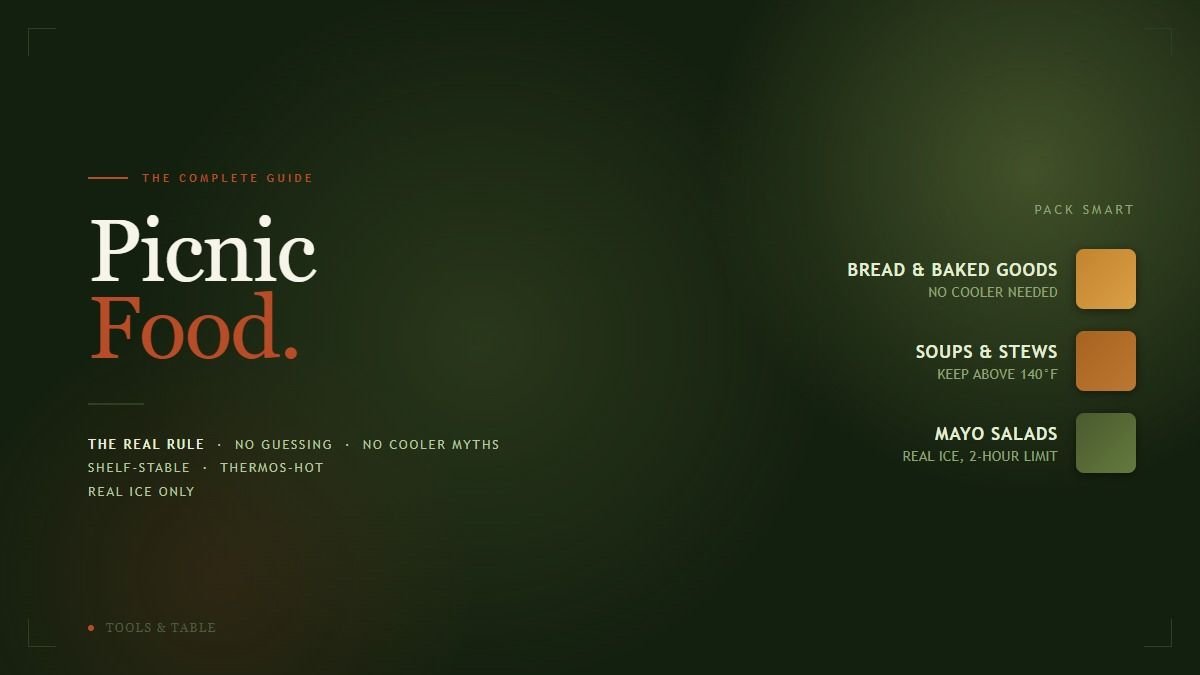
Most picnic advice worries about the wrong thing. It’s all “pack ice” and “don’t forget the cooler,” as if the cooler itself is the safety mechanism. It isn’t. The real rule is time and temperature, and once you actually know it, some of the food people bring out of pure habit, the mayo-based salads especially, turn out to be exactly the wrong choice for a warm afternoon in the sun.
This guide is built around three honest categories: food that’s genuinely fine at ambient temperature for hours, food that needs to stay actively hot, and food that needs real ice or should just stay home. No vague “use your judgment,” no smell tests, real time limits and the reasoning behind them.
The Real Rule: Time, Temperature, and the Danger Zone
Bacteria that cause food poisoning multiply fastest between 40°F and 140°F (4–60°C), what food safety guidelines call the danger zone. It’s not about any single food being inherently dangerous, it’s about how long a perishable food sits inside that range. This is the same logic behind why raw meat goes straight from the fridge to the pan on every other guide on this site, just applied to food that’s already cooked and now has to survive a few hours outdoors instead.
The actual numbers: two hours is the general limit for perishable food sitting in the danger zone. Drop that to one hour if the air temperature is above 90°F (32°C), which covers most mid-summer park afternoons and the inside of a car trunk in direct sun. Past that window, the honest move is to throw it out, not smell it and decide. Bacteria that cause real illness don’t reliably announce themselves with a bad smell or an off taste.
Shelf-Stable — No Cooler Required
These genuinely hold up for hours at whatever temperature the day throws at them. Low moisture, no dairy, no mayo, nothing that gives bacteria much to work with.
| Category | What to Bring | Why It Holds Up |
|---|---|---|
| Bread | Baguette, Pan de Barra, Pullman Loaf, Buttermilk Biscuits | Low moisture, no perishable filling. Fine all day. |
| Baked Goods | Banana Bread, Zucchini Bread, Chocolate Chip Cookies, Oatmeal Raisin Cookies, Bizcocho | Sealed crumb, no cream filling or glaze that needs refrigeration. |
| Fruit Desserts | Apple Crisp, Southern Peach Cobbler | Cooked fruit and a dry topping, no dairy component in the base. |
| Spanish Tapas | Pan con Tomate, anchovy-stuffed olives, Marcona almonds, aged Manchego, and cured meats like chorizo, jamón ibérico, and ibérico lomo | Cured meat and aged hard cheese were invented to survive without refrigeration. Olives are brined, and bread with tomato and olive oil was always a room-temperature food. |
| Trail Snacks | Nuts, dried fruit, jerky, trail mix, granola, granola bars | Low moisture is the whole point, there’s nothing here for bacteria to work with. |
A note on Tortilla Española. Across Spain, tortilla española is the picnic food, wrapped in foil and eaten unrefrigerated for hours, the same way a sandwich is treated here. It’s a fully-cooked egg-and-potato dish, not a raw one, but it is still an egg dish, and U.S. food safety guidance is more conservative about eggs sitting out than Spanish tradition is. Our honest read: for a cool morning or a couple of hours, it travels the way it always has. For a full day baking in direct summer sun, treat it like anything else on this page and keep it cold until serving.
Keep It Genuinely Hot — The Thermos Strategy
For an early fishing trip or a cold-weather outing, a good insulated thermos solves the danger zone from the other direction: instead of staying under 40°F, the food stays above 140°F the whole time, which is just as safe and a lot more appealing at 6 a.m. on a boat.
The step almost everyone skips: preheat the thermos first. Fill it with boiling water, let it sit capped for a few minutes, then dump it out right before adding the actual food, piping hot off the stove. Skip this and the thermos spends its first twenty minutes just warming up its own walls instead of holding your food’s temperature, and it’ll read noticeably cooler by lunchtime.
| Recipe | Why It Travels Well Hot |
|---|---|
| Classic Chili | Thick, dense, holds heat far longer than a thin broth. |
| Beef Stew | Same logic, and it’s genuinely better after a couple hours of carryover heat melding the flavors. |
| French Onion Soup | Skip the broiled cheese top until you’re ready to eat; bring the soup and bread separately. |
| Zuppa Toscana | A broth-based soup, so lean toward the shorter end of “keep it hot” if you’re out for many hours. |
Bring Something Frozen on Purpose
Frozen grapes are the single best trick on this list. Wash and dry a bag of grapes, freeze them overnight on a sheet pan so they don’t clump, then pack them still frozen. They thaw slowly over a few hours into a cold, slightly icy snack that tastes like a cross between a grape and sorbet, exactly what you want on a hot afternoon. Frozen berries work the same way, though they thaw a little softer.
It’s also doing double duty. A bag of frozen grapes sitting on top of everything else in the cooler acts as a free ice pack for the first hour or two, helping keep the real danger-zone items below it cold, and by the time it’s thawed enough to eat, the rest of the day’s food has already gotten the benefit.
Two more in the same category. Frozen juice boxes or pouches are the classic school-lunch trick for a reason, they’re a solid ice pack for the first stretch of the day and a slushy drink by the time anyone’s thirsty. Frozen citrus wedges (lemon or lime, sliced and frozen ahead) are the small clever one, drop a few into a water bottle or a thermos of iced tea and they cool the drink without watering it down the way regular ice cubes do as they melt. Frozen melon chunks work too, though they thaw softer and are better eaten within the first hour or two before they turn mushy.
What Not to Bring Without Real Ice
This is the section most picnic advice gets slightly wrong. Jarred mayonnaise itself is acidified and shelf-stable, it isn’t actually the danger. The real problem is what it’s mixed into: cooked chicken, egg, or potato, sitting in the exact temperature range bacteria like best, for exactly as long as a park afternoon lasts.
| Recipe | The Real Risk | If You Bring It |
|---|---|---|
| Egg Salad | Cooked egg + mayo, prime danger-zone territory | Pack directly on ice, serve within the 2-hour window |
| Tuna Salad | Same mechanism, cooked protein + mayo | Same as above |
| Macaroni Salad | Starch + mayo holds moisture bacteria can use | Same as above |
| Ensalada Rusa | Potato, egg, and mayo together, the same combination three times over | Same as above |
| Gazpacho | Different problem: it’s meant to be served cold, and it just tastes wrong warm | Thermos or cooler, the opposite strategy from the chili above |
| Flan | Dairy-based custard, a real refrigeration requirement, not a texture preference | Keep it in the cooler until the moment you serve it |
None of these are off-limits, they just need the ice to be real, not decorative. A cooler that’s mostly holding drinks with a bag of salad balanced on top isn’t doing the job.
Packing It Right
- Freeze what you can ahead of time. A frozen water bottle, ice pack, or bag of frozen grapes at the bottom of the cooler does double duty, keeping food cold now and giving you cold water or a snack later as it thaws.
- Pack cold food cold, not room temperature. A cooler keeps food at whatever temperature it starts at, it doesn’t actively chill anything down. Egg salad that goes in already cool stays safe far longer than one that goes in lukewarm.
- Keep the cooler shut and shaded. Every open-and-close lets warm air in and cold air out. Pack drinks in a second cooler if people are grabbing them constantly, so the food cooler stays closed.
- Eat in order of risk. Serve anything from the “real ice” list first, while it’s still coldest and closest to when it left the cooler. Save the shelf-stable bread and cookies for whenever, they don’t care.
- When in doubt about timing, don’t bring it. An all-day fishing trip and a quick two-hour park visit call for different food entirely, not the same list with more ice packs.