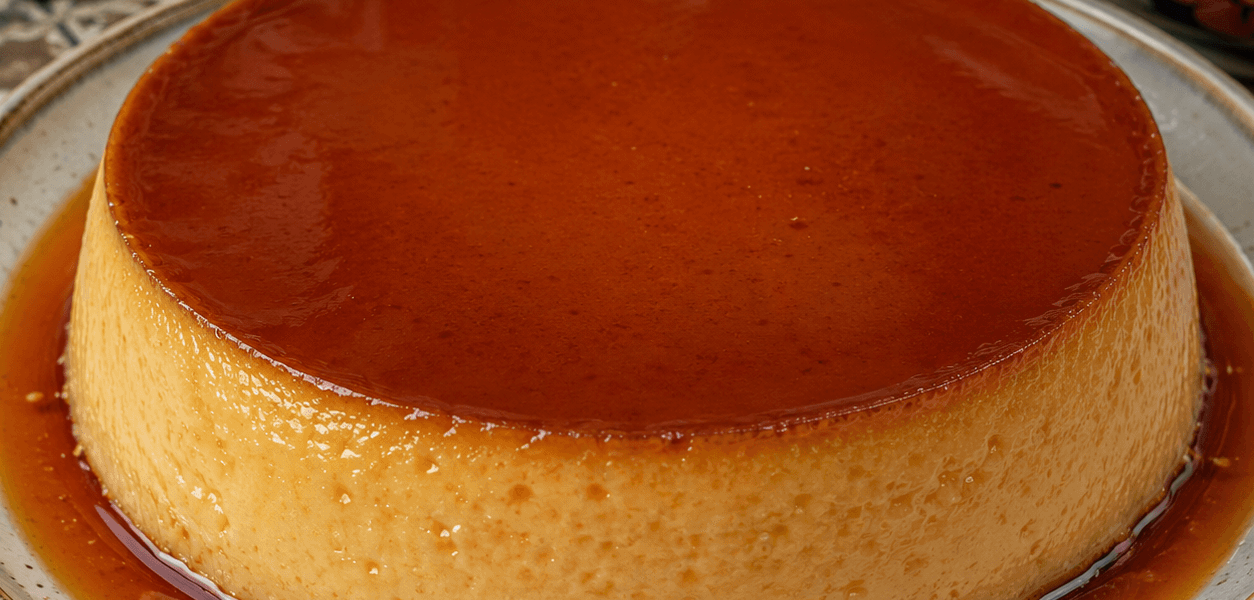
Caramel on the bottom, silky custard on top — then you flip it. One of the oldest tricks in the Old World kitchen, and one of the most rewarding things a beginner can pull off.
Flan is Spain’s most beloved dessert, carried across the Atlantic and adopted everywhere from Mexico to the Philippines. Its roots go back further still — Roman custards, Arab sugar work, medieval European confections. What survived across all those centuries and geographies is the same essential thing: eggs, milk, sugar, and heat. Nothing hidden, nothing clever. Just technique.
What makes flan seem difficult is actually what makes it forgiving: the water bath. Baking in a bain-marie — a pan of hot water — means the custard never gets hotter than 212°F regardless of the oven temperature. This is why flan sets evenly, why it doesn’t scramble, and why it has that glass-smooth texture. Understand the water bath and you’ve unlocked a whole family of Old World recipes: crème caramel, crème brûlée, bread pudding, savory terrines.
Ingredients
Serves 8–10. Made in a 2.5Qt (2.4L) Pyrex baking dish.
For the caramel
- ¼ cup (50g) granulated sugar
For the custard
- 4 cups (950ml) whole milk
- 5 whole eggs
- 2 egg yolks
- 1 cup (200g) granulated sugar
Method
- Make the caramel. Put ¼ cup of sugar into a small, heavy saucepan. Set it over medium heat and don’t touch it until the edges start to melt — then swirl the pan gently (don’t stir). Watch the color: pale gold is fine, deep amber is what you want, dark brown is the edge of burned. The moment it hits deep amber, pull it off the heat immediately and pour it straight into your 2.5Qt Pyrex dish. Tilt the dish to coat the bottom as evenly as you can. Move fast — caramel sets quickly. Then put the dish somewhere cold (fridge or freezer) and leave it until the caramel is completely hard. This matters: if the caramel is still warm when you pour the custard in, it will crack. Don’t rush it.
- Make the custard. In a large bowl, whisk together the 5 whole eggs, 2 yolks, and ¾ cup of sugar until thoroughly combined — the mixture should be pale and the sugar mostly dissolved, about 2 minutes of good whisking. Pour in the 4 cups of milk and whisk again until smooth. Don’t add the milk first. Getting the eggs and sugar fully combined before the liquid goes in gives you a smoother, more homogenous custard.
- Strain into the dish. Once the caramel has fully cooled and hardened, set a fine mesh strainer over the Pyrex dish and pour the custard mixture through it. The strainer catches any bits of chalazae (the stringy white cords attached to egg yolks) and any clumped sugar, giving you a cleaner, silkier final texture. Don’t skip this step — it’s ten seconds of work and makes a real difference.
- Bake in a water bath. Preheat your oven to 375°F (190°C). Place the Pyrex dish into a larger roasting pan. Pour hot tap water into the roasting pan until it comes about halfway up the sides of the Pyrex. Carefully slide the whole setup into the oven — this is the only tricky moment. Bake for 1 hour and 10 minutes. The flan is done when the edges are fully set and the center has a slow, uniform wobble — not a liquid slosh, but a gentle jiggle, like set gelatin. If you’re unsure, give it another 10 minutes.
- Cool, then serve. Remove the Pyrex from the water bath and let it cool to room temperature. Then cover and refrigerate for at least 4 hours — overnight is better. The cold is what firms the custard and makes it easy to unmold. To serve: run a thin knife around the edge of the dish. Place a large plate or platter face-down over the top, hold firmly, and invert in one confident motion. The liquid caramel will pour over the top and pool around the sides. Serve cold, in slices.
What You’re Learning
This recipe teaches three techniques that recur throughout Old World cooking. The first is caramelization — the transformation of sugar under dry heat, read by color and smell rather than temperature. The second is the bain-marie (water bath): using water as a heat buffer to cook delicate proteins gently and evenly without scrambling them. You’ll use this in crème brûlée, bread pudding, terrines, and cheesecakes. The third is custard set — learning to judge doneness by the wobble test rather than cutting into the food.
Flan is one of the oldest surviving desserts in Western cooking. The technique of baking a sweetened egg custard over a caramel base appears in medieval Spanish and French cookbooks virtually unchanged from what you’re making here. Some recipes are old because they work perfectly.
Notes
- Cool the caramel completely. Warm caramel plus custard means cracking. Give it at least 15 minutes in the freezer or 30 in the fridge. Touch it — it should be rock solid.
- Watch the caramel, not the clock. Every stovetop is different. Color is your guide: pale gold → deep amber → disaster. The window between perfect and burned is about 30 seconds. Don’t walk away.
- Use whole milk. Lower-fat milk produces a looser, less rich custard. Whole milk is standard for traditional flan.
- The wobble test. Shake the dish gently at 1 hour. The edges should be set and the center should wobble slowly and uniformly — not slosh. If it sloshes, give it another 10 minutes.
- Overnight is better than 4 hours. The flan sets firmer and the caramel loosens into a proper sauce. If you can make it the day before, do.
- Unmold confidently. A hesitant inversion results in a half-detached flan. Commit to the flip — run the knife all the way around the edge first.