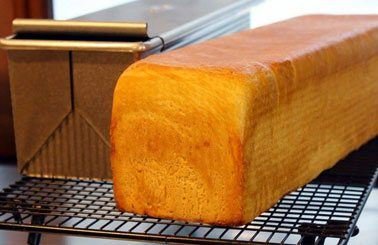
A Pullman loaf is the bread that rewards patience. Enclosed in its lidded pan, it bakes into a perfectly square, tight-crumbed sandwich loaf with a paper-thin crust and a soft, even interior. This is the recipe from The Bouchon Bakery cookbook by Thomas Keller and Sebastien Rouxel.
The technique here is straightforward but not quick. The dough needs a full triple-rise before shaping, then a long proof in the pan before going into the oven with the lid on. What you get at the end is a loaf that slices clean, holds its shape, and makes a sandwich that tastes noticeably different from anything you can buy. The cream cheese and butter in the dough give it a richness you won’t find in most white breads.
Featured Bakeware
USA Pan Large Pullman Loaf Pan — the lidded design is what makes this recipe work. It forces the dough to fill the pan completely and creates that distinctive square cross-section. You can split the dough between two small Pullman pans if that’s what you have.
Ingredients
Makes 1 large Pullman loaf.
- 547 g all-purpose flour
- 6 g instant yeast
- 32 g sugar
- 11 g fine sea salt (scant 1 tsp table salt)
- 285 g warm water
- 35 g beaten egg
- 25 g unsalted butter
- 79 g cream cheese
- Egg wash (1 egg beaten with 1 tbsp water)
Method
- Mix the dry ingredients. In a large mixing bowl, whisk together the flour and yeast until combined. Add the sugar and salt and stir until evenly distributed. Make sure the salt and yeast aren’t sitting directly on top of each other — salt can slow yeast activity if they’re in contact for too long before mixing.
- Rub in the fats. Add the butter and cream cheese directly to the flour mixture. Use your fingertips to work them in, rubbing and pressing until the mixture looks like coarse, slightly damp sand with no visible chunks of fat remaining. This step distributes the fat evenly before any liquid goes in, which keeps the crumb tender and tight.
- Add the liquid and rest. Make a well in the center of the flour mixture. Pour in the warm water and beaten egg. Use a sturdy wooden spoon to stir until the dough comes together into a rough, shaggy mass. It won’t look smooth yet — that’s fine. Cover the bowl and let it rest for 10 minutes. This resting period allows the flour to hydrate fully, which makes kneading significantly easier.
- Knead. Turn the dough out onto a clean work surface — no flour. Knead for at least 15 minutes. The technique that works best here: knead for a stretch, then pick the dough up and slap it firmly against the work surface, folding it back on itself as you go. Alternate between standard kneading and this slap-and-fold method. After 15 minutes the dough should be elastic, smooth, and slightly tacky — it should pull away cleanly from your hands but still feel soft. If it tears instead of stretching, keep going.
- First rise. Shape the dough into a ball and transfer it to a lightly greased large bowl. Cover with plastic wrap pressed gently against the surface. Let it rise at room temperature until it has tripled in size — about 1 hour, depending on how warm your kitchen is. Don’t rush this. A slow, full rise builds the flavor and the structure you want in the finished loaf.
- Deflate, rest, and shape. Turn the risen dough out onto the work surface. Knead briefly — just a few seconds — to expel the large air bubbles. Cover loosely and let it rest for another 5 minutes. This bench rest relaxes the gluten slightly, making the dough easier to shape without it springing back. Shape the dough into a log approximately 13 inches long. Place it seam-side down into your USA Pan Large Pullman Loaf Pan. Brush the top evenly with egg wash.
- Second rise (proof in pan). Slide the lid onto the pan, but leave it slightly open so you can monitor the dough’s progress. Let the dough proof for about 45 minutes, or until it has nearly reached the top of the pan. The timing will vary with kitchen temperature — in a warm kitchen it can happen faster; in a cool one it may take longer. Don’t bake it too early. An under-proofed Pullman loaf won’t fill the corners. While the dough proofs, preheat your oven to 390 degrees F (200 degrees C).
- Bake. Close the lid completely. Bake for 28 minutes with the lid on. Carefully remove the lid — the loaf will have filled the pan and the top will be pale and set. Return to the oven for another 10 minutes, or until the top is a rich golden brown. If the color isn’t quite there after 10 minutes, slide the loaf out of the pan onto a baking sheet and give it another few minutes uncovered until it reaches the color you want. Transfer to a wire rack and let it cool completely before slicing. Cutting into a hot loaf releases steam and makes the crumb gummy. Wait. It’s worth it.
What You’re Learning
This recipe introduces enriched dough — bread dough with added fat. Butter and cream cheese shorten the gluten strands, which gives this loaf its tender, tight crumb rather than the open, chewy texture of a lean dough like baguette. More fat means more tenderness. It also means a slower rise and a need for more thorough kneading to build enough structure to support the extra weight.
You are also learning what fully developed gluten actually feels like. After 15 minutes of kneading, dough that was rough and shaggy becomes elastic, smooth, and stretchy. Pull a small piece and stretch it gently toward a light source — well-kneaded dough stretches thin without tearing (this is called the windowpane test). That elasticity is what traps the CO2 from the yeast and allows the loaf to rise and hold its shape. Under-kneaded dough collapses; over-kneaded dough stiffens. Learn to feel the difference here and you will carry it into every bread recipe that follows.
Notes
- Why cream cheese? It adds fat and a subtle tang without making the dough noticeably dairy-forward. It’s part of what makes this loaf taste different from a standard white sandwich bread.
- No Pullman pan? You can bake this in a standard 9×5 loaf pan — skip the lid, let it rise until domed, and bake at the same temperature. You won’t get the square shape, but the flavor will be the same.
- Two small pans. This recipe fits two USA Pan Small Pullman pans if you prefer smaller loaves or want to give one away. Divide the dough evenly by weight before shaping.
- Cool completely. This cannot be overstated. The crumb is still setting as the loaf cools. Slice it too early and it compresses under the knife and never recovers. 1 hour minimum on the rack, 2 hours is better.
- Storage. Wrap tightly in plastic or store in a bread bag. It keeps well at room temperature for 2-3 days, or freeze sliced for up to a month.
Frequently Asked Questions
Can I make this without a Pullman loaf pan?
Yes. Bake it in a standard 9x5 loaf pan without a lid, let it rise until domed instead of proofing to the top of a closed pan, and bake at the same temperature. You lose the signature square shape, but the flavor and crumb are the same.
Why is my dough still sticky after 15 minutes of kneading?
Enriched doughs like this one, with butter and cream cheese worked in, take longer to develop than a lean dough and can feel tacky even when properly kneaded. Judge it by elasticity, not stickiness: pull off a small piece and stretch it toward a light source. If it stretches thin into a windowpane without tearing, it’s ready, even if it still feels a little tacky.
Can I skip the second rise in the pan and bake it right after shaping?
No, this recipe needs it. The dough has to proof until it nearly reaches the top of the pan before the lid goes on, or the loaf won’t fill the pan corners and you’ll lose the square cross-section. Under-proofing is the most common reason a Pullman loaf comes out misshapen.