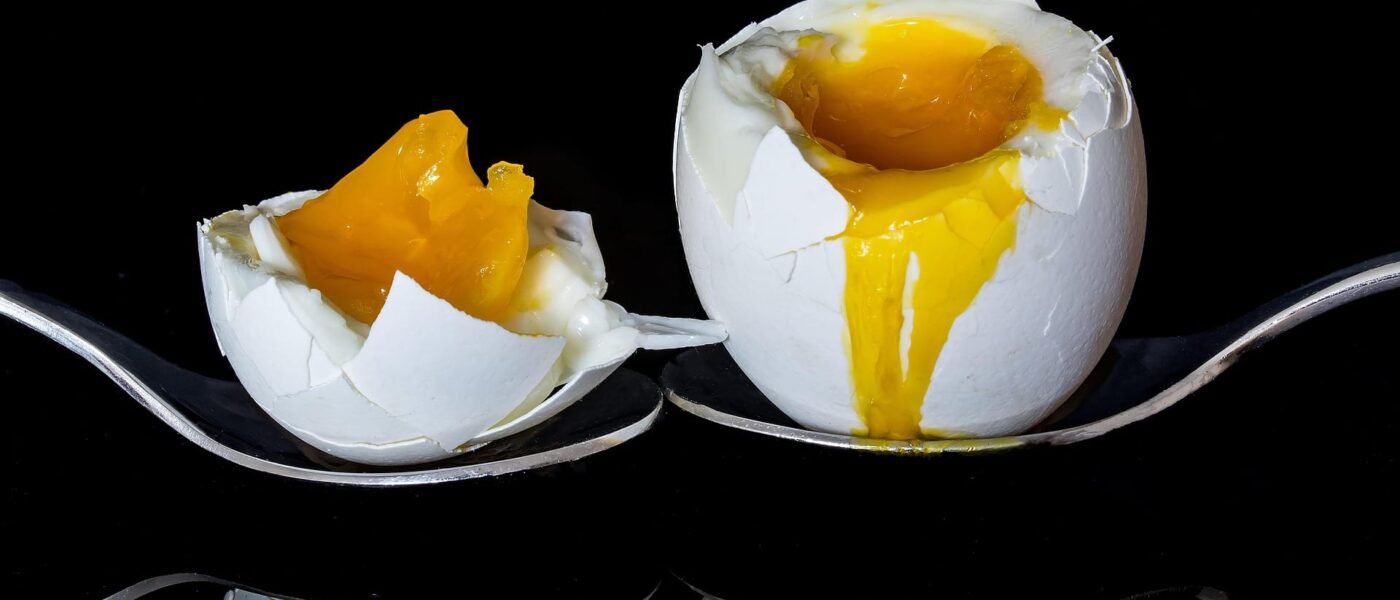
The first recipe everyone should know. Six minutes gives you a dippy egg. Eight gives you ramen. Twelve gives you hard. Once you know the timing, you’re in control.
The boiled egg requires no skill — only timing. Humans have been cooking eggs in hot water for thousands of years, and the fundamentals haven’t changed: get the water boiling, lower the eggs in, start the clock, and stop the heat with ice. What changes is the minute mark. A four-minute egg is barely set and trembling; a twelve-minute egg is firm through the yolk. Every minute between is a different egg, each with its own character and best use. This is not a recipe you learn once and forget — it’s one you return to constantly, for breakfast, salads, ramen, sandwiches, and everything in between.
What You’re Learning
Temperature is fixed — time is your variable. The water boils at a constant temperature (around 100°C / 212°F at sea level), so the only thing you control is how long the egg sits in it. Unlike roasting or braising, where heat level matters enormously, here your job is simply: count the minutes. This makes boiled eggs one of the most repeatable, predictable things you can cook once you find your preferred timing.
The ice bath stops the clock. Eggs continue cooking after they leave the hot water — the residual heat inside the shell keeps driving the process. An ice bath drops the internal temperature fast enough to arrest that carryover cooking at exactly the stage you want. Skip it and a 7-minute jammy egg becomes an 8-minute egg by the time it cools on the counter. The ice bath is not optional. It’s the off switch.
Ingredients
- 4 large eggs
- Water, enough to fully submerge the eggs by at least 2 cm / 1 inch
- Ice and cold water for the ice bath
Instructions
- Bring water to a full boil. Fill a medium saucepan with enough water to cover the eggs by at least 2 cm. Bring to a rolling boil over high heat.
- Prepare the ice bath. Fill a bowl with cold water and plenty of ice. Set it next to the stove so you’re ready the moment the timer goes off.
- Lower the eggs in gently. Use a spoon to lower eggs from the fridge directly into the boiling water. Start your timer immediately.
- Cook to your target time. 6 min = dippy/runny yolk · 7 min = jammy, soft center · 8 min = ramen-style fudgy yolk · 10–11 min = almost hard · 12–13 min = fully hard.
- Ice bath immediately. Transfer eggs straight from the boiling water to the ice bath the moment the timer sounds. Leave for at least 2 minutes.
- Peel. Tap gently on a hard surface to crack the shell, then peel under cold running water. Start at the wide end — there’s an air pocket there that makes the shell release more easily.
Notes
- Eggs straight from the fridge work best. Room-temperature eggs cook slightly faster — add or subtract 30 seconds if yours have been sitting out. Fridge eggs give you more consistent timing.
- Always boiling water, not simmering. Lowering eggs into already-boiling water gives you a precise start point. Starting in cold water and bringing to a boil makes timing unpredictable.
- Size matters. These times are for large eggs. Medium: subtract 1 minute. Extra-large or jumbo: add 1–2 minutes.
- Altitude adjustment. Above 1,500m / 5,000ft, water boils at a lower temperature. Add 1–2 minutes to each stage.
- Storage. Hard-boiled eggs keep unpeeled in the fridge for up to 1 week. Soft or jammy: store peeled in cold water and use within 2 days.