Five ingredients, twenty minutes, and something you’ll find uses for all week.
Rhubarb sauce is not a complicated thing, but it requires attention to one variable: sugar. Rhubarb is intensely tart — more so than most people expect the first time they cook with it — and the amount of sugar you add determines whether you end up with a sauce that tastes bright and vibrant or one that’s cloying and flat. This recipe uses ¾ cup of sugar for 1½ pounds of rhubarb, which produces a sauce that leans tart: noticeable sweetness, but with the rhubarb’s characteristic bite still intact. If you prefer something closer to jam, add another 2 to 3 tablespoons. If you’re serving it alongside something already sweet — ice cream, a rich cake — keep it as written. Taste before it finishes cooking, and adjust.
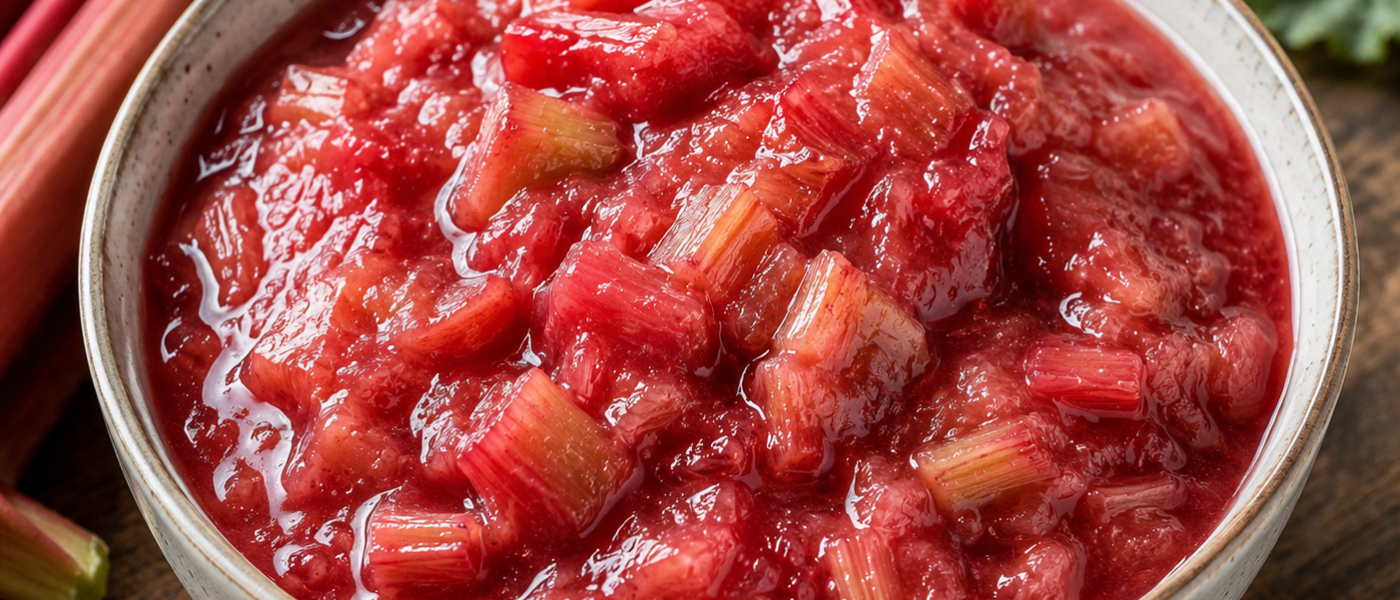
The other variable is texture. Rhubarb breaks down very quickly over heat. At 8 minutes it will have softened but still hold distinct pieces; at 12 minutes it will be mostly broken down with some visible chunks; by 15 minutes it’s essentially smooth. The photo shows a sauce with good texture — individual pieces of rhubarb still visible, the whole thing glossy and cohesive. Pull it off the heat at 10 minutes and check: if you want more texture, it’s ready. If you want it smoother, continue for 2 to 3 more minutes. Either way, it will continue to thicken noticeably as it cools.
What You’re Learning
How to taste and calibrate sugar for tart fruit. With sweetened fruit sauces, the mistake is either adding all the sugar upfront without tasting, or adding it at the end when it’s too late to cook it in properly. The right approach: add most of the sugar at the start so it dissolves into the fruit as it cooks, then taste at the halfway point and adjust before it finishes. Rhubarb’s tartness mellows slightly as it cooks and the natural sugars in the fruit develop, so a sauce that tastes aggressively tart at 5 minutes will often taste appropriately bright at 10. Wait before reaching for more sugar.
How to control texture in a stovetop fruit sauce. Rhubarb contains a lot of water and breaks down rapidly — which means texture is almost entirely a function of time on heat. The technique here is to cook over medium-low heat rather than high, which gives you more control and a narrower window between “still has structure” and “completely dissolved.” Watch the sauce rather than the clock: when most pieces have softened and the liquid around them has turned glossy and slightly thick, you’re at peak texture. Remove from heat immediately and let carryover cooking do the rest. If you want to stop it precisely — for a very chunky result — set the pan in a shallow bowl of cold water for 30 seconds before transferring to a jar.
Ingredients
Makes about 2 cups (8 small servings).
- 1½ lbs (680g) fresh rhubarb stalks, trimmed and cut into ½-inch pieces (about 5 cups chopped)
- ¾ cup (150g) granulated sugar, plus more to taste
- 3 tbsp water
- 1 tsp vanilla extract
- Pinch of fine salt
Method
- Combine. Add the rhubarb pieces, sugar, water, and salt to a medium saucepan. Stir once to coat the rhubarb.
- Start cooking. Set the pan over medium heat. Cook, stirring occasionally, until the sugar has fully dissolved and the rhubarb begins to release its liquid — about 3 to 4 minutes. The mixture will look dry at first, then suddenly quite wet as the rhubarb breaks down.
- Reduce and watch the texture. Reduce the heat to medium-low. Cook, stirring every couple of minutes, for 8 to 12 minutes depending on how much texture you want. At 8 minutes the rhubarb will still have distinct pieces; at 10 to 11 minutes it will be mostly broken down with some chunks; at 12 to 13 minutes it will be almost completely smooth. Check at the 8-minute mark and decide. The sauce is ready when the liquid around the rhubarb has turned glossy and slightly thick.
- Finish and taste. Remove from the heat and stir in the vanilla extract. Taste the sauce — it should be bright and tart with clear sweetness behind it. If it tastes aggressively sour, add sugar one tablespoon at a time, stirring to dissolve completely, and taste again after each addition. Remember that the sauce will taste less sharp once it’s cool.
- Cool before serving. Transfer to a jar or bowl and let cool for at least 15 minutes before serving. The sauce thickens considerably as it cools — it will look quite loose in the pan but will set to a proper spoonable consistency at room temperature, and thicker again straight from the fridge.
Notes
- Rhubarb is much more tart than you expect. First-timers almost always underestimate it. Don’t taste a raw stalk and extrapolate — raw rhubarb is intensely sharp in a way the cooked sauce isn’t. Trust the recipe ratio for your first batch, then adjust from there.
- Red versus green stalks. Deep red rhubarb produces a vivid pink-red sauce. Green-stalked varieties (just as common, just as flavourful) produce a more muted pink-green colour. The flavour is essentially identical — colour is purely cosmetic.
- Ways to use it. Spooned over Greek yogurt or oatmeal in the morning. On vanilla ice cream. Alongside pork chops or duck breast (the tartness cuts through fat beautifully). On buttered toast or scones. Stirred into whipped cream for a quick rhubarb fool. As a filling for crêpes.
- Storage. Keeps refrigerated in a sealed jar for up to 2 weeks. Freezes well for up to 3 months — freeze in small portions (an ice cube tray works well) so you can thaw exactly what you need.
- Add strawberries if you like. Rhubarb and strawberry is a classic combination. Add ½ cup of hulled, halved strawberries in the last 3 minutes of cooking. They soften quickly and add sweetness, which means you may want to reduce the sugar slightly upfront.