
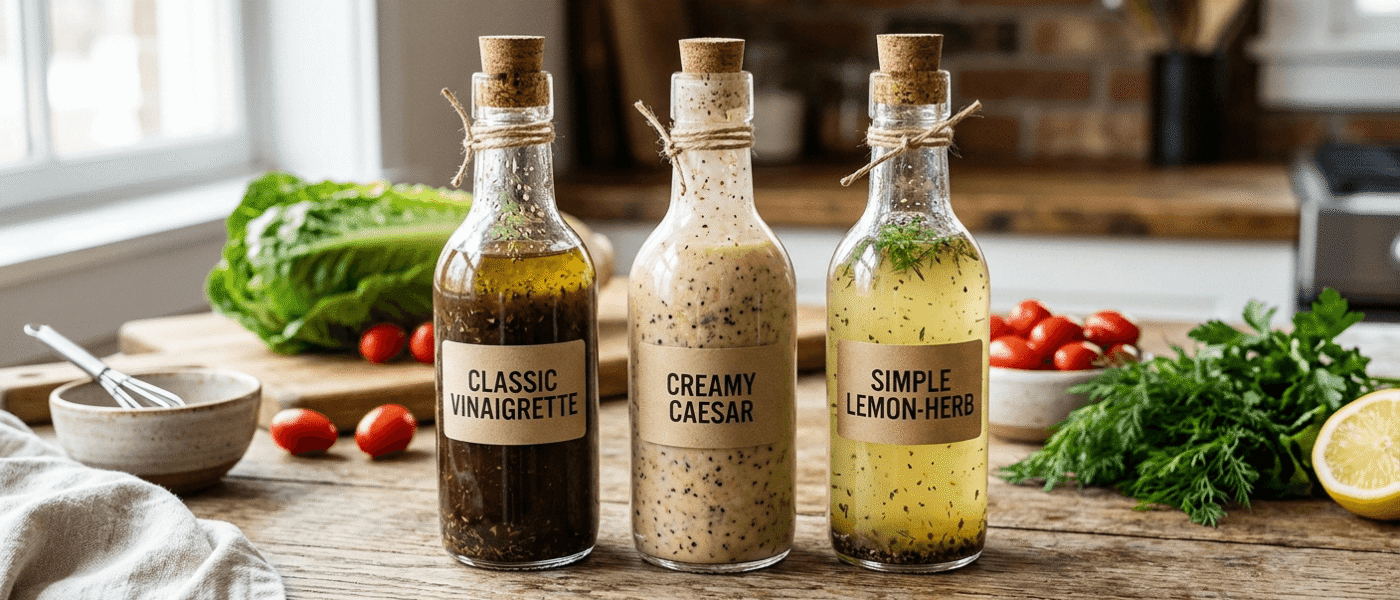
Three dressings to know: the classic vinaigrette, a creamy Caesar, and a simple lemon-herb. All take under five minutes and make salad worth eating.
The French vinaigrette — oil and vinegar with mustard as an emulsifier — is the fundamental dressing template that everything else builds on. The word comes from the French vinaigre (vinegar) and has been a staple of European cooking since at least the medieval period. What changed over time was the ratio: early vinaigrettes were often sharp and acidic, while the modern French standard settled on three parts oil to one part acid — enough acidity to cut through fat without overpowering. From this foundation, dozens of variations developed: creamy, herb-based, citrus, nut oil, and dairy-enriched.
What You’re Learning
Emulsification. Oil and water (or vinegar) don’t mix on their own — they separate into layers. An emulsifier is a molecule with one end that binds to fat and one that binds to water, holding both in suspension. In a vinaigrette, Dijon mustard is the emulsifier: it contains compounds that bridge the oil and vinegar molecules. Whisking vigorously while slowly adding oil creates a temporary emulsion — the dressing thickens slightly and stays blended long enough to dress the salad. Without an emulsifier, you need to re-whisk before every use.
The acid-to-fat ratio. The standard vinaigrette ratio is 3 parts oil to 1 part acid (3:1). This is a starting point, not a law — a bitter green like radicchio or endive can handle more acid, while a delicate butter lettuce wants less. A creamy Caesar shifts the fat source from oil to mayonnaise and adds umami from anchovy and Parmesan. Adjusting the ratio is how you tune a dressing to the salad it’s going with.
Three Dressings
Classic Vinaigrette
- 3 tbsp extra virgin olive oil
- 1 tbsp red wine vinegar or white wine vinegar
- ½ tsp Dijon mustard
- 1 small garlic clove, very finely minced or grated
- Salt and black pepper, to taste
- Optional: 1 tsp honey (to balance acidity)
Simple Lemon-Herb Dressing
- 3 tbsp extra virgin olive oil
- Juice of ½ lemon (about 1 tbsp)
- 1 tsp Dijon mustard
- 1 tbsp fresh herbs, finely chopped (parsley, chives, basil, or tarragon)
- Salt and pepper, to taste
Creamy Caesar
- 2 tbsp mayonnaise
- 1 tbsp lemon juice
- 1 tsp Worcestershire sauce
- 1 small garlic clove, grated
- 2 tbsp finely grated Parmesan
- Salt and black pepper, to taste
- Optional: 1 tsp anchovy paste (adds depth, not fishiness)
How to Make Each
- For the vinaigrette and lemon-herb: Combine the acid, mustard, garlic, and salt in a small bowl. Whisk together. While whisking continuously, slowly drizzle in the oil — the mixture will emulsify and thicken slightly. Taste and adjust acid, salt, or sweetness.
- For the Caesar: Whisk together mayonnaise, lemon juice, Worcestershire, and garlic until smooth. Stir in Parmesan. Add a little water to thin to your preferred consistency. Season with salt and pepper.
- Dress the salad: Add dressing gradually — you can always add more but you cannot take it away. Toss and taste on a leaf before serving.
Notes
- Make in a jar. Combine all ingredients in a sealed jar and shake vigorously. Works just as well as whisking and gives you a container to store it in. Keeps refrigerated for up to 1 week — shake again before using.
- Balance acid and fat to the salad. Delicate greens (butter lettuce, mâche) want a gentler 4:1 ratio. Robust leaves (kale, frisée, radicchio) can handle the standard 3:1 or even sharper.
- Dress at the last minute. Dressing breaks down cell walls in tender leaves and wilts them quickly. For greens, dress and serve immediately. For grain salads, dressings can be added ahead.
- Build on the base. The vinaigrette is a template: swap red wine vinegar for sherry, balsamic, apple cider, or rice wine vinegar. Swap olive oil for walnut, hazelnut, or sesame oil for completely different profiles.
- Salt on the leaves. A light pinch of flaky salt directly on the dressed salad before serving adds texture and brightness that dressing-salt alone doesn’t deliver.