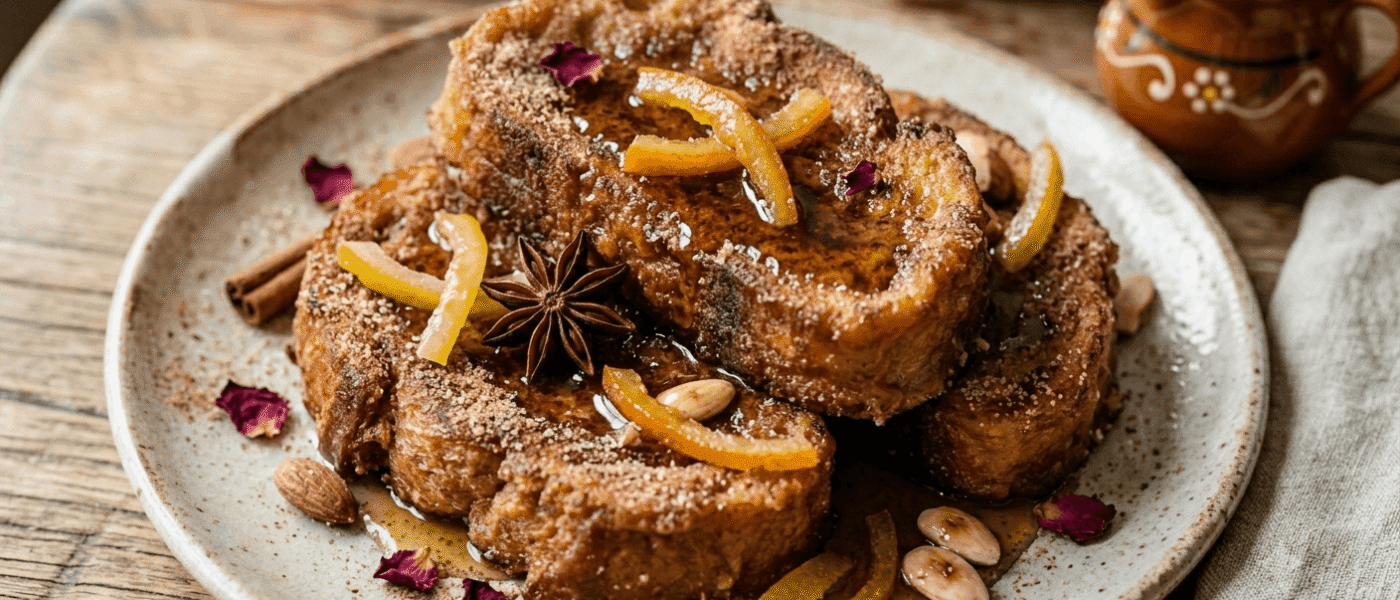
Torrijas are Spain’s answer to pain perdu — stale bread soaked in spiced milk, dipped in egg, fried in olive oil, and finished with honey or cinnamon sugar. They’ve been made across Spain for Semana Santa (Holy Week) for centuries, and they are distinctly their own thing.
The differences from French toast are specific and intentional. Where pain perdu uses butter, torrijas use olive oil — which fries at a higher temperature and crisps the exterior differently. Where French toast is a one-step custard soak, torrijas use two: first a warm spiced milk soak that flavors the bread deeply, then an egg dip that seals the exterior. The honey or syrup finish is not optional — it pulls everything together and gives torrijas their characteristic sweet-savory depth. Eat them warm, or eat them at room temperature hours later. They hold remarkably well both ways.
What You’re Learning
Two-step soaking: milk first, egg second. Most French toast combines milk and egg into a single custard. Torrijas separate them deliberately. The warm milk soak — infused with cinnamon and lemon — flavors the bread all the way through before any egg is involved. The egg dip then coats the exterior in a thin, sealed layer that fries to a crisp. The result is a piece of bread that is flavored throughout and protected on the outside — better than a single-step custard soak because the flavoring penetrates more deeply, and the egg exterior crisps more cleanly.
Olive oil frying and heat management. Olive oil has a higher smoke point than butter and a distinctly savory flavor that complementss the sweet finish of honey or syrup. For torrijas, the oil should be shallow — about ½ inch — and heated to roughly 350°F (175°C) before the bread goes in. At the right temperature, the egg exterior sets immediately on contact and the torrijas cook without absorbing excess oil. Too cool and they soak up oil and go greasy; too hot and the egg scorches before the bread heats through. The visual cue: the bread sizzles actively but not violently when it hits the oil.
Ingredients
Makes 4 servings (8 torrijas).
- 8 thick slices day-old baguette or white bread (about 1 inch / 2.5cm thick)
- 1 cup (240ml) whole milk
- 1 cinnamon stick
- Zest of ½ lemon
- 2 tbsp sugar (for the milk)
- 2 large eggs, beaten
- Light olive oil for frying (about ½ cup / 120ml)
- For serving: honey, or cinnamon sugar (2 tbsp sugar + ½ tsp cinnamon)
Method
- Make the spiced milk. Combine the milk, cinnamon stick, lemon zest, and sugar in a small saucepan. Heat over medium-low until just steaming — do not boil. Remove from heat and let steep for 10 minutes. The milk should smell strongly of cinnamon and lemon.
- Soak the bread in the spiced milk. Pour the warm milk into a shallow dish. Add the bread slices and soak for 2–3 minutes per side. The bread should absorb the milk fully but not fall apart. Day-old bread handles this well; very fresh bread may get too soft — reduce soak time if needed.
- Dip in beaten egg. Beat the eggs in a separate shallow bowl. Lift each soaked slice from the milk, let excess drip off, and dip in egg on both sides. The egg coating should be thin and even.
- Heat the olive oil. Pour olive oil into a wide skillet to about ½ inch depth. Heat over medium-high until a small piece of bread dropped in sizzles immediately — about 350°F (175°C). Do not let it smoke.
- Fry until golden, 2–3 minutes per side. Fry in batches — don’t crowd the pan. The torrijas should sizzle actively, not violently. Flip once when the underside is deep golden. Transfer to a plate lined with paper towels.
- Finish with honey or cinnamon sugar. Drizzle generously with honey while still warm, or dust with cinnamon sugar. Serve immediately or at room temperature.
Notes
- Day-old baguette is ideal. Its crumb is open enough to absorb the milk without collapsing, and its crust holds structure through the egg dip and frying. Brioche works too but is richer — good if you want something more indulgent.
- Light olive oil, not extra-virgin. Extra-virgin olive oil has a lower smoke point and a more assertive flavor. For frying torrijas, use a light or pure olive oil, or a neutral oil like sunflower if you prefer.
- Torrijas are good at room temperature. Unlike French toast, which loses its texture as it cools, torrijas hold remarkably well for several hours. In Spain, they’re often made ahead and served at room temperature with honey at the table.
- The honey is not garnish. It’s a functional part of the dish. Don’t skip it or treat it as optional — the sweetness and floral depth of honey completes the cinnamon-lemon-egg combination in a way that powdered sugar doesn’t.
- Add a splash of anise liqueur to the milk (optional). Some Spanish recipes add a small amount of anís (anise liqueur) to the milk soak. It adds an herbal, slightly licorice note that is traditional in certain regions.
- The Semana Santa connection. Torrijas are associated with Holy Week because they’re a meatless dish made from pantry staples — bread, milk, eggs — that was eaten during the fasting days of Lent. The recipe hasn’t changed much in centuries.