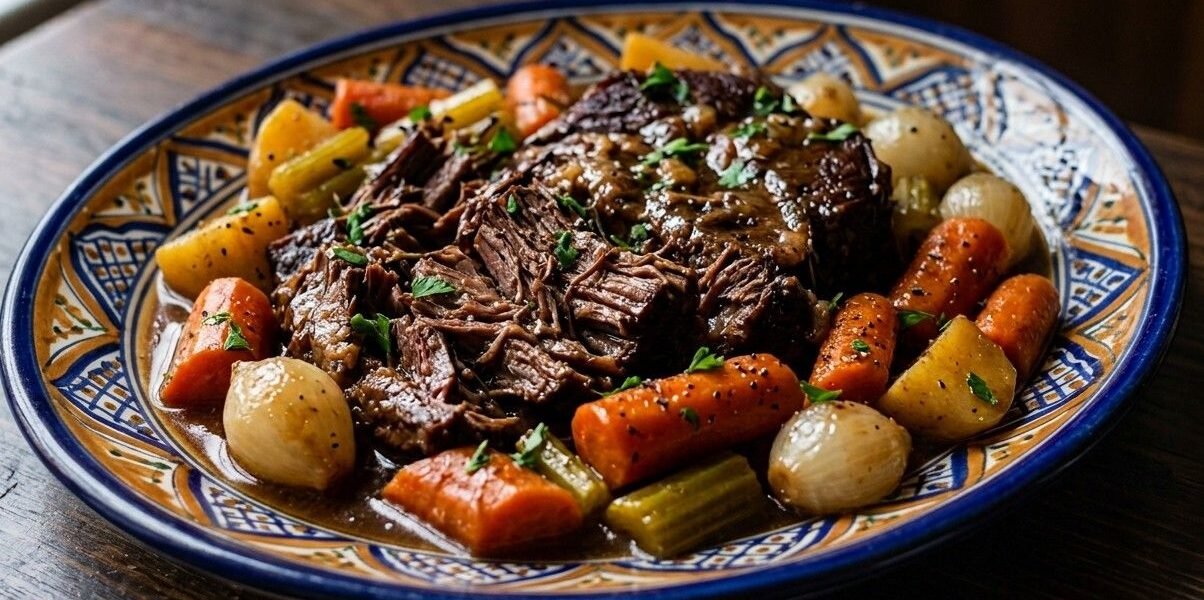
Season it, dump it, walk away. Eight hours later a tough, cheap cut of beef falls apart with a fork and the gravy is already made from what was in the pot the whole time.
What You’re Learning
Why chuck, and why low and slow. Chuck roast comes from the cow’s shoulder, a hardworking muscle laced with collagen and connective tissue. Cooked hot and fast, that collagen stays tough and chewy, which is exactly why chuck is a poor grilling cut. But held at a gentle simmer, roughly 180 to 200°F for hours, the same collagen slowly melts into gelatin, which is what gives a good pot roast its fall-apart texture and rich, silky mouthfeel. A crockpot is essentially a slow, unattended braise: sealed, moist heat held at a steady low temperature for as long as the connective tissue needs to fully break down.
Turning the braising liquid into gravy. After eight hours with meat, vegetables, wine, and aromatics, the liquid left in the crockpot is deeply flavored but thin. Straining it removes the softened vegetable scraps and herb stems, and a flour slurry whisked in while the liquid simmers thickens it into a proper gravy instead of a watery broth. Whisking the slurry in gradually, rather than dumping it in all at once, is what keeps the gravy smooth instead of lumpy — the flour needs to be evenly dispersed before the starch molecules start swelling and thickening.
Ingredients
Makes 6 servings.
- 3–4 lb (1.4–1.8kg) boneless chuck roast
- 1½ tsp fine salt
- ½ tsp freshly ground black pepper
- 4 garlic cloves, smashed
- 1 lb (450g) pearl onions, peeled (fresh, or frozen and thawed)
- 4 large carrots, cut into 2-inch chunks
- 4 celery stalks, cut into 2-inch pieces
- 1 lb (450g) baby potatoes, halved
- 2 cups (475ml) beef broth
- ¼ cup (60ml) dry red wine
- 2 tbsp tomato paste
- 1 tbsp Worcestershire sauce
- 3 sprigs fresh thyme (or 1 tsp dried)
- 1 sprig fresh rosemary (or ½ tsp dried)
- 2 bay leaves
- 3 tbsp all-purpose flour, for the gravy
- Fresh parsley, chopped, for garnish
Method
- Season and layer. Season the chuck roast all over with the salt and pepper. Scatter the smashed garlic in the bottom of the crockpot, then set the roast on top — this keeps it lifted just off the floor of the insert instead of sitting directly in the liquid.
- Add the vegetables and braising liquid. Arrange the carrots, celery, potatoes, and pearl onions around the roast. In a bowl, whisk together the beef broth, red wine, tomato paste, and Worcestershire sauce until the tomato paste is fully dissolved, then pour it over everything. Tuck in the thyme, rosemary, and bay leaves.
- Cook low and slow. Cover and cook on Low for 8 hours, or on High for 4 to 5 hours, until the roast is fall-apart tender and shreds easily when pressed with a fork. Keep the lid on for the full cook — lifting it even once lets out enough heat that the crockpot needs 20 to 30 minutes to recover.
- Rest the meat and hold the vegetables. Transfer the roast to a cutting board and tent loosely with foil, let it rest for 10 minutes before shredding. Use a slotted spoon to lift the carrots, celery, potatoes, and pearl onions onto a serving platter, cover loosely to keep warm.
- Build the gravy. Discard the bay leaves and herb stems, then strain the remaining cooking liquid into a saucepan and bring it to a simmer over medium heat. Whisk the flour with 3 tablespoons of cold water in a small bowl until smooth, then whisk it into the simmering liquid. Cook for 3 to 4 minutes, whisking often, until the gravy thickens enough to coat the back of a spoon. Taste and season with salt and pepper.
- Shred and serve. Shred the rested roast into large pieces with two forks, or slice it against the grain. Arrange it with the vegetables on the platter, spoon the warm gravy generously over the top, and scatter the chopped parsley over everything before serving.
Notes
- Chuck is the right cut, don’t substitute lean. Chuck roast (sometimes labeled chuck eye roast or shoulder roast) has the connective tissue this recipe depends on. A lean cut like eye of round or top round will still be tough after 8 hours — it doesn’t have enough collagen to break down into gelatin, no matter how long it cooks.
- Low beats High for texture. Both settings will cook the roast through, but Low’s longer, gentler cook gives the collagen more time to fully convert to gelatin. If you’re short on time, High for 4 to 5 hours works — the roast will be tender, just slightly less silky than a full 8-hour Low cook.
- Keep the lid on. Every time you lift the lid to check on it, the crockpot loses enough heat that it needs 20 to 30 minutes to recover. Trust the timer instead of peeking.
- Make it a day ahead. Pot roast reheats beautifully, and the flavor actually improves overnight as the gravy and vegetables keep absorbing the braising liquid. Refrigerate the meat, vegetables, and gravy together, then reheat gently on the stovetop or in the microwave.
- Want more depth? Sear it first. Searing the seasoned roast in a hot skillet for 2 to 3 minutes per side before it goes into the crockpot builds a deeper, more complex gravy through the Maillard reaction — the same browning technique used in Pork Tenderloin with Pan Sauce. It’s an extra step, not required, but a real upgrade if you have five extra minutes.
- See the Meat Cuts guide for more on chuck. If you want to understand where chuck sits relative to other beef cuts and cooking methods, the Meat Cuts & Cooking Methods guide breaks it down.