Real churro dough is just three ingredients: flour, boiling water, and salt. No eggs, no butter, no sugar mixed in, nothing American-style choux pastry would recognize as enrichment. Boil the water, pull it off the heat, stir in the flour all at once, and it’s ready to pipe.
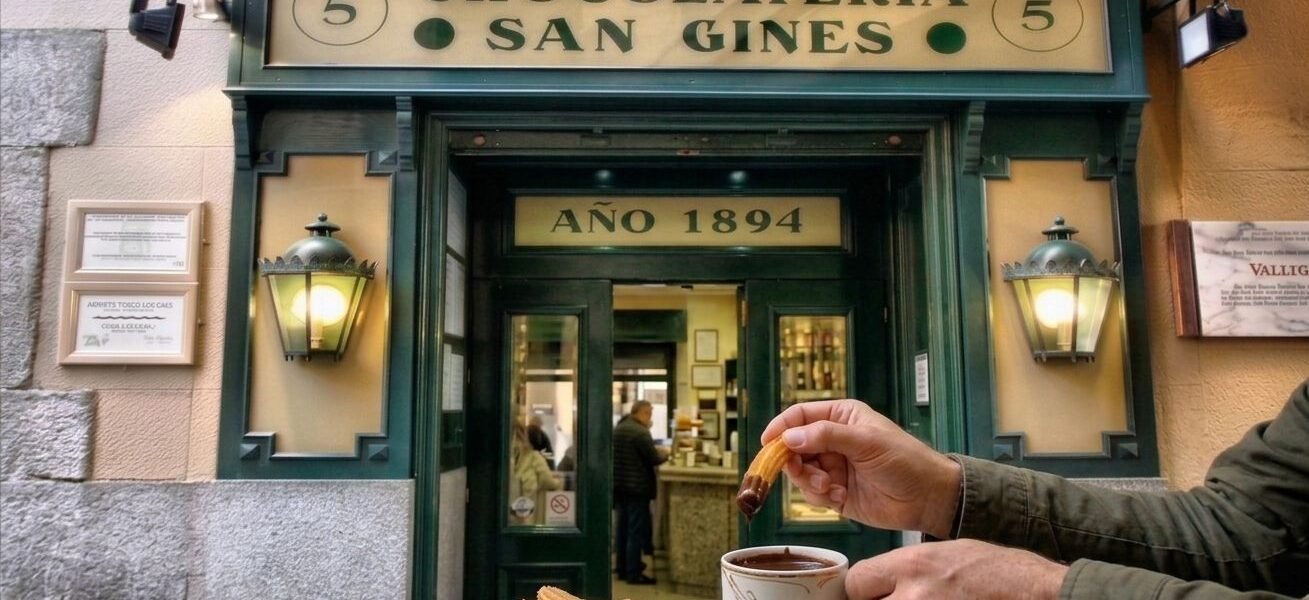
That dough goes straight from the pot into a piping bag, and from the piping bag straight into hot oil, snipped off in short lengths that puff and turn deep gold in a few minutes. Serve them warm alongside a cup of thick Spanish hot chocolate, more like a warm pudding than cocoa, and made for dipping rather than drinking. It’s the classic churrería pairing, and it’s genuinely simple to make at home.
What You’re Learning
A dough built from a scald, not a roux. The flour goes into the boiling water, not the other way around, stirred in all at once off the heat until it seizes into a smooth dough. That residual heat is enough to gelatinize the starch and turn three plain ingredients into a dough sturdy enough to hold the ridges of a star tip and puff cleanly in the fryer instead of collapsing. It has to be piped and fried the same day it’s made, since there’s no yeast or baking powder holding it together over time.
Oil temperature is the whole game. Too hot, and the outside browns and sets before the inside cooks through, leaving a raw, gummy center under a dark crust. Too cool, and the churros soak up oil instead of sealing quickly, turning greasy and heavy rather than light and crisp. 350 to 375°F is the window where the outside crisps at roughly the same pace the inside finishes cooking.
Ingredients
Makes about 20-24 churros, serving 6.
For the Churros:
- 1 cup all-purpose flour
- 1 cup water
- 1/2 teaspoon sea salt
- Olive oil, for frying (about 4 cups)
- Sugar, for dusting (optional)
For the Chocolate:
- 1 cup whole milk
- 4 oz dark chocolate (60-70%), finely chopped
- 1 tablespoon cornstarch
- 1 tablespoon granulated sugar
Method
- Boil the water. In a saucepan, bring the water and salt to a rolling boil.
- Add the flour. Remove the saucepan from the heat and add the flour all at once, stirring vigorously with a wooden spoon until a smooth, compact dough forms with no dry spots.
- Cool and knead. Let the dough cool for 1 to 2 minutes, then knead briefly by hand until smooth.
- Pipe. Transfer the warm dough to a piping bag fitted with a large star tip.
- Heat the frying oil. Fill a heavy pot with 2 to 3 inches of oil and heat to 350 to 375°F.
- Fry. Pipe 5 to 6-inch lengths of dough directly over the hot oil, snipping each one off with kitchen scissors. Fry in small batches, 5 to 6 minutes, turning occasionally, until deep golden brown and crisp.
- Drain. Lift the churros out with a slotted spoon onto a wire rack or paper-towel-lined plate. Let the oil temperature recover between batches.
- Dust with sugar, if using. Sprinkle lightly with sugar while still warm. It’s traditional but genuinely optional, the dough itself has none.
- Start the chocolate. In a small saucepan, whisk the cornstarch with a splash of the milk until smooth, then whisk in the rest of the milk.
- Melt and thicken. Add the chopped chocolate and remaining tablespoon of sugar. Whisk over medium-low heat until the chocolate melts and the mixture thickens enough to coat the back of a spoon, 3 to 4 minutes.
- Serve. Serve the churros warm, with the chocolate alongside for dipping.
Notes
- Skip the cinnamon. It’s a common add-in outside Spain, and the dough itself has no sugar in it either, just flour, water, and salt. A light dusting of sugar at the end is optional, and plenty of purists skip it entirely.
- Snip the dough directly over the oil with kitchen scissors instead of piping long ropes onto a board first, it’s faster and the cut ends seal cleanly the moment they hit the oil.
- The dough isn’t cooked on the stove beyond the initial boil. Stirring the flour into the boiling water off the heat is what gelatinizes it. There’s no yeast or baking powder either, so pipe and fry it the same day it’s made.
- A large closed star tip, about a 1/2-inch opening, is what gives churros their ridges. Those ridges are what let a sugar dusting cling, if you’re using one, a plain round tip won’t do the same job.
- Watch the oil temperature with a thermometer rather than guessing. It drops each time a batch goes in, so let it climb back to 350°F before adding the next.
- The chocolate should be thick enough to coat a spoon, closer to a warm pudding than hot cocoa. Cornstarch, not extra chocolate, is what gets it there.
- Churros are best within an hour of frying. They lose their crisp fast, though a few minutes in a hot oven will partially revive leftovers.