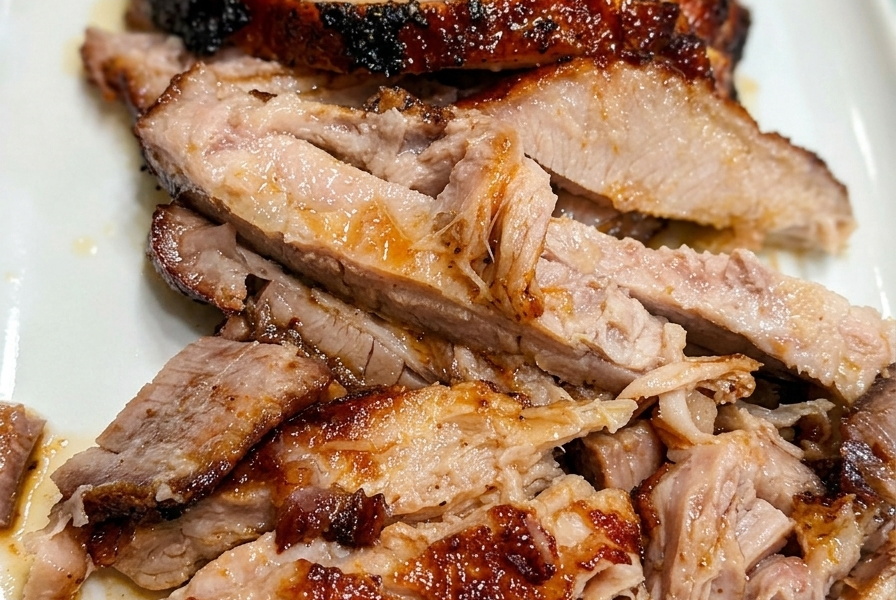
Pork belly rewards patience more than technique. A simple rub and a long, low roast do almost everything, turning a slab that would be tough and chewy at a normal “done” temperature into something that slices clean and pulls apart with a fork.
Four ingredients go into the rub, and the oven does the rest. No broiler, no basting, no flipping, just time at a moderate temperature until the fat renders and the sugar on the surface turns into a deep, dark crust on its own.
What You’re Learning
Why this cooks to 200°F, well past pork’s normal 145°F safe temperature. Pork belly is loaded with collagen and connective tissue, the same as brisket or short ribs. At 145°F it’s technically safe to eat but still tough and chewy. Only sustained heat well beyond that point slowly melts the collagen into gelatin, which is what makes the belly tender enough to fall apart instead of fighting back with every bite.
Why the crust caramelizes without a broiler. Two hours at a moderate 325°F gives the brown sugar in the rub plenty of time to slowly caramelize into a deep crust as the fat underneath renders out. A broiler works faster but risks burning the sugar before the inside is anywhere near done. Low and slow gets you there without having to watch it.
Why it rests in the fridge before roasting. An 8- to 24-hour dry-brine gives the salt in the rub time to draw moisture out of the pork belly, dissolve into it, and get reabsorbed, seasoning the meat all the way through instead of just the surface. It also dries out the exterior, which helps the crust caramelize faster and darker once it hits the oven.
Ingredients
Serves 4.
- 2 lb (900g) pork belly, skin removed
- 1½ tbsp packed brown sugar
- 1 tbsp sweet smoked paprika
- 2 tsp kosher salt
- ½ tsp black pepper
Method
- Prep the pork belly. Pat the pork belly completely dry with paper towels and trim any ragged edges.
- Mix the rub. In a small bowl, combine the brown sugar, smoked paprika, salt, and pepper.
- Season. Rub the mixture over every side of the pork belly, pressing it into the surface so it sticks.
- Dry-brine. Place the seasoned pork belly on a rack or plate and refrigerate, uncovered or loosely covered, for 8 to 24 hours.
- Roast. Set the pork belly fat-side up on a wire rack over a foil-lined sheet pan. Roast at 325°F (163°C) for about 2 hours, until an instant-read thermometer reads 200°F (93°C) at the thickest part.
- Rest. Let the pork belly rest 10 to 15 minutes before slicing, so the juices settle back in.
- Slice and serve. Slice against the grain into thick pieces.
Notes
- Don’t skip the dry-brine. Even the low end of the range, 8 hours, makes a real difference, but the closer to 24 hours you get, the deeper the seasoning and the better the crust.
- Cook to temperature, not time. Bellies vary in thickness and fat content, so start checking with an instant-read thermometer around the 1½-hour mark.
- The wire rack matters. It lifts the belly out of its own rendered fat so the bottom caramelizes instead of steaming.
- 200°F seems high for pork, and it is, deliberately. Pork belly is loaded with collagen like brisket or short ribs, and only sustained heat past that point melts it tender.
- No broiler needed. Two hours at 325°F gives the brown sugar rub enough time to caramelize into a deep crust on its own. If you want more char anyway, a couple of minutes under the broiler at the end works, just watch it closely, the sugar burns fast.
- Rest before slicing or the juices end up on the cutting board instead of in the meat.
- Leftovers reheat well in a hot skillet, which re-crisps the caramelized edges.