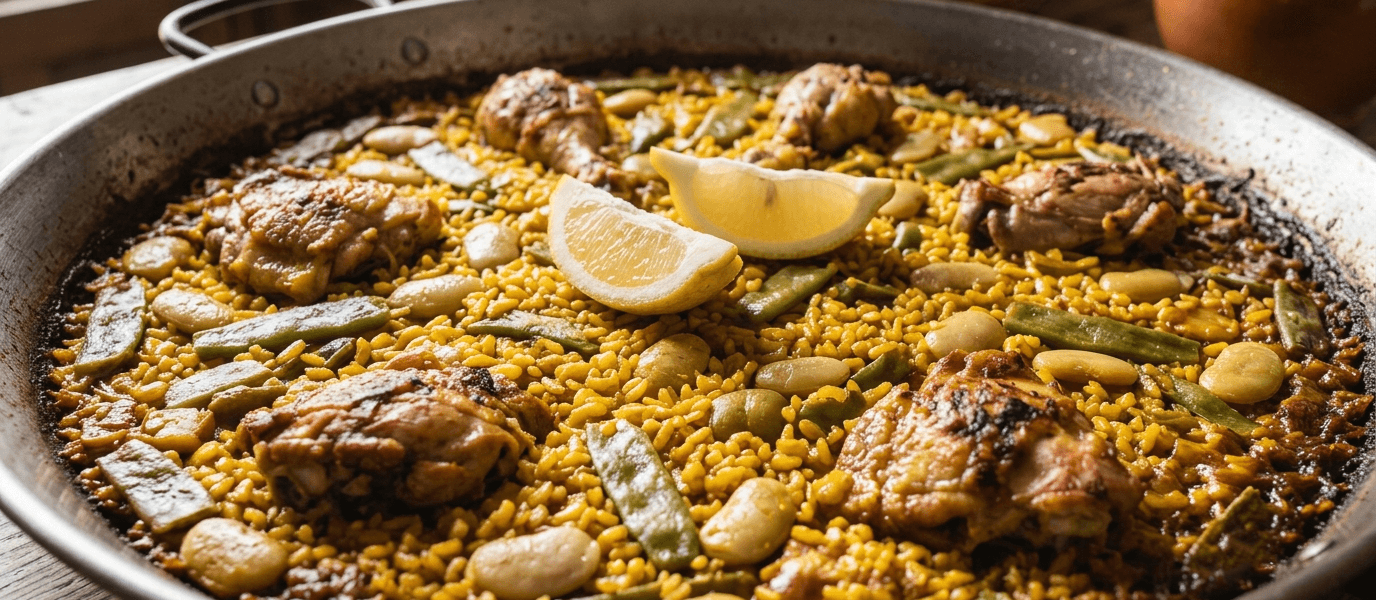
Everything you’ve been told about paella is probably wrong. It isn’t Spanish risotto. You don’t stir it. And the crust stuck to the bottom of the pan isn’t a mistake, it’s the entire point.
Paella comes from the rice fields around Valencia, on Spain’s east coast, cooked outdoors over wood fires in wide shallow pans that gave the dish its name. The version most people know outside Spain, a mix of chicken, seafood, and whatever else was in the walk-in, is a restaurant invention. The original is simpler and more specific: chicken, rabbit, a few local beans, rice, and saffron, cooked in one thin layer so the bottom caramelizes into something better than the rice above it. Get that technique right once and you’ll never make risotto-style mush again.
What You’re Learning
Not stirring the rice. Every instinct from risotto or stir-fry tells you to keep food moving in a hot pan. Paella works the opposite way. Once the rice goes in, it gets spread into one even layer and left alone. Stirring releases starch and turns the dish creamy and gluey, which is exactly what paella is not supposed to be. The rice should stay separate, grain from grain, all the way to the bottom.
Building the socarrat. Socarrat is the thin, deeply caramelized layer of rice that forms on the bottom of the pan in the last few minutes of cooking, and it’s considered the best part of the dish, not a burnt mistake to scrape off. You get there by listening, not watching: near the end, the pan goes from a gentle simmer to a faint crackle as the last of the liquid cooks away and the rice touching the metal starts to toast. Pull it the moment you hear that sound. A few seconds too long and toasted becomes burnt.
Ingredients
- 3 tbsp olive oil
- 1½ lbs bone-in chicken thighs, cut into 2 to 3 inch pieces
- 1 lb rabbit, cut into pieces (or substitute more chicken thighs, or pork ribs)
- 1 tsp salt, plus more to taste
- 1 cup flat green beans (or Romano beans), trimmed and halved
- 1 cup garrofón or large lima beans, fresh or thawed from frozen (or 1 can butter beans, drained and rinsed, a close and easy substitute)
- 1 ripe tomato, grated on a box grater, skin discarded
- 2 cloves garlic, minced
- 1 tsp sweet smoked paprika (pimentón dulce)
- 25 saffron threads, steeped in 2 tbsp warm water
- 6 cups chicken stock, kept warm on the stove
- 2 cups Bomba or Calasparra rice
- 1 sprig fresh rosemary (optional)
- Lemon wedges, for serving
Method
- Heat the pan. Warm the olive oil in a 15 to 16 inch paella pan over medium-high heat until it shimmers.
- Brown the meat. Season the chicken and rabbit with the salt. Add to the pan in a single layer and brown on all sides, 8 to 10 minutes, then push everything to the edges of the pan.
- Cook the vegetables. Add the green beans and garrofón to the cleared center of the pan. Sauté 3 to 4 minutes, until they soften and pick up a little color.
- Build the sofrito. Push the vegetables aside and add the grated tomato and garlic to the center. Cook 3 to 4 minutes, until it darkens and most of the liquid cooks off. Stir in the paprika and cook 30 seconds, just until fragrant, then stir everything in the pan back together.
- Add the stock and saffron. Pour in the warm stock along with the saffron and its soaking water. Stir once to combine, bring to a boil, then taste the broth and adjust the salt. It should taste slightly saltier than you’d want a soup to taste, since the rice will absorb a lot of it. Simmer uncovered for 10 minutes.
- Add the rice. Sprinkle the rice evenly across the entire pan. Give it one gentle stir to distribute it, then don’t stir again for the rest of the cook.
- Simmer without stirring. Cook at a steady simmer for 15 to 18 minutes, rotating the whole pan occasionally on the burner for even heat, until most of the liquid is absorbed and the rice is just tender.
- Build the socarrat. In the last 1 to 2 minutes, raise the heat to medium-high. Listen for a faint crackling sound from the bottom of the pan, that’s the rice caramelizing against the metal. Pull it off the heat the moment you hear it.
- Rest and serve. Remove from heat, cover loosely with foil or a clean kitchen towel, and rest 5 to 10 minutes. Serve straight from the pan with lemon wedges, scraping up the socarrat with each portion.
Notes
- Rabbit can be hard to find outside a good butcher counter. More chicken thighs or a few pork ribs are both traditional-enough substitutes; the dish doesn’t fall apart without it.
- Bomba or Calasparra rice matters more than people expect. Both absorb roughly triple their volume in liquid without turning starchy or blowing out, which gives you a much wider margin for error than Arborio, which was bred for creaminess, the opposite of what paella wants.
- The wide, shallow pan isn’t optional styling, it’s the technique. A deep pot traps steam and cooks the rice more like a pilaf, and you’ll never get a real socarrat without enough surface area touching direct heat.
- If you don’t hear any crackling by a minute or two after the liquid looks gone, the heat is probably too low. If it starts smelling sharp and burnt instead of toasted, it’s already gone too far. Both take practice to catch by ear.
- Leftovers keep 2 to 3 days refrigerated. Reheat gently in a skillet with a splash of stock; the microwave turns the rice rubbery.
- For a coastal version, swap the chicken and rabbit for shrimp, mussels, and squid, added later since seafood cooks much faster than meat, this becomes paella de marisco.