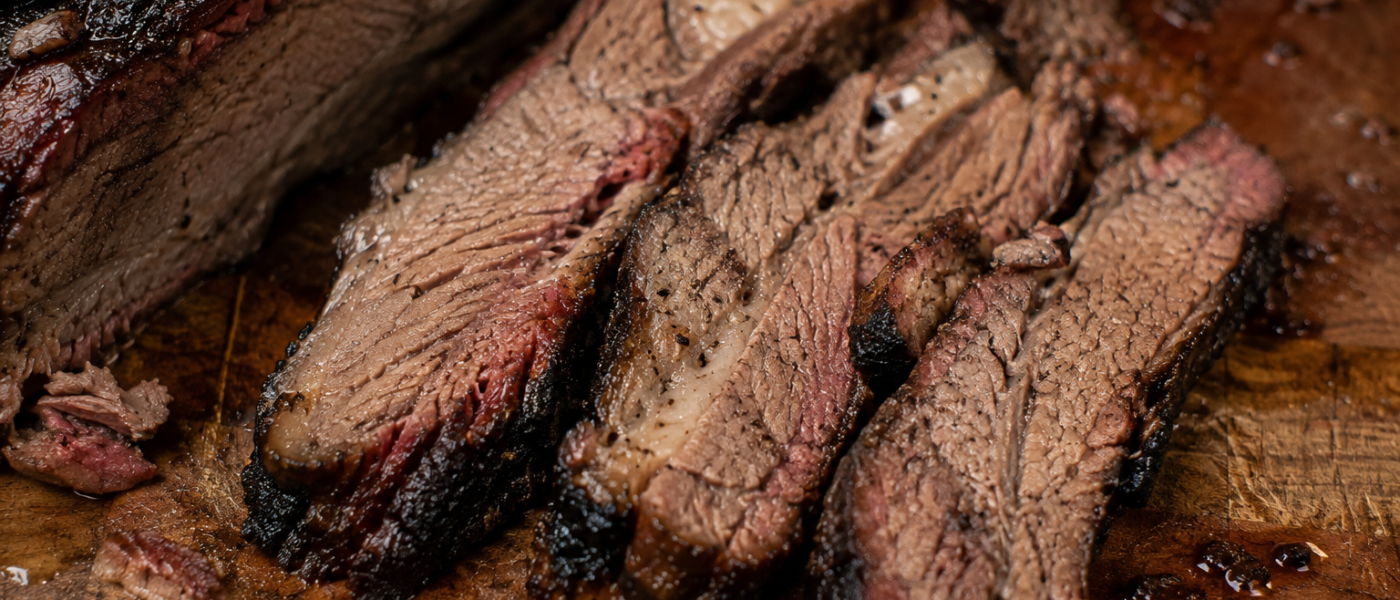
Real Texas brisket isn’t a recipe with a lot of ingredients. It’s salt, pepper, smoke, and time, and it’s unforgiving about the time part. Every shortcut you’re tempted to take, more heat, a foil wrap too early, slicing before it’s rested, shows up directly in the texture. This is the version that doesn’t cut those corners.
A whole packer brisket is two muscles, the flat and the point, wrapped in fat and connective tissue that only breaks down properly with hours of low, steady heat. Rush it and you get a tough, chewy slab. Give it the time it actually needs, including the hour-plus stall where the temperature seems to stop climbing entirely, and the collagen melts into something closer to gelatin than muscle.
What You’re Learning
Why the stall isn’t a problem to fix. A few hours in, the brisket’s internal temperature will climb steadily into the 150s°F and then stop, sometimes for two hours or more, no matter how hot the smoker runs. This is evaporative cooling: moisture working its way out of the meat cools the surface at almost exactly the rate the smoke is heating it, the same reason sweat cools skin. Cranking the smoker’s temperature up to force it through just dries the outside out and doesn’t actually speed up what’s happening inside. The fix is patience, not more heat.
Why butcher paper beats foil for the wrap. Once the bark has set, usually somewhere around 160-165°F internal, wrapping helps push through the rest of the stall faster. Foil does that too, but it also traps steam directly against the crust, and steam turns a hard-earned peppery bark soft and rubbery. Pink butcher paper is porous. It still holds in enough heat and moisture to speed up the cook, but it lets steam escape instead of pooling, so the bark that took twelve hours to build survives the last few.
Ingredients
Makes 1 whole brisket, about 12 servings.
- 1 whole packer brisket (10-14 lbs), trimmed
- 2 tbsp yellow mustard, as a binder (optional)
- ¼ cup coarse kosher salt
- ¼ cup coarse black pepper
Method
- Trim the brisket. Trim the fat cap down to about ¼ inch, thick enough to protect the meat during the long cook, thin enough to render and let smoke through. Remove any hard, waxy fat pockets and square off the thin edges so the whole brisket cooks more evenly.
- Season. Rub the brisket all over with yellow mustard if using, it helps the rub stick but cooks off without adding flavor. Coat generously and evenly with the kosher salt and coarse black pepper on all sides, pressing it in. This is the classic Texas rub, just the two, in roughly equal parts.
- Rest the rub. Let the seasoned brisket sit uncovered in the fridge at least 1 hour, or overnight if you can, so the salt starts working into the meat before it hits the smoker.
- Set up the smoker. Bring your smoker to a steady 225-250°F using a mild wood like post oak or hickory. Add a water pan if your setup has one, it helps stabilize temperature and keeps the cooking environment humid.
- Smoke fat-side up. Place the brisket fat-side up so the rendering fat continually bastes the meat as it drips down. Close the lid and leave it alone. Resist opening it more than necessary, every open door lets heat and smoke escape and adds real time to the cook.
- Monitor and spritz. Track internal temperature with a wireless probe thermometer so you’re not opening the lid to check. Once the bark starts to set, after 2-3 hours, spritz the surface with water or apple cider vinegar every hour to keep it from drying out before it’s fully formed.
- Ride out the stall. Somewhere in the 150-165°F range, the internal temperature will plateau for an hour or more. This is expected. Keep the smoker steady and don’t chase the temperature with more heat.
- Wrap in butcher paper. Once the bark is dark, firm, and set, usually around 160-165°F internal, wrap the brisket tightly in two sheets of pink butcher paper. This holds in heat to push through the rest of the stall while still letting steam escape, so the bark doesn’t turn soft.
- Finish smoking. Return the wrapped brisket to the smoker and continue cooking until it reaches 203-205°F internal and a probe thermometer slides into the thickest part of the flat with almost no resistance, like pushing into softened butter.
- Rest. This step is not optional. Wrap the brisket, still in its butcher paper, in a towel and let it rest in a dry cooler for at least 1 hour, ideally 2. Resting lets the juices redistribute through the meat instead of running out onto the cutting board the moment you slice it.
- Slice against the grain. Separate the point from the flat where the fat seam runs between them, the grain direction changes between the two muscles. Slice each piece against its own grain, in pencil-width slices, for tender, easy-to-chew bites.
Notes
- Total smoke time runs 10-14 hours depending on the brisket’s size and your smoker’s consistency, plus the rest. Start early. A brisket that finishes ahead of schedule and rests an extra hour in the cooler is never a problem.
- Go by temperature and feel, not the clock. Two briskets of the same weight can finish an hour or more apart depending on fat content and how consistently the smoker holds its temperature.
- No offset smoker? A kettle grill set up for indirect heat (coals banked to one side, brisket on the other, lid vents cracked) works with the same technique, just watch the temperature more closely since it drifts more.
- Leftover brisket reheats best wrapped in foil with a splash of beef broth, low oven heat, until just warmed through. The microwave dries it out fast.
- Save the trimmed fat. Rendered slowly in a low oven, it makes a rich beef tallow worth keeping for roasting vegetables or searing steaks.