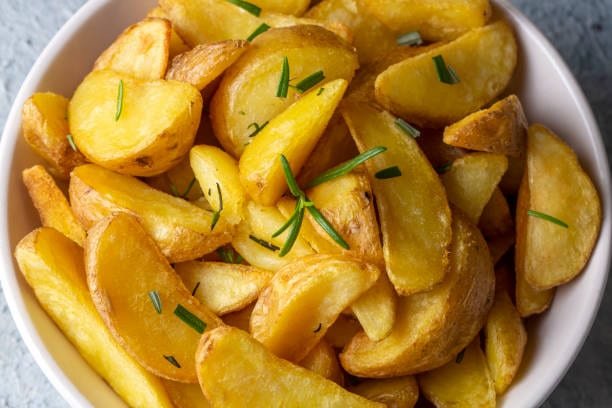
Home fries are what you cook when you want hash brown flavour but can’t be bothered with the grating. Skillet, hot oil, patience for the crust — that’s the whole recipe.
Home fries are a distinctly American diner invention — wedges of par-cooked or leftover potato cooked in a cast iron skillet with onion until the edges are deeply browned and the insides are soft. They appear on breakfast plates alongside eggs from coast to coast, and they’re one of the first dishes home cooks learn because the technique is straightforward and the result deeply satisfying. The key distinction from hash browns (which use grated, shredded potato) is the texture: home fries are chunky with varied surfaces — crispy edges, soft centers, browned faces wherever the potato contacted the hot pan. You need a heavy pan, enough oil, and the discipline not to stir constantly.
What You’re Learning
The Maillard reaction on a flat surface. When a starchy cut potato sits in hot oil against a hot metal surface, the surface moisture evaporates rapidly and the exterior starch and sugars begin browning. This creates a golden, savory crust with completely different texture to the interior. Moving the potatoes constantly interrupts this process — each time you stir, you cool the contact surface and allow moisture to re-accumulate. Leave the potato sitting, undisturbed, and the crust develops.
Pre-cooking versus raw start. Home fries can be made from raw potatoes (starting from scratch, needing 20–25 min on lower heat) or from par-cooked or leftover potatoes (needing only high heat and a short time to achieve crust on an already-tender interior). Leftover cooked potatoes make the best and fastest home fries — a compelling reason to cook extra potatoes whenever you’re making them.
Ingredients
- 500g / 1 lb waxy or all-purpose potatoes (Yukon Gold, red potatoes, or Charlotte), scrubbed, skin on
- ½ medium yellow onion, diced
- ½ bell pepper (any colour), diced (optional)
- 2–3 tbsp olive oil or clarified butter
- ½ tsp salt, plus more to taste
- ¼ tsp paprika or smoked paprika
- ¼ tsp black pepper
Instructions
- Par-cook the potatoes (if starting raw). Cut potatoes into wedges: halve each potato lengthwise, then cut each half into 3–4 wedges, about 2–3 cm thick at the widest point. Boil in salted water for 8–10 minutes until just barely tender — a knife should meet slight resistance. Drain and let steam for 2 minutes. Skip this step if using leftover cooked potatoes.
- Heat the pan properly. Heat a heavy skillet — cast iron preferred — over medium-high heat for 2–3 minutes until very hot. Add oil and heat until shimmering.
- Add potatoes in a single layer. Add the par-cooked potato wedges and spread into a single layer, cut sides down where possible for the best contact with the pan. Season with salt, pepper, and paprika. Press down lightly with a spatula.
- Don’t touch them. Cook undisturbed for 4–6 minutes until the bottom is deep golden-brown. Resist the urge to stir.
- Flip and add aromatics. Flip the potatoes with a spatula, exposing fresh faces to the hot pan. Add the diced onion (and bell pepper if using) at this stage. Cook for another 4–5 minutes, stirring occasionally, until the onion is soft and more surfaces are browned.
- Taste and serve. Adjust salt and serve immediately alongside fried or scrambled eggs.
Notes
- Leftover potatoes are ideal. Any cooked potato — roasted, boiled, baked — works. Cut into wedges and go straight to step 2. A great way to use potatoes sitting in the fridge.
- Cast iron is best. The heavy thermal mass of cast iron holds its temperature when the potatoes go in and distributes heat evenly. Thin skillets create hot spots and uneven browning.
- Add aromatics at the flip. Onion and peppers go in after the first flip so they don’t burn during the initial crust-building stage. They need only 4–5 minutes of contact with the hot pan.
- Fat matters. Clarified butter, duck fat, or bacon fat produce superior flavour to olive oil. Don’t use too little — potatoes need fat contact on their surface to brown.
- Oven finish. For large batches, start on the stovetop and finish in a 200°C / 400°F oven for 10–15 minutes — easier than managing large quantities in a single pan.