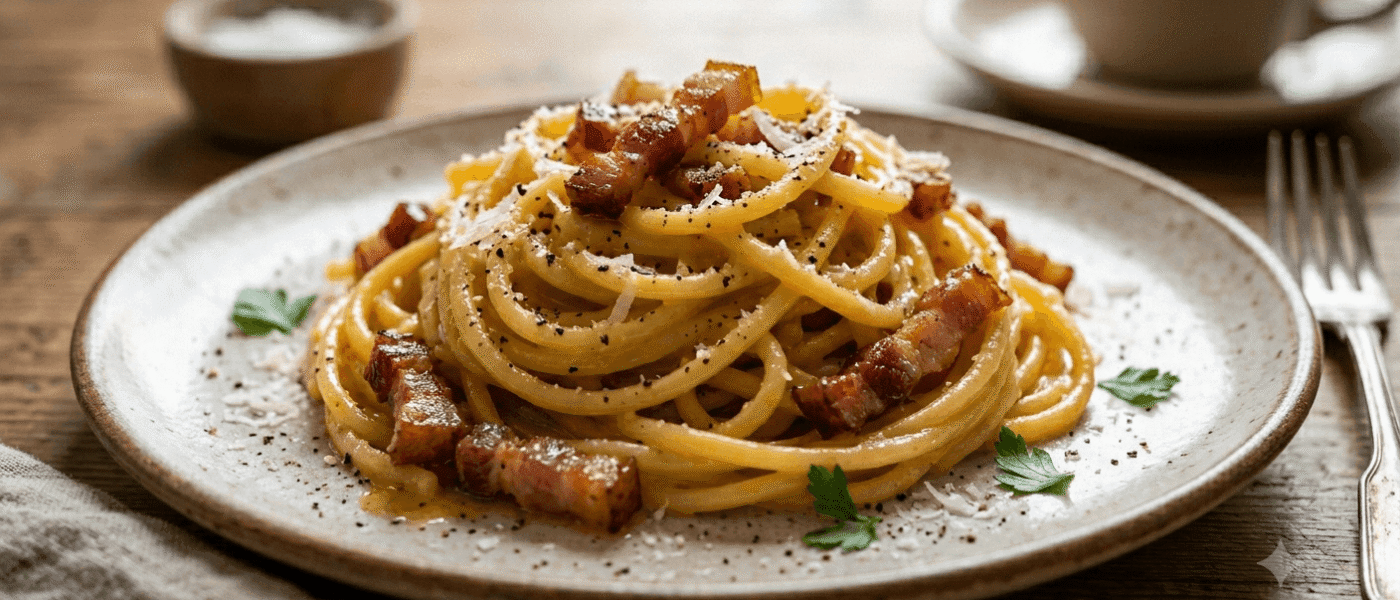
Roman carbonara has four ingredients, no cream, and a technique that separates every cook who’s made it well from every cook who hasn’t.
Carbonara is one of Rome’s four canonical pasta dishes — alongside cacio e pepe, amatriciana, and gricia — and arguably the most misunderstood outside Italy. The version most people encounter in restaurants outside Rome is made with heavy cream. The authentic version is not. It uses eggs (whole eggs and yolks), finely grated aged pecorino romano, guanciale (cured pork cheek), and an aggressive amount of black pepper. That’s it. The creaminess comes entirely from the emulsification of fat, egg, and pasta water — and from knowing exactly when to pull the pan off the heat.
The technique is simple but unforgiving. Too much heat and you have scrambled eggs on pasta. Too little and the sauce stays loose and watery. The goal is a sauce that coats every strand thickly, stays glossy, and slides slowly off a tilted plate. Get the temperature right once and the technique becomes intuitive. Miss it and you’ll know immediately — and you’ll know exactly why.
What You’re Learning
Egg emulsification off heat. Raw eggs set at around 160°F (71°C). The residual heat of the drained pasta and the warm pan is enough to cook the egg proteins just enough — creating a thick, creamy sauce — without cooking them so much that they scramble. The moment you add the egg mixture to the pan, you’re working in a narrow window. Pull the pan off the heat first. Add the egg mixture. Toss constantly. Add pasta water a splash at a time to loosen the sauce and keep the temperature from spiking. Return the pan briefly to very low heat only if the sauce is completely loose. This off-heat technique is the entire skill of carbonara.
Pasta water as a sauce ingredient. The starchy water that pasta cooks in is one of the most useful liquids in Italian cooking. The starch it contains helps emulsify fat and egg, giving the sauce body and helping it cling to the pasta. For carbonara, you need to reserve a full cup before draining — don’t guess, measure it out and set it aside while the pasta is still cooking. Add it to the egg mixture before it goes into the pan, and use it to adjust the sauce consistency as you toss. A sauce that looks too thick in the pan will tighten significantly as it cools on the plate.
Ingredients
Makes 2 servings.
- 200g (7 oz) spaghetti or rigatoni
- 100g (3½ oz) guanciale, cut into ½-inch lardons — pancetta works as a substitute
- 2 large eggs plus 2 egg yolks
- 60g (2 oz) aged pecorino romano, finely grated — plus more for serving
- 1 tsp freshly ground black pepper, plus more to taste
- Fine salt for the pasta water
Method
- Make the egg mixture. In a bowl, whisk together the eggs, yolks, and grated pecorino until smooth and combined. Season generously with black pepper. The mixture will be thick — that’s correct. Set aside at room temperature while you cook everything else. Cold eggs from the fridge will drop the pan temperature and make the sauce harder to control.
- Render the guanciale. Place the guanciale in a cold skillet and set it over medium-low heat. Let it render slowly — no oil needed, the guanciale will release its own fat. Cook, stirring occasionally, for 8 to 10 minutes until the fat has turned translucent and the meat is lightly golden but not crispy. You want the fat to remain soft and yielding, not brittle. Remove the pan from heat. Leave the guanciale and fat in the pan.
- Cook the pasta. Bring a large pot of water to a boil. Salt it until it tastes like mild seawater — about 1 tablespoon of salt per 4 quarts. Cook the pasta until 2 minutes short of al dente (it will finish cooking in the pan). Before draining, ladle out at least 1 cup of pasta water and set it aside. Drain the pasta — do not rinse it.
- Combine. Return the skillet with the guanciale to medium-low heat for 30 seconds to warm the fat. Add the drained pasta and toss to coat in the fat. Remove the pan from the heat completely. Add a splash of pasta water (about 3 tablespoons) to the egg mixture to temper it — stir quickly — then pour the egg mixture over the pasta. Toss immediately and constantly, using tongs, a fork, or a pasta spoon. Add more pasta water a tablespoon at a time as needed to achieve a glossy, creamy sauce that coats every strand. The sauce should not be loose or watery — it should cling. This step takes 60 to 90 seconds of active tossing.
- Serve immediately. Divide between two warm bowls. Top with a generous amount of freshly grated pecorino and a heavy crack of black pepper. Carbonara waits for no one — serve it the moment it’s done. The sauce tightens as it cools.
Notes
- No cream. Cream masks the egg’s flavour, makes the sauce heavier than it should be, and bypasses the technique entirely. The silkiness in proper carbonara comes from emulsification, not dairy fat. If you add cream, you’re making a different dish.
- Guanciale vs pancetta. Guanciale (cured pork cheek) is the traditional fat for carbonara. It renders to a silkier, more unctuous result than pancetta (cured pork belly). If you can find guanciale, use it. Pancetta is a legitimate substitute. Bacon changes the flavour too much — avoid it for this particular recipe.
- Grate the cheese yourself. Pre-grated pecorino often contains anti-caking agents that prevent it from emulsifying smoothly. Use a Microplane or the fine holes of a box grater and grate immediately before using.
- The pan temperature is everything. If the eggs look like they’re starting to set in clumps, add pasta water immediately and move the pan off the heat. If the sauce is too loose, return to very low heat for 10 seconds and toss. You’re threading a needle — but it’s a wide needle once you’ve done it a few times.
- Warm your bowls. Carbonara cools fast. Run hot water into your serving bowls for 30 seconds before plating, then dry them quickly. The extra thirty seconds makes a real difference in how the sauce holds on the plate.