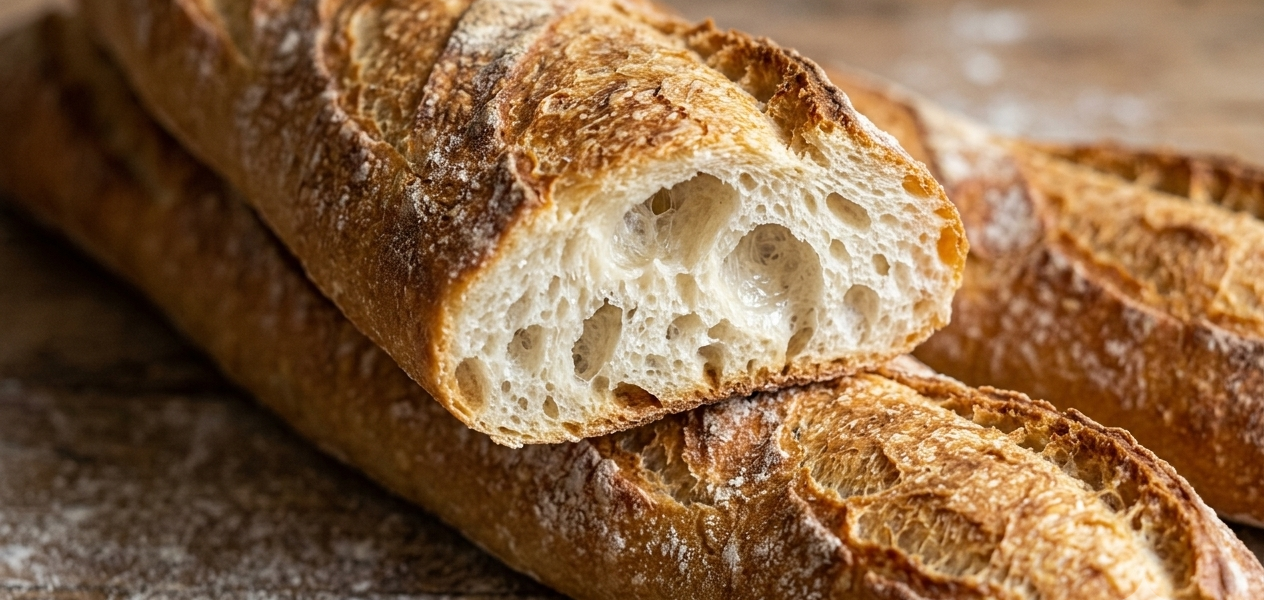
Pan de barra is the bread you actually eat in Spain. Not the tourist-photo baguette, the loaf under the counter at every neighborhood panadería, sliced open for a bocadillo or torn apart next to a plate of jamón. It’s shorter and thicker than a French baguette, with a crust built to hold up and a crumb built to hold fillings.
The flavor starts the night before with a biga, a small, stiff pre-ferment that sits on the counter for 12 to 16 hours before it ever meets the rest of the flour. It’s a different move than our no-knead baguette, which lets one loose, wet dough ferment overnight start to finish. Here, the biga develops real wheat flavor on its own, then gets kneaded into a fresh dough the next day, so you keep full control over the final shape and crumb.
What You’re Learning
Why a biga instead of a straight overnight dough. A biga is a small, stiff mix of flour, water, and a trace of yeast, fermented on its own before it’s ever kneaded into the final dough. It builds the same deep, slightly tangy wheat flavor as a long overnight ferment, but because you mix a fresh dough around it the next day, you still get to knead, fold, and shape with full control. An all-in-one overnight dough like the baguette’s trades that control for simplicity. A biga keeps both the flavor and the structure.
Why the shape and the scoring are deeper than a baguette’s. Barra is shaped shorter and noticeably thicker than a French baguette on purpose. A bocadillo needs a crumb sturdy enough to hold cured meat, cheese, or a fried egg without collapsing or turning soggy, which a thin, airy baguette crumb can’t do. The thicker shape needs a longer bake to cook all the way through, and a deeper score, about ½ inch instead of a baguette’s shallow slash, so the crust has room to open properly instead of tearing.
Ingredients
Makes 2 loaves.
- 1 cup (125g) bread flour, for the biga
- ½ cup (120ml) cool water, for the biga
- ¼ tsp instant yeast, for the biga
- 2½ cups (315g) bread flour, for the dough
- 1 cup (240ml) water, room temperature
- 2 tsp fine salt
- ½ tsp instant yeast
- 1 tbsp olive oil
Method
- Make the biga (the night before). In a medium bowl, mix 1 cup bread flour, ½ cup cool water, and ¼ tsp yeast into a stiff, shaggy paste. Cover and leave at room temperature 12 to 16 hours, until domed and bubbly.
- Mix the dough. The next day, tear the biga into a few pieces in a large bowl. Add the remaining 2½ cups flour, 1 cup water, salt, ½ tsp yeast, and olive oil. Mix until a rough, sticky dough forms.
- Knead. Turn out onto a lightly floured surface and knead 8 to 10 minutes, until smooth and elastic. Resist adding much extra flour, a slightly sticky dough shapes better than a dry one.
- Bulk ferment with folds. Place the dough in an oiled bowl, cover, and let rise 2 hours at room temperature. At the 30 and 60 minute marks, stretch and fold the dough over itself a few times, then re-cover.
- Divide and shape. Turn the dough out and divide into 2 equal pieces. Shape each into a short, wide log, about 12 inches long and noticeably thicker than a baguette.
- Proof. Place the loaves seam-side down on a floured couche or parchment-lined baking sheet. Cover loosely and proof 45 to 60 minutes, until visibly puffy.
- Preheat with a steam setup. About 30 minutes before baking, preheat the oven to 475°F (245°C) with a baking stone or steel on the middle rack and an empty metal pan on the lowest rack.
- Score. Just before baking, make 3 to 4 diagonal slashes in each loaf, about ½ inch deep, deeper than a baguette’s shallow scoring.
- Bake with steam. Slide the loaves onto the hot stone. Immediately pour 1 cup hot water into the pan on the lower rack to create steam. Bake 25 to 30 minutes, until deep golden and hollow-sounding when tapped on the bottom.
- Cool. Cool on a wire rack at least 20 minutes before slicing.
Notes
- The biga can go the full 16 hours if that fits your schedule better, more time means more flavor, the same logic as the baguette’s overnight rest.
- If the dough feels too sticky while shaping, wet your hands instead of flouring the counter heavily, it handles better and keeps the crumb open.
- No baking stone? Bake on a preheated heavy sheet pan instead. The bottom crust won’t be quite as crisp, but the loaf still turns out well.
- This is the everyday bread of Spain, the loaf behind bocadillos, pan con tomate, and tostas. Like any lean-dough bread, it’s best the day it’s baked.
- Freezes well after baking. Wrap tightly once fully cooled, then thaw and re-crisp in a hot oven for 5 minutes.
- Slice thick for bocadillos, the whole point of barra’s fatter shape is a crumb that can hold a real filling.