Walk into most American grocery stores and “chorizo,” “prosciutto,” and “salami” get treated as a handful of interchangeable cured-meat words, mixed and matched across countries like it doesn’t matter. It matters. Spanish chorizo and Mexican chorizo aren’t the same product with a different accent, they’re built differently from the ground up, one cured and ready to eat, the other raw and meant for the pan. Jamón and prosciutto come from different pigs raised on different diets for different lengths of time, and the difference shows up on the plate. None of this is trivia. It’s the difference between buying what a recipe actually calls for and buying whatever’s closest on the shelf.
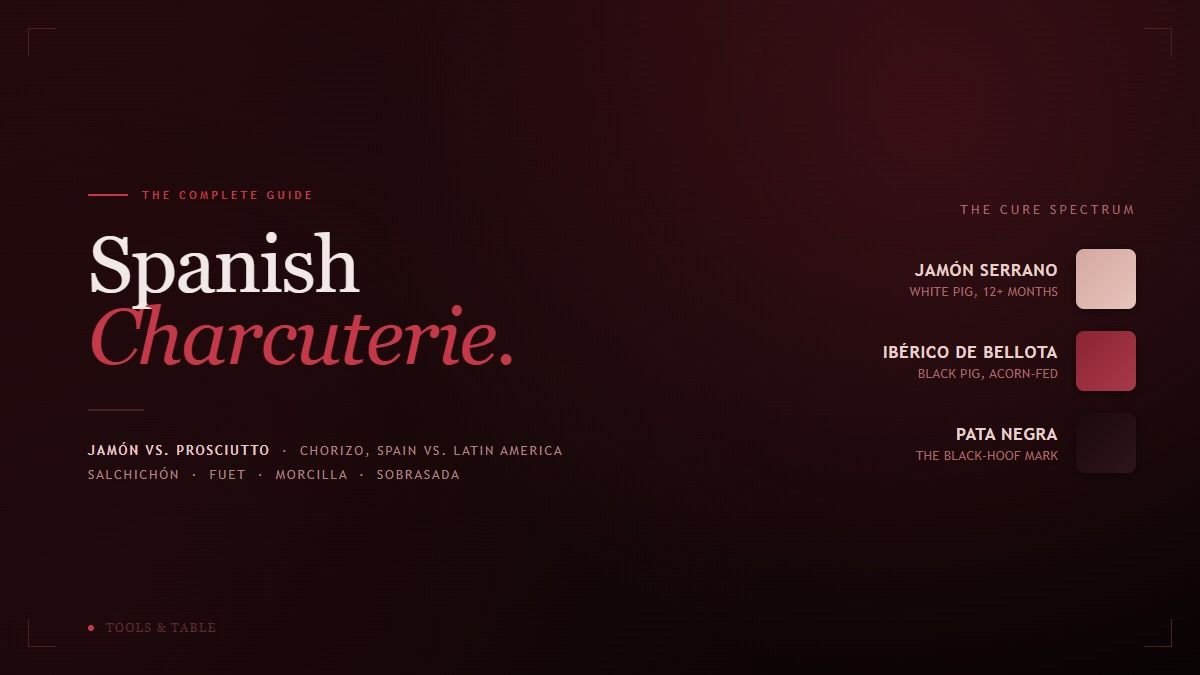
This guide covers the three places Spanish charcuterie gets confused with something else: jamón against its Italian and American cousins, chorizo against its Mexican and South American namesakes, and the smaller cured sausages, salchichón, fuet, morcilla, sobrasada, that rarely get explained at all. It ends with the label system that actually tells you what you’re buying, because “pata negra” on its own promises less than most people think.
Jamón vs. Prosciutto, Speck, and Country Ham
Three products get flattened into “Spanish ham” by people who haven’t compared them side by side: jamón, prosciutto, and speck all start the same way, a pig’s hind leg (or, for speck, a boned-out version of one), rubbed with salt and hung to dry. What separates them is the pig, the diet, the climate, and, for one of them, smoke.
| Ham | Origin | Pig / Diet | Cure Time | Smoked? |
|---|---|---|---|---|
| Jamón Serrano | Spain | White pig breeds, standard feed | 12+ months | No |
| Jamón Ibérico | Spain | Iberian black pig; top grade is acorn-fed (de bellota) in oak woodland | 24–48 months | No |
| Prosciutto di Parma / San Daniele | Italy | Large White, Landrace & Duroc, grain and whey-fed | 12–24 months | No |
| Speck | Alto Adige, Italy | Same commercial breeds as prosciutto, but boned out first | ~5 months, plus smoking | Yes — cold-smoked, then aged |
| Country Ham | United States (Virginia, Kentucky, Tennessee) | Commercial breeds | Varies, often shorter | Often, and usually saltier |
The breed is what actually separates jamón serrano from jamón ibérico, not just the region. Serrano comes from white commercial pig breeds, the same general family used for most European ham. Ibérico comes from the native Iberian black pig, and the top grade, de bellota, spends its final months roaming Spain’s oak woodlands (the dehesa) eating acorns almost exclusively. Acorn fat is high in oleic acid, the same fat that makes olive oil what it is, and it’s why real ibérico de bellota has a glossy, almost translucent marbling and a nutty flavor no grain-fed ham reaches. Prosciutto’s pigs are typically grain and whey-fed commercial breeds, which is part of why it reads sweeter and milder than jamón even before you account for Parma’s shorter, more controlled cure.
Speck is the odd one out on this list because it’s smoked, and jamón and prosciutto never are. It comes from Alto Adige, the German-speaking corner of northern Italy near the Austrian border, where the tradition leans Central European rather than Mediterranean: the leg is boned out first, rubbed with juniper, bay, and other spices, cold-smoked, then aged a few months, a fraction of jamón ibérico’s cure time, because the smoke is doing flavor work the long air-cure otherwise handles alone.
American country ham descends from the same salt-curing tradition European settlers brought over, but it’s built for a different result. It’s typically cured faster and saltier, often smoked, and traditionally meant to be soaked and cooked before serving rather than sliced paper-thin and eaten raw the way jamón and prosciutto are. A few modern American producers now age country ham long enough to eat it raw, but that’s the exception, not the rule your grandmother’s ham followed.
Chorizo Is Three Different Sausages
Nothing on this list causes more confusion at the grocery store than “chorizo.” Spain, Mexico, and South America all make something called chorizo, all from pork, and the three products barely resemble each other beyond that. The trap is assuming “cured vs. raw” is the dividing line, Spain makes both. The real constant is pimentón: every Spanish chorizo, cured or fresh, is built around Spanish paprika. Take that away and it isn’t Spanish chorizo anymore, no matter how it’s cured.
| Spanish Chorizo | Mexican Chorizo | South American Chorizo | |
|---|---|---|---|
| State | Both: cured (curado, ready to eat) and fresh (fresco, must be cooked) | Raw, must be cooked | Raw, must be cooked |
| Defining flavor | Pimentón (smoked or sweet Spanish paprika), in both forms | Dried chiles (ancho, guajillo) and vinegar | Garlic and herbs, mild |
| Color | Deep red, from pimentón | Deep red-orange, from chiles | Pale, not red |
| Texture | Cured: firm, sliceable, like salami. Fresh: soft, like any raw link sausage | Loose and crumbly once cooked | Coarse-ground link, like a grilling sausage |
| How it’s used | Cured: sliced cold as a tapa. Fresh: grilled, pan-fried, or simmered into stews like fabada asturiana | Squeezed from its casing and browned loose, for tacos or eggs | Grilled whole, classically in choripán |
Spanish chorizo actually comes in two forms, and pimentón, sweet (dulce) or hot (picante), sometimes smoked (ahumado) is what makes both of them Spanish chorizo, not an optional seasoning. Chorizo curado is fully cured and dried, safe to eat sliced cold straight from the counter, the same way you’d eat salami, and it’s the form most familiar outside Spain. Chorizo fresco is the same pimentón-forward seasoning on raw, uncured pork, sold to be grilled, pan-fried, or simmered into a stew, exactly the way fresh chorizo is central to dishes like fabada asturiana, a bean stew from Asturias, our own Patatas a la Riojana, or crumbled into our own Croquetas de Cocido Madrileño, or made completely from scratch with our own Homemade Chorizo Fresco recipe. Both forms exist and both are authentically Spanish, the difference is cure time, not authenticity.
Mexican chorizo is a completely different category of product: always fresh, raw ground pork seasoned with dried chiles and vinegar instead of pimentón, sold in a casing but meant to be squeezed out and browned in a pan, never sliced cold. Pimentón is what actually marks a chorizo as Spanish, cured or not, so a raw chorizo seasoned with ancho and guajillo chiles is Mexican chorizo no matter how similar the two look raw in the case. If a recipe calls for Spanish chorizo and only Mexican chorizo is on the shelf, check which form the recipe actually needs, curado can be eaten as-is, fresco needs to be cooked, but neither one is the chile-forward Mexican product.
South American chorizo (Argentina, Uruguay, Colombia, and neighboring countries) is a third thing again: a fresh, coarse-ground grilling sausage, closer in spirit to an Italian sausage or bratwurst than to either Spanish or Mexican chorizo. It’s seasoned with garlic and herbs rather than chiles or paprika, so it stays pale rather than red, and it’s built to be grilled whole over live fire, most famously split into choripán, Argentina’s chorizo sandwich.
Beyond Chorizo: Spain’s Other Cured Sausages
Chorizo gets all the attention, but it’s one entry in a much longer Spanish charcuterie tradition. These rarely get explained in English at all, and most have no exact American equivalent.
| Sausage | What It Is | Closest Comparison |
|---|---|---|
| Salchichón | Dry-cured pork sausage seasoned with black pepper, not paprika, so it stays pale pinkish-grey instead of chorizo’s red | Salami, though the seasoning is peppercorn-first rather than fennel or garlic |
| Fuet | Thin, Catalan dry-cured sausage that develops a white mold rind during curing, a feature of the process, not a flaw; milder and more delicate than chorizo or salchichón | A thin, mild salami; often eaten in rounds as a tapa |
| Morcilla | Blood sausage, cooked before eating rather than sliced raw; Morcilla de Burgos includes rice and onion, other regional versions skip the rice | Black pudding or boudin noir, though the rice-based Burgos style is distinctly its own |
| Sobrasada | Soft, spreadable cured sausage from Mallorca, extremely high pimentón content, almost pâté-like texture, traditionally spread on bread | ‘Nduja, the spreadable Calabrian sausage — the closest real match on either list |
| Lomo Embuchado | Cured, whole-muscle pork loin rubbed with pimentón and garlic, not ground or a sausage at all, but cured and sliced the same way as the rest | Capicola, another cured whole-muscle cut rather than a ground sausage |
The pattern worth remembering: paprika is what turns a Spanish cured sausage red (chorizo, sobrasada), and its absence is what keeps salchichón and fuet pale. That one detail, red or not, is often the fastest way to tell two similar-looking cured sausages apart at a deli counter.
Morcilla: Spain’s Blood Sausage
Morcilla breaks the pattern every other sausage on this list follows. Chorizo, salchichón, fuet, sobrasada are all built on pork meat and fat, cured or fresh, and the cured ones are meant to be sliced and eaten cold, straight from the counter. Morcilla is built on pork blood, thickened with fat and, depending on the region, rice or onion, and it’s already fully cooked (usually boiled) during production. It’s never sliced cold as a tapa the way chorizo curado or salchichón are, it goes back onto heat before it’s eaten, which makes it closer in spirit to a French boudin noir or British black pudding than to anything else in Spanish charcuterie.
The regional variation is bigger than most people expect, and rice is the dividing line. Morcilla de Burgos, the version most commonly exported and the one most Americans have actually encountered, is built around rice, onion, and pork fat, giving it a soft, almost creamy interior once cooked and a mild flavor from the rice diluting the blood. Morcilla de León goes the opposite direction: no rice at all, just onion and a higher proportion of blood, producing a denser, more intensely flavored sausage. Asturian morcilla skips rice too and leans smokier, since it’s traditionally smoked over wood, and it’s the version built specifically to be simmered for hours in fabada asturiana, the bean stew it’s named for, rather than pan-fried on its own. The Canary Islands make a completely different morcilla dulce, sweetened with raisins, almonds, and sometimes cinnamon or sugar, meant to be eaten more like a dessert sausage than a savory one.
| Style | Region | Defining Feature | How It’s Used |
|---|---|---|---|
| Morcilla de Burgos | Burgos, Castile | Rice + onion, soft interior, most widely exported | Sliced into rounds, pan-fried until the casing crisps |
| Morcilla de León | León, Castile | No rice; more onion and blood, denser and more intense | Pan-fried or grilled in thick slices |
| Asturian Morcilla | Asturias | No rice; wood-smoked | Simmered for hours in fabada asturiana |
| Morcilla Dulce | Canary Islands | Sweetened with raisins, almonds, sometimes cinnamon | Eaten more like a sweet snack than a savory sausage |
Because it’s already cooked at the point of sale, home cooking morcilla is really about texture, not food safety, the interior is safe cold, the point of heat is to crisp the casing and warm it through. The most common preparation is thick rounds pan-fried in a dry skillet until the outside crackles, served on its own or with a fried egg the way it often appears as a tapa. It also shows up crumbled into croquetas, folded into rice dishes, or, in its Asturian form, simmered whole into stews, the same slow-cooked role chorizo fresco plays in dishes like our own Croquetas de Cocido Madrileño, though morcilla brings an earthier, iron-forward flavor no chorizo replicates.
How to Buy the Real Thing
“Pata negra,” black hoof, is the phrase most Americans have actually heard, since purebred Iberian pigs typically do have black hooves. It’s a real, useful visual cue, but it isn’t a legal guarantee on its own, some crossbred Ibérico pigs show black hooves too. Spain’s actual regulated system is a set of four color-coded seals, tied to breed purity and diet, and it’s the label that tells you what you’re really buying:
| Seal Color | What It Means |
|---|---|
| Black | Jamón Ibérico de Bellota, 100% Ibérico breed, acorn-fed — the top tier |
| Red | Jamón Ibérico de Bellota, at least 50% Ibérico breed, acorn-fed |
| Green | Ibérico de Cebo de Campo — pasture-raised on a mixed grass-and-feed diet |
| White | Ibérico de Cebo — raised on compound feed, no acorn diet |
For prosciutto and speck, look for the DOP (Denominazione di Origine Protetta) seal, Parma and San Daniele are both protected names with rules about pig breed, region, and, for Parma, a salt-only cure with no other seasoning permitted. For Spanish products beyond jamón, a Denominación de Origen label (Guijuelo and Jabugo are the two best-known jamón DOs) is the same kind of guarantee: it means the product was actually made where and how it claims to be, not just labeled to sound like it was.
Common Mix-Ups
- Buying Mexican chorizo for a Spanish recipe. Pimentón vs. chiles is the real tell, not cured vs. raw, Spain has a raw chorizo fresco too. Check the seasoning, not just whether it needs cooking.
- Assuming “pata negra” alone proves authenticity. It’s a real, informal marker, but the black/red/green/white seal system is the actual regulated standard behind it.
- Calling salchichón “Spanish salami.” Close in spirit, but salchichón’s signature is black pepper, not the fennel or garlic that defines most Italian salami.
- Adding chorizo to paella. Traditional Valencian paella never includes it, chorizo’s smoky pimentón overpowers the saffron and rice; see our Paella Valenciana recipe for what actually goes in.
- Treating jamón and prosciutto as interchangeable. Different pig breeds, different diets, different cure times, and it shows up directly in flavor, jamón ibérico’s nuttiness comes specifically from an acorn diet no grain-fed prosciutto pig eats.
- Expecting sobrasada to slice like other cured sausage. It’s meant to be spread, not sliced, its soft texture is by design, not a sign it’s underdone.
For the Spanish pantry staples that pair with all of this, jamón serrano, Spanish chorizo, saffron, sherry vinegar, see the Spanish & Latin Pantry section of our Ingredient Substitutions guide, or browse the full Spanish Cuisine collection for recipes built around them.