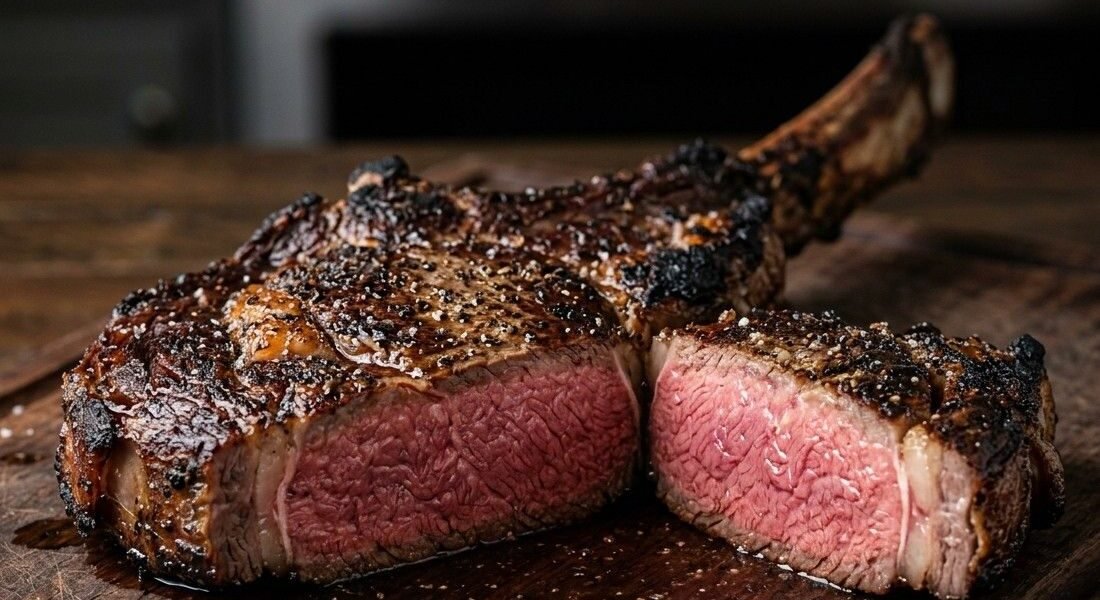
Reverse searing flips the usual order. Instead of starting in a screaming-hot pan and hoping the middle catches up before the outside burns, the steak goes into a low oven first, then gets a hard sear at the very end. The result is a steak that’s an even rosy pink from edge to edge, with a deep, dry crust on the outside and no gray band of overcooked meat sitting between the crust and the center.
What You’re Learning
Why the gray band happens, and how this avoids it. Sear a thick steak straight in a hot pan and heat has to travel from the crust all the way to the center — by the time the middle hits medium-rare, a wide ring just under the crust has overshot into gray, dry, well-done territory. Roasting low first (275°F) brings the whole steak up to temperature gently and evenly, so the final sear only has to build a crust in a minute or two — it’s not doing the job of cooking the interior anymore. This only pays off on a genuinely thick cut; see How to Cook Steak: The Complete Method Guide for why thickness, not weight, is what determines cook time and method here.
Pull it before it’s done — on purpose. A resting steak keeps cooking from its own residual heat, a real effect called carryover cooking (see the Cooking Glossary). Between the oven rest and the sear, this steak gains another 10–15°F after it leaves direct heat. Pull the oven phase at 115–120°F internal for a final medium-rare around 130–135°F — pulling at your actual target temperature guarantees an overcooked steak by the time it’s rested and seared.
Ingredients
- 2 bone-in or boneless ribeye steaks, 1½–2 inches thick (14–16 oz each)
- Kosher salt
- Coarse black pepper
- 1 tbsp neutral oil (avocado or grapeseed)
- 2 tbsp unsalted butter
- 2 cloves garlic, smashed
- 2–3 sprigs fresh thyme or rosemary
Method
- Salt ahead. Salt both steaks generously and set them uncovered on a rack in the fridge at least 45 minutes before cooking, up to overnight. This is a real dry-brine, the same idea covered in Brining & Marinating and Salt Is a Conversation, Not an Afterthought — it seasons past the surface and dries the exterior for a better crust later.
- Set up the oven. Preheat the oven to 275°F. Set a wire rack inside a rimmed sheet pan and place the steaks on it — air needs to move under the meat, not just around it.
- Slow-roast to temperature. Roast until a wireless probe thermometer reads 115–120°F at the thickest part, about 40–50 minutes depending on thickness. Check early the first time you do this; oven-to-oven variation is real.
- Rest briefly. Pull the steaks and let them sit 10 minutes while the skillet heats. They’ll drop a little in temperature before the sear brings the surface back up hard and fast.
- Get the skillet screaming hot. Heat a cast iron skillet over high heat until it’s just short of smoking, then add the oil.
- Sear hard. Sear the steaks 60–90 seconds per side, turning with tongs, until deeply browned. Stand them on their fat edge for 30–45 seconds too, if there’s a fat cap.
- Baste with butter. Drop in the butter, garlic, and thyme. Tilt the pan and spoon the foaming butter over the steaks for the last 30–45 seconds of the sear.
- Rest again, then slice. Move the steaks to a cutting board and rest 5 minutes before slicing against the grain. This second rest is short on purpose — most of the resting already happened in step 4.
Notes
- This only makes sense on a thick steak. Under 1¼ inches, there’s no meaningful gray band to prevent — just pan-sear it straight through instead, the same as the thinner cuts in the Steak guide.
- Bone-in vs. boneless: the bone slows heat slightly right around it and adds flavor during the roast, but doesn’t change the method. Use whichever your butcher has.
- No probe thermometer? An instant-read spot-check every 10 minutes after the 30-minute mark works, but you’ll open the oven repeatedly and lose some of the gentle, even heating that’s the whole point here.
- Doneness targets (post-rest, post-sear) run the same as the site’s general steak numbers — see the doneness table in How to Cook Steak for rare through well-done, not just the medium-rare pull used above.
- Ribeye specifically because its fat marbling renders well over the long, gentle roast — see Meat Cuts & Cooking Methods for how it compares to leaner cuts that don’t reverse-sear as well.
- Don’t skip the rest in step 4. Searing a steak straight out of a 115°F oven, with no pause, tightens the crust-building window and makes it easier to overshoot into gray again — the whole point of the method.