
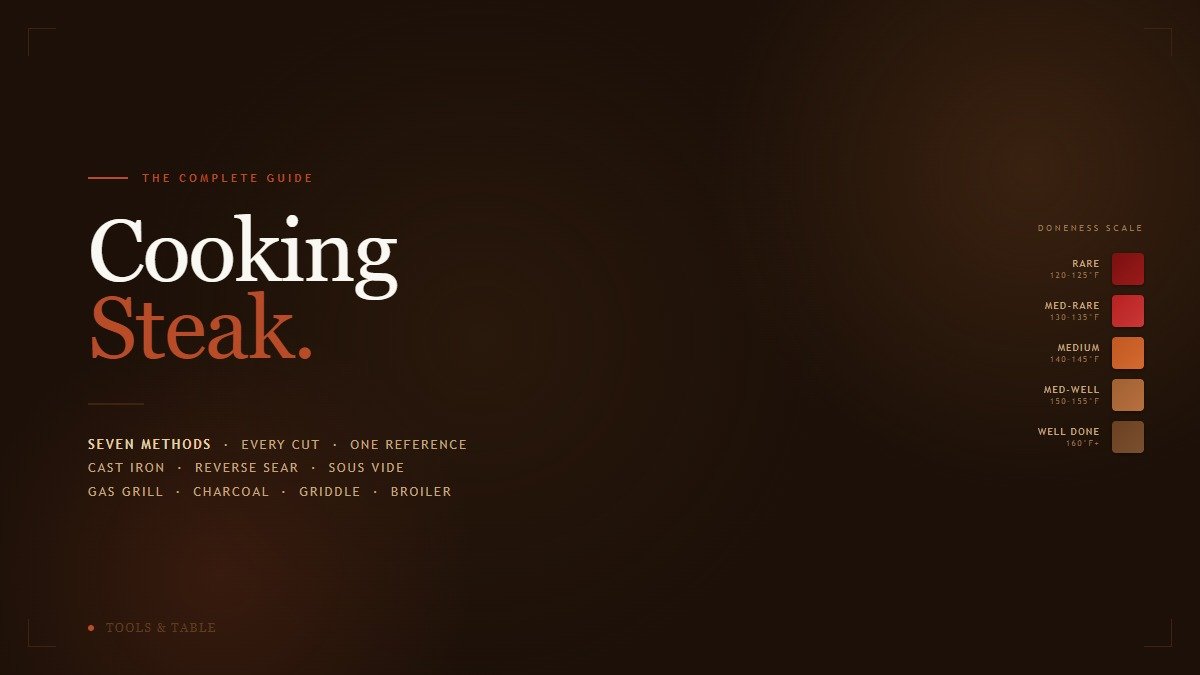
A proper steak is one of the most satisfying things you can cook — and one of the easiest to get wrong until you understand exactly why each step matters.
The variables that govern a good steak are the same regardless of method: cut selection, surface preparation, heat management, and rest. Every method in this guide applies those four things differently. Some are better for precision, some for crust, some for convenience. The right method depends on what equipment you have, what cut you’re using, and what result you’re after. This guide covers all of them.
Choosing Your Cut
The cut determines almost everything about how you should cook a steak. The wrong method for the wrong cut produces a result that no technique can rescue. For a deeper look at how each cut is butchered and where it comes from, see our Meat Cuts & Cooking Methods guide.
Two variables drive the decision: fat distribution and muscle fiber structure. Well-marbled cuts (ribeye, NY strip) have intramuscular fat that lubricates the muscle as it cooks, making them forgiving of aggressive heat and slight overcooking. Lean, tender cuts (filet mignon) have no fat buffer and dry out fast — they need gentle, precise methods. Thin, tough cuts (skirt, flank, hanger) have intense flavor but require either very high, very fast heat to stay rare throughout, or marination to tenderize — and they must be sliced against the grain to be chewable.
| Cut | Fat | Tenderness | Best Methods |
|---|---|---|---|
| Ribeye | High | High | All methods; especially grill, cast iron, reverse sear |
| NY Strip | Medium-high | High | All methods |
| T-bone / Porterhouse | Medium | High | Charcoal grill, gas grill |
| Filet Mignon | Very low | Very high | Sous vide, reverse sear, cast iron |
| Sirloin | Low-medium | Medium | Cast iron, gas grill, griddle |
| Hanger | Medium | Medium-low | Cast iron, charcoal, griddle |
| Flank / Skirt | Low-medium | Low | Griddle, grill (fast/hot), broiler |
Universal Prep — Before You Cook Anything
These four rules apply regardless of which method follows. Skipping any of them limits what’s possible.
1. Dry Brine
Salt your steak generously on all sides at least 45 minutes before cooking — ideally 1 to 24 hours ahead, uncovered in the fridge. Salt initially draws moisture to the surface, which dissolves it; that salty liquid is then reabsorbed, seasoning the meat throughout. The surface also dries out in the fridge, which is exactly what you want for crust formation. Do not salt 5 to 40 minutes before cooking — in that window the surface is wet but the salt hasn’t reabsorbed, and you get steam instead of crust. For more on why timing matters this much, read Salt Is a Conversation, Not an Afterthought.
2. Room Temperature
Take the steak out of the fridge 30 to 45 minutes before cooking. This matters more for thick cuts (over 1 inch) than thin ones. A cold interior creates a steep temperature gradient — the surface overcooks before the center reaches temperature. Tempering doesn’t fully close that gap, but it narrows it meaningfully.
3. Pat Dry
Right before cooking, pat every surface dry with paper towels. Surface moisture turns to steam on contact with the pan or grill and prevents crust formation. Even a dry-brined steak that’s been in the fridge overnight benefits from a final pat immediately before it hits the heat.
4. Use a Thermometer
Every experienced cook still uses one. The palm test and timing charts are unreliable because steak thickness and starting temperature vary too much. A good instant-read thermometer — the single most valuable tool for steak — costs $25 to $30 and eliminates the guesswork entirely. Pull temperatures in this guide are 5°F below the final target to account for carryover cooking during rest.
Doneness Reference
Pull temperature is measured at the thickest part, away from bone and fat. Pull 5°F below the final target — carryover cooking during rest closes the gap.
| Doneness | Pull Temp | Final Temp | Center Appearance |
|---|---|---|---|
| Blue / Rare | 110°F / 43°C | 115–120°F / 46–49°C | Cold, deep red throughout |
| Rare | 120°F / 49°C | 125°F / 52°C | Cold red center |
| Medium-Rare | 125–130°F / 52–54°C | 130–135°F / 54–57°C | Warm red center — the sweet spot for most cuts |
| Medium | 135°F / 57°C | 140–145°F / 60–63°C | Warm pink center |
| Medium-Well | 145°F / 63°C | 150–155°F / 65–68°C | Slight pink |
| Well Done | 155°F+ / 68°C+ | 160°F+ / 71°C+ | No pink throughout |
Above 140°F (medium), muscle proteins begin squeezing out moisture aggressively. A well-done ribeye is safe to eat and structurally intact — but the marbling you paid for no longer matters. For most premium cuts, medium-rare is the target. For lean cuts like filet, medium keeps texture without the dryness risk of well-done.
Method 1: Cast Iron Skillet
Best for: Ribeye, NY strip, sirloin, filet mignon. The most reliable indoor method, year-round.
Cast iron holds heat better than any other common pan and produces a crust that’s difficult to match any other way. The Maillard reaction — the browning that creates crust flavor — requires a surface temperature of around 300–350°F (149–177°C). Cast iron gets there and stays there even when cold meat hits it. Stainless can work in a pinch; non-stick cannot.
What You Need
A 10–12 inch cast iron skillet. High-smoke-point oil (avocado, grapeseed, or refined vegetable — not olive oil). A thermometer. Optional but excellent: unsalted butter, smashed garlic cloves, fresh thyme or rosemary.
Steps
- Heat the dry cast iron skillet over high heat for 4 to 5 minutes until it begins to smoke lightly. This is hotter than most people are comfortable with. It needs to be this hot.
- Add 1 tablespoon of high-smoke-point oil and let it heat for 30 seconds until it shimmers.
- Add the steak. Do not move it. Cook for 2 to 3 minutes per side for a 1-inch steak targeting medium-rare — but read the thermometer, not the clock.
- Once both sides are seared, hold the steak upright on its edge with tongs to render the fat cap if there is one. 30 to 60 seconds.
- Baste (optional but worth it): Reduce to medium heat. Add 2 tablespoons of butter, 2 smashed garlic cloves, and a sprig of thyme or rosemary. Once the butter foams, tilt the pan and spoon the hot butter continuously over the steak for 60 to 90 seconds. This adds flavour and aromatic depth without significantly raising internal temperature.
- Pull at 5°F below your target. Rest on a wire rack, not a cutting board.
For steaks over 1 inch thick: After searing both sides, transfer the pan to a 400°F (205°C) oven to finish. This allows heat to penetrate evenly without burning the crust. Pull when the thermometer reads target minus 5°F.
The grey band problem: Cast iron produces a ring of overcooked grey meat just under the crust on thick steaks. This happens because the searing phase is so aggressive that it drives heat deep into the outer layers before the interior catches up. The reverse sear method below eliminates this entirely.
Method 2: Reverse Sear
Best for: Thick steaks (1.5 inches or more). Filet mignon. Any cut where edge-to-edge doneness matters.
Reverse sear is the best method for thick steaks, full stop. Instead of searing first and finishing in a hot oven, you reverse the order: bring the steak up to temperature slowly in a low oven (225–250°F / 107–121°C), then sear in a ripping-hot cast iron at the very end.
The advantage is a near-zero grey band. At 225°F, heat moves slowly and evenly through the meat — there’s no steep temperature gradient between crust and center. You end up with edge-to-edge pink right to the crust, rather than a thick grey ring around a small perfect center. The slow oven phase also dries the surface further, which makes the final sear faster and the crust more intense.
Steps
- Season and dry-brine as usual. The overnight fridge step is ideal here — you want the surface very dry for the final sear.
- Place the steak on a wire rack set over a sheet pan. Cook in a 225–250°F oven until the internal temperature reads 10°F below your target — typically 120–125°F for medium-rare. This takes 25 to 55 minutes depending on thickness.
- Rest the steak on the rack for 10 minutes while you heat the cast iron to maximum heat. This brief rest firms up the surface further.
- Sear for 60 to 90 seconds per side — just enough to build the crust, since the interior is already done. Add butter and aromatics for the last 30 seconds.
- Serve immediately. No second rest needed — the slow oven phase already allowed the meat to equalize.
Timing in the oven varies by thickness and oven accuracy. A 1.5-inch ribeye typically takes 25 to 35 minutes; a 2-inch porterhouse 45 to 55 minutes. Use the thermometer, not the clock.
Method 3: Sous Vide + Sear
Best for: Filet mignon, leaner cuts, cooking for a crowd, exact-doneness control.
Sous vide holds the steak at a precise temperature for as long as you need — the steak cannot overcook as long as it remains in the water bath. It’s the right method when you need multiple steaks done identically, when you’re cooking for someone who needs exact doneness, or when you’re working with an expensive lean cut that punishes imprecision.
Temperature and Time
| Doneness | Water Bath Temp | Time Range |
|---|---|---|
| Rare | 120°F / 49°C | 1–2.5 hours |
| Medium-Rare | 130°F / 54°C | 1–4 hours |
| Medium | 140°F / 60°C | 1–4 hours |
| Medium-Well | 150°F / 66°C | 1–3.5 hours |
Beyond 4 hours, the texture softens and becomes uniformly yielding in a way that some find unpleasant. 1 to 2 hours produces the most conventional steak texture.
Steps
- Season the steak with salt and pepper. Seal in a zip-lock bag using the water displacement method, or vacuum-seal if you have the equipment. Cook in the water bath at the target temperature for the specified time.
- Remove from the bag and pat thoroughly dry with paper towels — then pat dry again. The surface must be completely dry for a good sear. Even a small amount of moisture creates steam and prevents crust.
- Sear immediately in a smoking-hot cast iron skillet for 45 to 60 seconds per side. The interior is already at temperature; you’re only building crust, so the window is very tight. Work fast.
- Optional: finish with a butane torch for better surface coverage on irregular shapes, or for cuts like T-bone where the pan can’t make full contact.
The limitation of sous vide is that the crust is always somewhat thinner compared to a direct-sear method. Moisture released during the water bath affects the surface even after drying. For maximum crust, cook sous vide at a temperature slightly below your target (e.g., 125°F for medium-rare) and sear more aggressively.
Method 4: Gas Grill
Best for: Ribeye, NY strip, T-bone, sirloin. The most convenient outdoor method.
A gas grill produces excellent results with a proper two-zone setup: high heat on one side for searing, lower heat on the other for gentle finishing. This mirrors the reverse sear principle — aggressive heat builds the crust, lower heat finishes the interior without overcooking the exterior.
Setup
- Preheat all burners on high for 10 to 15 minutes with the lid closed. Grates should reach 500–550°F (260–290°C).
- Turn one side down to medium-low or off. This is your indirect zone.
- Clean the grates with a stiff brush while hot.
- Oil the steak (not the grates — excess oil on grates flares up). Pat the steak with a very thin coat of high-smoke-point oil just before it goes on.
Steps
- Sear over the high-heat zone for 2 to 3 minutes per side, lid open. You want strong grill marks and a formed crust before moving.
- Move to the indirect zone and close the lid. The grill acts as an oven. Continue cooking until the internal temperature reaches your target minus 5°F.
- Rest off the grill — not on it. Do not tent with foil: this creates steam and softens the crust.
Lid open or closed? Open when directly over the flame for more control and less flare-up. Closed when on the indirect side so the grill acts as an oven.
Flare-ups happen when fat drips onto open flames — unavoidable with well-marbled cuts. Move the steak temporarily to the indirect zone, let the fire die down, return. Don’t spray with water.
Add Wood Smoke for More Flavor
Gas grills don’t produce smoke on their own, but you can add it with wood chips. Mesquite is bold and fast-burning — good for a short, high-heat sear. Apple and cherry are milder and slightly sweet, pairing well with beef without overwhelming it. Pecan sits in the middle: nutty, moderate, and forgiving.
Two approaches:
- Chip smoker box: A small cast iron or stainless box that sits directly on the burner, under the grates. Fill it with dry or soaked chips, preheat until it starts smoking, then add the steak. Available at most hardware stores for under $15. Reusable indefinitely.
- Foil packet: Place a generous handful of chips in the center of a double layer of heavy-duty foil. Fold into a flat packet and poke 6 to 8 small holes in the top with a skewer or knife. Set it directly on a burner, under the grates, during preheat. It starts smoking within a few minutes. Disposable — use a fresh packet each cook.
Either method works best when the grill is fully preheated and the chips are already smoking before the steak goes on. For a steak that only spends 6 to 8 minutes on the grill, you want the smoke established from the first second.
Method 5: Charcoal Grill
Best for: Ribeye, T-bone, NY strip. When you want maximum crust and smoke.
A charcoal grill reaches higher temperatures than most gas grills and adds a smoke character that no other method replicates. The trade-off is setup time and less precise heat control. The technique is the same as gas (two-zone), but you manage the charcoal arrangement rather than a dial.
Two-Zone Charcoal Setup
- Use a chimney starter — no lighter fluid. Fill the chimney, light from below with newspaper or a fire starter, and wait 15 to 20 minutes until the coals are glowing orange with grey ash on the edges.
- Pour the lit coals to one side only. This creates your hot zone (direct heat) and cool zone (indirect heat).
- Replace the grates and let them preheat for 5 minutes before anything goes on.
Temperature Control
- More coals = more heat. Add unlit coals to increase output for a long cook.
- Open bottom vents = more oxygen = higher temperature. Fully open for searing, partially close to moderate during indirect phase.
- The grill reaches 700–800°F (370–425°C) directly over the coals — significantly hotter than most gas grills. Use this to your advantage for rapid crust formation.
Steps
Same as gas grill: sear directly over the coals for 2 to 3 minutes per side, move to the indirect zone, close the lid, finish to temperature, rest off the grill.
Wood for smoke: For additional smoke flavor, place one or two chunks (not chips) of hardwood — oak, hickory, or cherry — directly on the coals before adding the steak. Chunks smolder rather than flare, producing clean, consistent smoke.
Method 6: Outdoor Griddle
Best for: Skirt steak, hanger, sirloin, thinner cuts. High-volume cooking. When you want dense, uniform crust without the grill marks.
A flat-top outdoor griddle (Blackstone, Camp Chef, etc.) runs very hot and uniform across the entire surface. It lacks the charring and smoke of a grill, but the contact between flat steel and steak produces a Maillard crust that rivals cast iron — with more space, easier basting, and the ability to cook multiple steaks or sides at the same time.
Steps
- Preheat the center zone on high for 10 minutes. Add a thin coat of oil to the surface — just enough to coat, wiped evenly with a paper towel held with tongs. The surface temperature should be 550–600°F.
- Lay the steak flat. Press firmly once with a spatula to maximize contact with the steel. Do not move it after pressing.
- Cook for 2 to 3 minutes per side for a 1-inch steak. Watch the edge of the steak — the grey ring of cooked meat should travel about halfway up the side before flipping.
- Add a knob of butter and aromatics directly to the griddle surface and baste during the second side.
- Pull at target temp minus 5°F.
For thin cuts (skirt, flank): Cut into portion sizes and cook on maximum heat for 60 to 90 seconds per side. Slice immediately and against the grain — these cuts are too tough to eat in large pieces without this step.
Method 7: Broiler
Best for: NY strip, sirloin, thinner cuts. When you want high-heat indoor cooking without the smoke of cast iron.
The broiler is underrated. It delivers radiant heat from above rather than conduction from below, which produces a different type of crust — slightly less intense than cast iron but good, and much easier to clean up after. Useful when you’re cooking multiple steaks or want to avoid filling the kitchen with smoke.
Setup
- Move the oven rack to the highest position — about 3 inches from the broiler element.
- Preheat the broiler on high for 10 minutes with a cast iron or heavy broiler pan inside. The pan must be hot before the steak goes on.
- For steaks under 1 inch, keep on the top rack throughout.
- For thicker steaks, start on the top rack, then move down one position after the initial sear to finish more slowly.
Steps
- Pat the steak dry, season, and place on the preheated pan.
- Broil on high for 3 to 4 minutes per side for a 1-inch steak, checking temperature at the 3-minute mark.
- Do not open and close the oven repeatedly — each opening drops the broiler temperature significantly and stalls the crust.
- Rest on a wire rack after pulling.
Resting
Every method benefits from resting. The conventional wisdom of “rest as long as it took to cook” is approximately right: for a 1-inch steak cooked in 8 minutes, 5 to 8 minutes of rest is enough. For a thick reverse-seared cut, rest is less critical because the interior has already equalized during the slow oven phase — but 5 minutes doesn’t hurt.
As meat cooks, the muscle proteins tighten and push moisture toward the center. When you cut a hot steak, that moisture runs out onto the board. Resting allows the fibers to relax and reabsorb some of that moisture. You won’t get perfect redistribution — some moisture is always lost — but you’ll get measurably juicier meat with even 5 minutes of patience.
Rest on a wire rack, not a cutting board. The cutting board traps steam from the underside and softens the crust. A rack keeps air circulating around the whole steak.
Do not wrap in foil. Foil creates steam, softens the crust, and continues raising the internal temperature. The goal of resting is to let carryover cooking settle and for juices to equalize — foil fights both of those things.
Finishing: Butter, Garlic, and Aromatics
Compound butter is one of the simplest and highest-impact finishes for steak. Make a batch, roll it in clingfilm into a log, freeze it, and slice a round onto each steak as it comes off the heat and begins to rest. The butter melts into the crust as the steak sits.
Basic Garlic-Herb Compound Butter
8 tablespoons (115g) softened unsalted butter + 2 finely minced garlic cloves + 1 tablespoon finely chopped fresh flat-leaf parsley + ½ teaspoon flaky salt + several grinds of black pepper. Mix until combined. Roll in clingfilm into a 1.5-inch diameter log and refrigerate or freeze. Slice into rounds as needed.
Variations
- Blue cheese butter: Replace herbs with 2 oz (55g) crumbled blue cheese. Works especially well with ribeye.
- Anchovy and herb: 2 mashed anchovy fillets + fresh thyme + flat-leaf parsley. The anchovy dissolves and adds depth without tasting fishy.
- Shallot and red wine: Reduce ¼ cup of dry red wine with 1 minced shallot until almost dry. Cool completely, then mix into butter.
Pan Sauce (Cast Iron Method)
After removing the steak, pour off most of the fat from the cast iron, leaving 1 tablespoon. Deglaze with ¼ cup of dry red wine or good beef stock. Scrape up the fond (dark browned bits) with a wooden spoon — this is pure flavor. Add 1 tablespoon of butter and reduce over medium heat for 2 minutes until slightly thickened. Season with salt, add a squeeze of lemon if the sauce needs lifting, and spoon over the sliced steak. The same fond-based technique builds the sauce in our Pork Tenderloin with Pan Sauce recipe.
Common Mistakes
- Not drying the surface. Moisture turns to steam on contact with heat and prevents crust formation. Pat dry before every method, every time.
- A pan that isn’t hot enough. Most people don’t preheat long enough. If the oil barely shimmers when you add the steak, you’ll steam it. The pan should be smoking before the steak goes in.
- Overcrowding the pan. Each steak you add drops the pan temperature. Cook one or two steaks per pan maximum. Work in batches.
- Moving the steak too early. A steak will initially stick to the pan. This is not a sign to force it — it means the Maillard reaction hasn’t finished yet. Once the crust has formed, the steak releases naturally. Wait for it.
- Cutting to check doneness. Every cut releases moisture. Buy a thermometer.
- Resting on a cutting board. Traps steam. Rest on a wire rack.
- Salting at the wrong time. The danger zone is 5 to 40 minutes before cooking — the surface is wet with drawn-out moisture but the salt hasn’t been reabsorbed. Either cook immediately after salting, or salt at least 45 minutes ahead.
- Skipping rest. Five minutes costs nothing. The steak will be noticeably juicier for it.