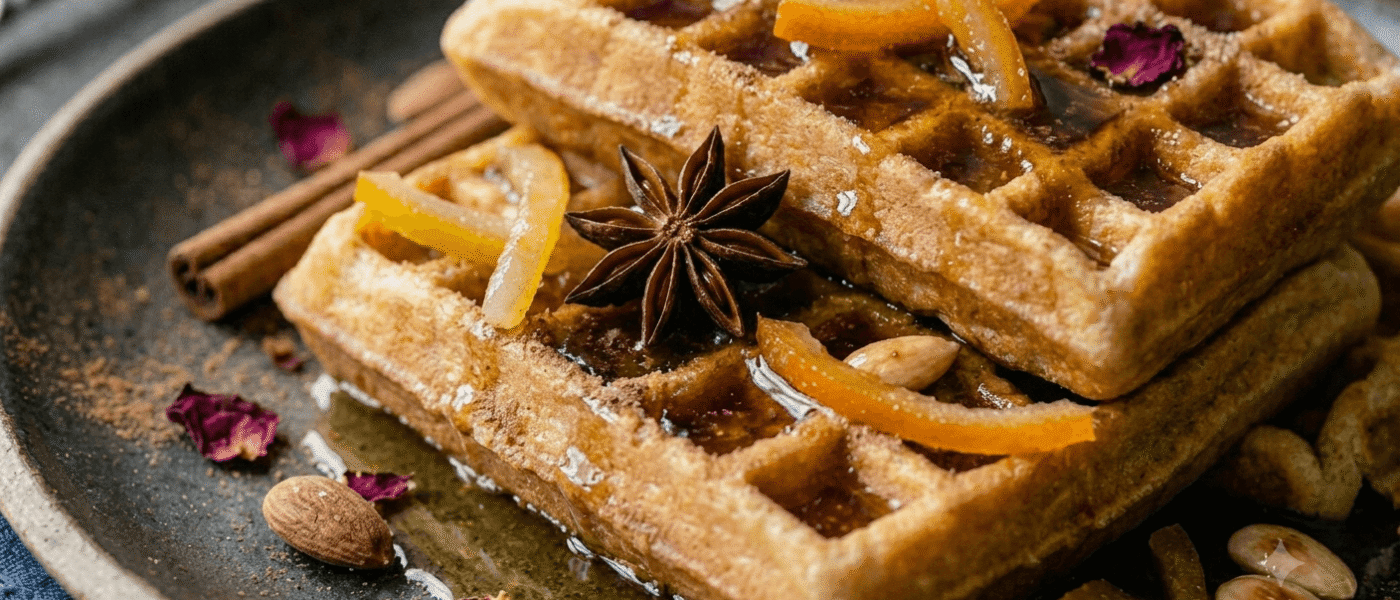
Belgian waffles have deeper pockets, a crispier exterior, and a lighter interior than their American counterparts — and the difference comes down to one technique: separating the eggs and folding beaten whites into the batter at the end.
Most waffle recipes combine everything together and call it done. That produces a decent waffle. Belgian waffles go further by introducing air into the batter through beaten egg whites — the same principle used in soufflés, mousse, and chiffon cake. The whites create thousands of tiny bubbles that expand in the heat of the iron, pushing the batter outward into the deep grid and setting into a structure that is simultaneously crisp on the outside and open on the inside. The technique adds five minutes and a second bowl, and the result is noticeably different.
What You’re Learning
Egg white aeration and its effect on batter structure. Egg whites are mostly protein and water. When beaten, the proteins unfold and wrap around air bubbles, creating a stable foam. Folded into a batter, this foam introduces a large volume of air that the base batter alone cannot hold. In the waffle iron, heat causes the air bubbles to expand and the batter proteins to set around them — creating a lighter, more open crumb with crisp walls. The key technique is folding, not stirring: a gentle over-under motion with a spatula preserves the air bubbles instead of deflating them. Over-folding collapses the foam; under-folding leaves streaks of white. Aim for 15–20 folds — just until incorporated.
Steam and waffle iron temperature. The steam produced when batter hits the hot iron is what creates the initial rise. A cold iron doesn’t generate enough steam and produces flat, pale waffles; an iron that’s too hot scorches the outside before the batter can set through. The correct temperature is one where the waffle iron closes easily, steam escapes immediately from the edges, and the indicator light (if present) signals “ready.” The golden rule: don’t open the iron before the steam stops escaping from the sides — that steam is still doing work. Opening early tears the waffle apart.
Ingredients
Makes 4 large Belgian waffles.
- 2 cups (250g) all-purpose flour
- 2 tbsp sugar
- 1 tbsp baking powder
- ½ tsp fine salt
- 1¾ cups (420ml) whole milk
- 2 large eggs, separated
- ½ cup (115g) unsalted butter, melted and cooled
- 1 tsp vanilla extract
- Neutral oil or cooking spray for the iron
Method
- Preheat your waffle iron. Give it at least 5 minutes to come to temperature. Brush or spray the plates lightly with oil or cooking spray.
- Mix the dry ingredients. Whisk together flour, sugar, baking powder, and salt in a large bowl. Make a well in the center.
- Mix the wet ingredients (except the whites). In a separate bowl, whisk together the milk, egg yolks, melted butter, and vanilla until combined. Pour into the well in the dry ingredients and fold together until just combined — 10–12 strokes, lumps are fine.
- Beat the egg whites to soft peaks. In a clean bowl, beat the egg whites with a hand mixer or stand mixer until they hold soft peaks — the tips fold over gently when the beater is lifted. Stop before stiff peaks; over-beaten whites are grainy and don’t fold in smoothly.
- Fold the whites into the batter. Add the beaten whites in two additions. Use a wide spatula with a gentle over-under motion. Fold until no large white streaks remain — about 15–20 folds total. A few small streaks are fine; over-folding deflates the foam.
- Cook until the steam stops. Ladle batter into the iron (amount varies by iron — usually ¾ to 1 cup). Close and cook until steam stops escaping from the sides, about 4–5 minutes. Don’t open early.
- Serve immediately or keep warm. Waffles lose their crispness quickly. Serve directly from the iron, or keep warm on a wire rack in a 200°F (93°C) oven — never stacked, which traps steam and softens them.
Notes
- Soft peaks, not stiff. Soft-peaked whites fold into batter more smoothly and produce a lighter result. Stiff whites are harder to fold in evenly and tend to leave rubbery white patches in the finished waffle.
- No fat on the beaters or bowl when beating whites. Even a trace of egg yolk or butter prevents whites from foaming properly. Use a clean, dry bowl and make sure you separate the eggs cleanly.
- Don’t open the iron before steam stops. The escaping steam means the batter is still setting. Open too early and the waffle will tear down the middle.
- Make batter the night before (without the whites). The base batter keeps overnight in the fridge. Beat and fold in the whites fresh in the morning for faster prep.
- Freeze leftover waffles. Cool completely on a wire rack, then freeze flat. Reheat from frozen in a toaster — they come out nearly as crisp as fresh.
- Toppings: keep it simple. Fresh whipped cream, sliced strawberries, and a dusting of powdered sugar. Or salted butter and maple syrup. The waffle texture is the point — don’t bury it.