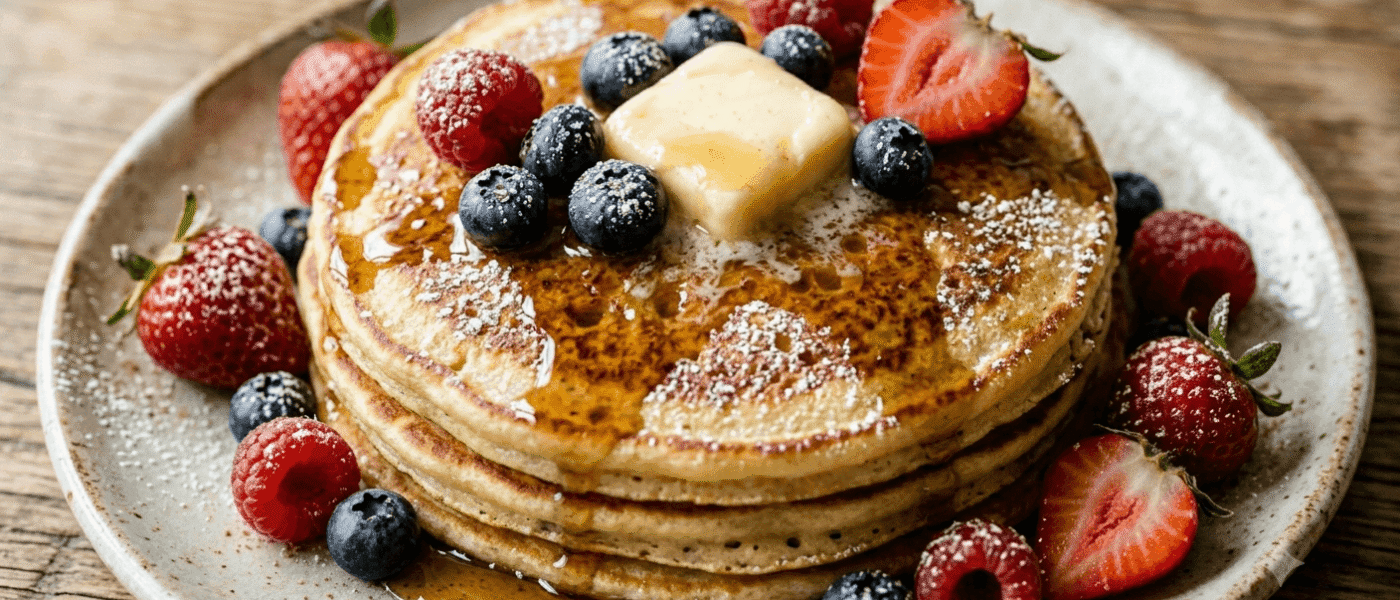
American pancakes are one of those recipes that looks simple and hides real technique. The secret is counterintuitive: the less you mix the batter, the better the pancakes. Lumps are correct. A smooth batter means overworked gluten, and overworked gluten means tough, flat pancakes.
The other thing most people get wrong is the flip. Pancakes tell you when they’re ready — bubbles form across the surface and the edges look dry and set. Flip too early and they fall apart; flip too late and you lose the steam that gives them their lift. Patience with the first side is the whole game. Once you understand these two things — don’t overmix, wait for the bubbles — you can make good pancakes every time without a recipe.
What You’re Learning
Gluten development and why overmixing is the enemy. All-purpose flour contains proteins that, when hydrated and worked, form gluten — the network of elastic strands that gives bread its chew. In pancake batter, a small amount of gluten development is fine, but too much makes the pancakes rubbery and dense. The trick is to mix wet and dry ingredients together with as few strokes as possible — ten to twelve folds with a spatula, not twenty. Lumps of unincorporated flour in the batter are not a problem; they hydrate and disappear as the batter rests. A batter that looks slightly lumpy and rough will produce lighter, more tender pancakes than one that looks perfectly smooth.
Chemical leavening and the bubble test. Pancakes rise from two leavening agents working together: baking powder (which releases carbon dioxide when heated) and baking soda (which reacts with an acidic ingredient — in this case, buttermilk — to release additional gas). The gas bubbles that form during cooking are what give pancakes their lift and open crumb. The “bubble test” for flipping is simply watching for this leavening process to complete on the surface: when bubbles break through the top of the batter and the edges look dry and set, the structure of the pancake has stabilized enough to flip without collapsing. The second side cooks much faster — usually 1–2 minutes — because the structure is already set.
Ingredients
Makes 4 servings (about 12 pancakes).
- 1½ cups (190g) all-purpose flour
- 2 tbsp sugar
- 1 tsp baking powder
- ½ tsp baking soda
- ½ tsp fine salt
- 1 cup (240ml) buttermilk (or whole milk + 1 tbsp lemon juice, rested 5 minutes)
- 1 large egg
- 2 tbsp unsalted butter, melted and cooled, plus more for the pan
- 1 tsp vanilla extract (optional)
Method
- Mix the dry ingredients. Whisk together the flour, sugar, baking powder, baking soda, and salt in a large bowl. Make a well in the center.
- Mix the wet ingredients separately. In a separate bowl or measuring jug, whisk together the buttermilk, egg, melted butter, and vanilla until combined.
- Combine with as few strokes as possible. Pour the wet ingredients into the dry. Fold together with a spatula — 10 to 12 strokes maximum. The batter should look lumpy and slightly rough. Visible streaks of flour are fine; they’ll hydrate as the batter rests. Stop mixing the moment no large dry pockets remain.
- Rest the batter for 5 minutes. This allows the leavening agents to activate and the flour lumps to hydrate. Do not stir again.
- Heat a griddle or skillet over medium heat. Add a small knob of butter and let it melt. The pan is ready when a drop of water flicked onto the surface bounces and evaporates immediately.
- Cook until the bubble test passes. Pour about ¼ cup of batter per pancake. Cook until bubbles form across the entire surface and the edges look dry and matte — about 2–3 minutes. Don’t touch them before this point.
- Flip once and cook 1–2 minutes more. The second side cooks fast. The pancake is done when it springs back lightly to the touch. Serve immediately or keep warm on a wire rack in a 200°F (93°C) oven.
Notes
- The first pancake is a test. It always is. Use it to calibrate the heat and adjust if the bottom is browning before bubbles appear. Lower the heat slightly if needed.
- Buttermilk is better than regular milk. The acid in buttermilk reacts with the baking soda to produce extra lift and a subtler tang. If you don’t have it, stir 1 tbsp of lemon juice or white vinegar into 1 cup of whole milk and wait 5 minutes.
- Don’t press down on the pancakes. Pressing flattens the steam structure that’s giving them their height. Leave them alone.
- Lumps in the batter are correct. A smooth batter means overmixed gluten. Stop mixing as soon as the dry ingredients are mostly incorporated.
- Rest the batter, don’t skip it. Five minutes makes a real difference. The flour absorbs the liquid and the leavening activates — the batter thickens slightly and the pancakes cook taller.
- Freeze leftover pancakes. Stack them between pieces of parchment and freeze. Reheat directly from frozen in a toaster — faster and better than reheating in a pan.