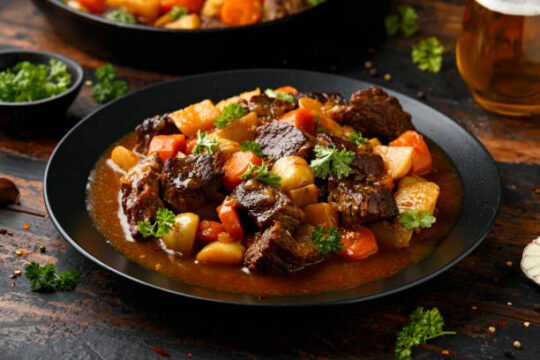
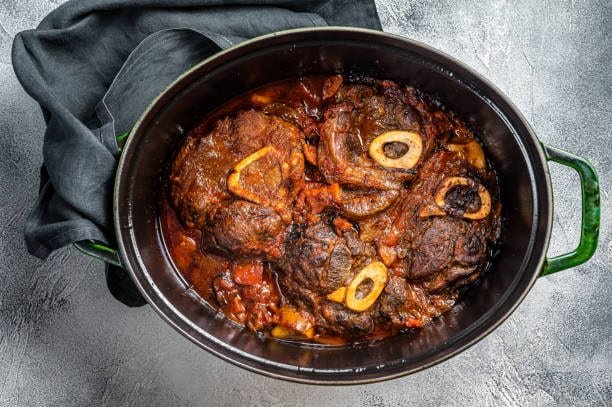
Cross-cut beef shanks, braised low and slow until the bone marrow softens into the sauce and the collagen dissolves into something silken and deep.
Estofado de jarrete — braised beef shank — appears across Spain’s northern and central cooking traditions, from Castile to the Basque Country. The cut is the cross-section of the beef shin, always braised rather than grilled because its connective tissue demands time. That tissue — collagen — is what makes this dish: as it renders slowly in wine and stock, it transforms into gelatin, creating the thick, glossy sauce that a long braise produces and a short one never can. This is Old World cooking at its most patient. The recipe calls for two hours but rewards that investment with something that tastes like it took all day — because, in a sense, it did.
What You’re Learning
Collagen and the long braise — Beef shanks contain more collagen than almost any other cut. At simmering temperature (185–195°F / 85–90°C), that collagen gradually dissolves into gelatin, which thickens the cooking liquid without any starch or flour. The longer it cooks within reason, the more gelatin is released, the richer the sauce becomes. This is why stew meat must be braised — not roasted, not grilled. Heat and time are doing chemical work that no shortcut can replicate.
Build the fond, then deglaze it — Before the liquid goes in, the shanks get a hard sear in a hot Dutch oven. This isn’t about cooking them through — it’s about building the fond: the layer of browned proteins and sugars stuck to the bottom of the pan. When you deglaze with wine, that fond dissolves into the liquid and carries depth and color that you cannot add after the fact. Skipping the sear produces a pale, thin braise. Doing it properly produces something dark and complex.
Ingredients
- 3–4 beef shanks, cross-cut about 1 inch thick (~2.5 lb / 1.1 kg total)
- 2 tsp salt, plus more to taste
- 1 tsp black pepper
- 3 tbsp extra-virgin olive oil
- 1 large yellow onion, roughly chopped
- 4 cloves garlic, smashed
- 2 medium carrots, cut into large chunks
- 2 stalks celery, sliced
- 2 tbsp tomato paste
- 1 tsp smoked paprika (Pimentón de la Vera)
- 1 cup dry red wine (Rioja, Tempranillo, or similar)
- 2 cups beef stock
- 2 bay leaves
- 4–5 sprigs fresh thyme (or 1 tsp dried), plus fresh parsley to finish
Instructions
- Preheat oven to 325°F (165°C). Pat the shanks completely dry with paper towels — any surface moisture will steam instead of sear. Season all over with salt and pepper.
- Sear the shanks. Heat the olive oil in a Dutch oven over high heat until just smoking. Add the shanks and sear without moving them for 3–4 minutes per side until deeply browned. Work in batches — do not crowd the pan. Remove and set aside.
- Soften the vegetables. Reduce heat to medium. Add the onion, carrots, and celery to the same pot. Cook for 5 minutes, scraping up any browned bits. Add the garlic and cook 1 minute more.
- Build the base. Push the vegetables to the sides. Add the tomato paste to the center and cook, stirring, for 2 minutes until it darkens to a rust color. Add the smoked paprika and stir to combine.
- Deglaze. Pour in the wine and scrape the bottom of the pot thoroughly to dissolve all the fond. Let it bubble and reduce by half, about 3 minutes.
- Braise. Add the stock, bay leaves, and thyme. Return the shanks to the pot — they should be about half-submerged. Bring to a gentle simmer, cover tightly, and transfer to the oven. Braise for 1 hour 45 minutes to 2 hours, until the meat is very tender and pulling away from the bone.
- Finish the sauce. Remove the shanks and rest them. Discard the bay leaves. If the sauce needs more body, simmer uncovered on the stovetop for 5–10 minutes. Taste and adjust salt.
- Serve. Place the shanks in deep bowls or on a platter, spoon the sauce and vegetables over them, and finish with fresh parsley. Serve with crusty bread, mashed potatoes, or white rice.
Notes
- Pat completely dry: Moisture on the surface of the shanks will steam on contact with the oil and prevent browning. The drier the surface, the better the sear — paper towels, then let them air for a minute if you have time.
- Don’t rush the sear: 3 to 4 minutes per side minimum, without moving. The crust needs to form fully before it will release cleanly from the pan. If it sticks, it is not ready. Patience here pays off in every bite.
- Oven braising vs. stovetop: The oven distributes heat evenly and prevents scorching the bottom. If you braise on the stovetop, use the lowest possible heat and check every 20–30 minutes. Even heat is everything in a long braise.
- The bone marrow: The rich, gelatinous center of the shank bone is a reward. Scoop it out and spread it on crusty bread with a pinch of salt. This is not optional.
- Make ahead: Braises always improve the next day after refrigerating overnight. The fat solidifies on the surface for easy removal. Reheat gently over low heat with a splash of stock if the sauce has thickened too much.
- Wine choice: Use a wine you’d actually drink. Any dry red with body works — Rioja, Tempranillo, Garnacha, Merlot. It doesn’t need to be expensive, but it shouldn’t be undrinkable.
Frequently Asked Questions
Can I make this in a slow cooker instead of the oven?
Yes, after searing the shanks and building the base on the stovetop as written, transfer everything to a slow cooker and cook on low for 6 to 8 hours instead of braising in the oven. Don’t skip the sear and deglaze steps beforehand. That’s where most of the dish’s flavor and color comes from, and a slow cooker can’t replicate it.
My sauce came out thin. What went wrong?
Most likely the braise didn’t go long enough for the collagen in the shanks to fully break down into gelatin, which is what thickens the sauce naturally without flour or cornstarch. Give it the full 1 hour 45 minutes to 2 hours, and if it’s still thin at the end, simmer it uncovered on the stovetop for 5 to 10 minutes to reduce it further.
What can I use instead of red wine?
Beef stock with a tablespoon of red wine vinegar or balsamic vinegar stirred in gets you similar acidity and depth without the alcohol. The wine is doing double duty as both a deglazing liquid and a flavor base, so replace it with something that brings some acid, not just more stock.