Queimada (Galician Fire Punch)
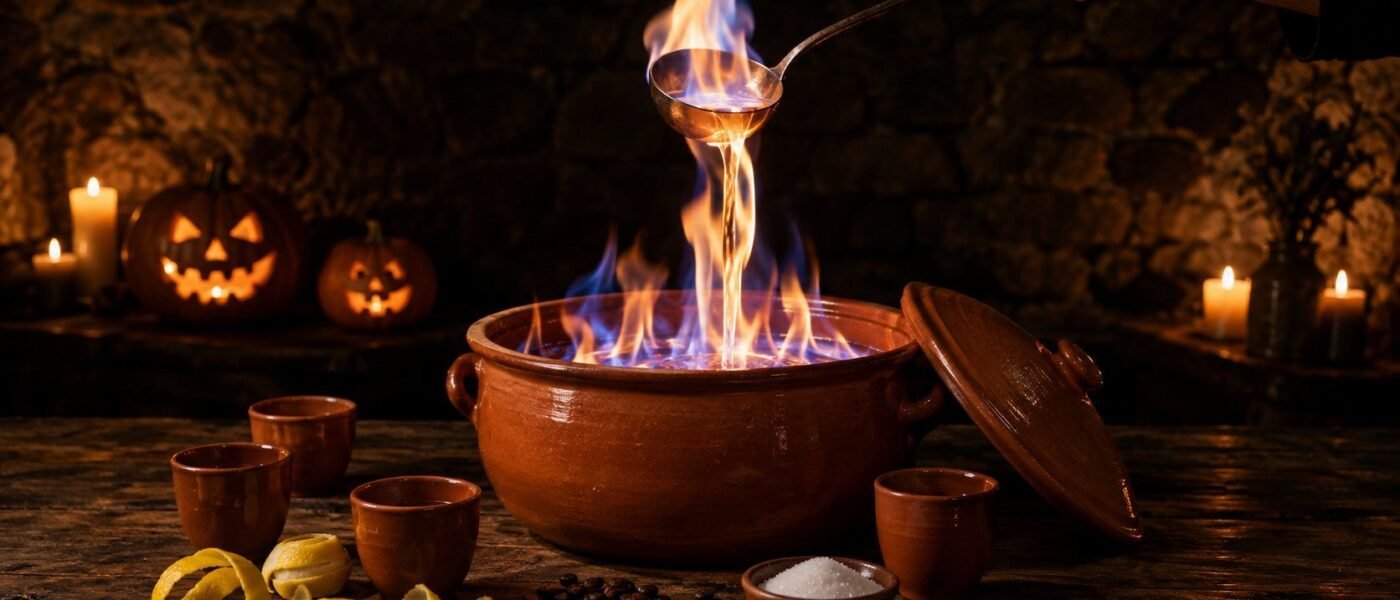
Queimada means “the burned one,” and that’s exactly what it is. In Galicia, in Spain’s green, rainy northwest corner, friends gather around a clay pot of orujo, a clear spirit distilled from grape skins, add sugar, lemon peel and coffee beans, and set it on fire. Someone stirs, lifting ladles of blue flame and letting them pour back into the pot, while someone else reads the conxuro, a spell that calls out the witches, ghosts and evil spirits and sends them away. When the flames die down, everyone drinks a small cup of the warm, sweet result.
It’s made for gatherings all year, but the night that suits it best is Samaín, the old Celtic festival on October 31 that Halloween grew out of. Galicia still celebrates it, with carved pumpkins and a queimada at the end of the night. If you’ve made our Carajillo, you’ve already seen a Spanish drink that gets its flavor from fire. This one is the whole show.
What You’re Learning
Burning sets the strength. Orujo is strong, usually around 40 to 50 percent alcohol. As it burns, some of the alcohol goes up in flame and the sugar melts and starts to caramelize, so the longer you let it burn, the softer and sweeter the queimada gets. A short burn gives a fiery drink; a long one, until the flames are small and blue, gives something closer to a warm liqueur. It never burns off completely, so it’s still a strong drink served in small cups.
You put out alcohol fires by smothering them. Fire needs air. Covering the pot with its lid cuts off the air and the flames go out in seconds. Water does the opposite: it can splash burning alcohol out of the pot. Blowing on it just feeds it. Keep the lid within reach the whole time, and you’re in control.
Ingredients
Makes about 10 small cups.
- 1 liter (about 4 cups) orujo blanco (aguardiente de orujo), or grappa
- 3/4 cup (150 g) sugar, plus 1 tablespoon for lighting
- Peel of 1 lemon, in wide strips with no white pith
- About 15 whole coffee beans
- 1 cinnamon stick (optional)
- Peel of 1/2 orange, in wide strips (optional)
- 1 small apple, cut into chunks (optional)
Method
- Set up safely. Make it outdoors or on a sturdy heatproof surface, well away from curtains, shelves and anything that can catch fire. Tie back long hair and roll up loose sleeves. Keep children and pets away, and keep the lid of the clay pot right next to you.
- Fill the pot. Set the clay pot on a heatproof board or tile. Pour in the orujo, then add the 3/4 cup sugar, the lemon peel, the coffee beans and any of the optional extras. Stir for a moment to dissolve some of the sugar.
- Light a ladleful. Scoop up a ladleful of orujo and sprinkle the extra tablespoon of sugar into it. Light it with a long lighter, keeping your hand back and the ladle level.
- Light the pot. Lower the burning ladle slowly to the surface of the pot until the orujo in the pot catches. If it doesn’t catch right away, hold the flame just above the surface for a few seconds to warm it.
- Stir and lift. Stir slowly, now and then lifting a ladleful of burning liquid and pouring it back from a little height so the flames run down into the pot. This is when the spell is read aloud. Keep going for 8 to 10 minutes, until the flames are low and mostly blue.
- Put it out. Cover the pot with its lid to smother the flames. Never use water and never blow on it. Leave the lid on for a minute so the fire is fully out.
- Serve. Ladle the warm queimada into small clay cups, with a strip of peel or a coffee bean in each if you like. Drink it warm.
Notes
- Finding orujo. Look for “aguardiente de orujo” or “orujo blanco” in a Spanish shop or online. Grappa is the closest substitute: it’s the Italian version of the same spirit, distilled from grape skins. Avoid flavored orujo liqueurs; they’re too sweet and don’t burn well.
- Choose your strength. Taste a little from the ladle (carefully, after blowing out that ladle’s flame away from the pot) as it burns. Put the lid on as soon as it tastes right to you. Longer means softer and sweeter.
- The spell. In Galician it is the conxuro da queimada. It sounds ancient, but the version read today was written in 1967 by Mariano Marcos Abalo. It’s in Galician and starts “Mouchos, coruxas, sapos e bruxas” (owls, barn owls, toads and witches). Find the full text online, print it, and have the best reader in the room take it on.
- The pumpkin version. At Samaín parties, queimada is sometimes served from a hollowed-out pumpkin. Burn it in the clay pot as usual, put it out, and then pour it into the pumpkin for serving. Never burn it inside the pumpkin: it’s narrow, unsteady and hard to cover.
- A smaller batch. Halve everything for 4 or 5 people. Use a smaller heatproof pot so the orujo is still a few inches deep; a thin layer is hard to light and burns out fast.
- Drink it responsibly. Even after burning, queimada is a strong drink. Small cups, and nobody who has had one drives home.
More 🌍 Old World

Negroni
Equal parts gin, Campari, and sweet vermouth — stirred, not shaken. The Negroni is one of the few cocktails where understanding the formula is the entire lesson.

Espresso Martini
Vodka, fresh espresso, and coffee liqueur, shaken hard until a thick, creamy foam settles on top. The foam comes from the coffee itself, and it only happens when the espresso is pulled fresh.
Tinto de Verano
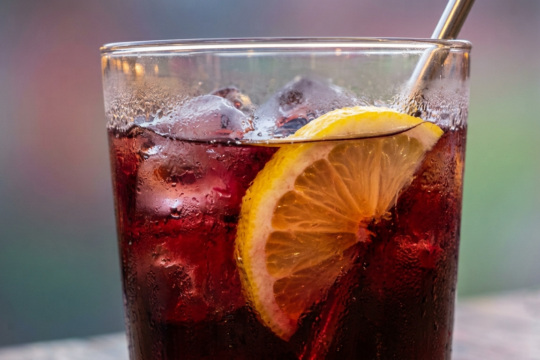
Red wine and lemon soda over ice, in a 1:1 ratio. Spain's actual everyday summer drink, the one locals order far more than sangria.