
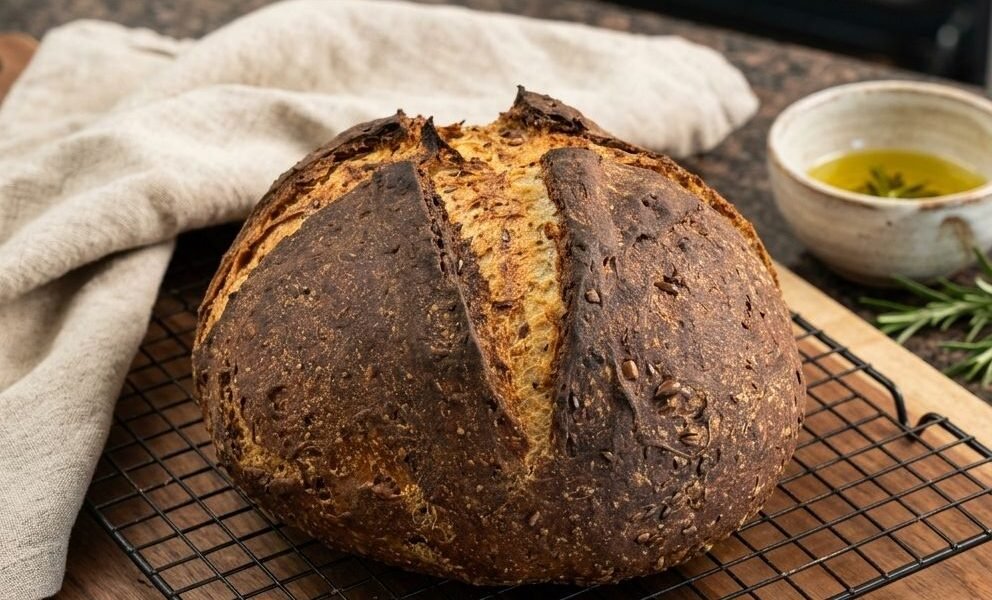
Multigrain Sourdough Discard Boule (Hogaza Multicereales con Descarte de Masa Madre)
This is the hearty sibling of our Sourdough Discard Bread. Same idea: unfed discard straight from the fridge brings the tang, and a little instant yeast does the lifting. This time a third of the flour is whole wheat and rye, and there’s a cup of oats, flax, sunflower and sesame seeds folded through the dough. It slices thin, toasts beautifully, and stays moist for days.
It takes two days but very little work. Mix and fold it in the evening, shape it, and let it sit in the fridge overnight. Bake it the next morning straight from the cold. If you have a sourdough starter going, this is one of the best ways to use up a week of discard.
What You’re Learning
Seeds need a soak. Dry oats and seeds pull water out of the dough while it rises and bakes, and you end up with a dry, crumbly loaf full of hard little bits. Soaking them in boiling water first fills them up, so they leave the dough’s water alone. Flax also turns gel-like when it soaks, which helps keep the finished bread moist. Bakers call this mix a soaker.
Cold rising builds flavor. In the fridge, the yeast slows almost to a stop but the bacteria from the discard keep working, making more of the acids that give sourdough its tang. Whole grains have more for them to feed on, so the flavor gets nutty and deep. A cold loaf is also firm, so it holds its shape and takes a clean cut when you score it.
Ingredients
Makes 1 large round loaf, about 12 slices.
For the soaker
- 40 g (about 1/2 cup) old-fashioned rolled oats
- 25 g (about 3 tablespoons) whole flaxseed
- 30 g (about 1/4 cup) raw sunflower seeds
- 15 g (about 2 tablespoons) sesame seeds
- 120 g (1/2 cup) boiling water
For the dough
- 300 g (1 1/4 cups) lukewarm water, about 95°F
- 150 g (about 2/3 cup) sourdough discard, unfed, straight from the fridge
- 3 g (1 teaspoon) instant yeast
- 20 g (1 tablespoon) honey
- 300 g (about 2 1/2 cups) bread flour, plus more for shaping
- 100 g (about 3/4 cup) whole wheat flour
- 50 g (about 1/2 cup) rye flour
- 12 g (2 teaspoons) fine sea salt
Method
- Make the soaker. Put the oats, flaxseed, sunflower seeds, and sesame seeds in a small bowl and pour the boiling water over them. Stir, cover, and set aside for at least 30 minutes. It will turn thick and sticky as the water disappears.
- Mix the dough. In a large bowl, whisk the warm water, discard, yeast, and honey together until the discard breaks up. Add the bread flour, whole wheat flour, rye flour, and salt. Stir with a sturdy spoon, then finish with one wet hand until no dry flour is left. Cover and rest 30 minutes.
- Work in the soaker. Scrape the soaker onto the dough. Squeeze it through with a wet hand, folding the dough over itself, for a minute or two, until the seeds are spread evenly. It will feel slippery at first and then come back together.
- Stretch and fold. Wait 30 minutes. Wet your hand, grab one edge of the dough, stretch it up until it resists, and fold it over the middle. Turn the bowl a quarter turn and repeat, four times in all. Cover, wait another 30 minutes, and do one more round.
- Let it rise. Cover and leave it somewhere warm until it has grown by about three-quarters, looks domed, and jiggles when you shake the bowl, about 1 1/2 to 2 hours more. Whole grains and seeds make a heavier dough, so it won’t quite double.
- Shape the loaf. Tip the dough onto a lightly floured counter, pull each edge into the center, flip it seam side down, and drag it toward you a few times with cupped hands until the surface is tight and smooth.
- Chill overnight. Dust a banneton or a towel-lined bowl generously with flour and set the loaf in it, smooth side down. Cover it and refrigerate for 8 to 16 hours.
- Heat the pot. The next day, put a 5- to 6-quart Dutch oven with its lid in the oven and heat it to 475°F for 45 minutes. Leave the dough in the fridge until the pot is ready.
- Score and bake covered. Turn the cold loaf out onto a square of parchment paper, smooth side up. Cut two parallel slashes about 1/2 inch deep, a few inches apart, with a razor or very sharp knife. Lift it by the parchment into the hot pot, put the lid on, and turn the oven down to 450°F. Bake 25 minutes.
- Bake uncovered. Take the lid off and bake another 22 to 25 minutes, until the crust is a deep brown and the inside reads 205 to 210°F on an instant-read thermometer.
- Cool completely. Move the loaf to a wire rack and leave it for at least 2 hours. Whole-grain bread holds more water than white bread, and cutting it warm gives you a gummy middle.
Notes
- Seeded crust. Before the loaf goes into the banneton, mist the top with water and roll it in 2 tablespoons oats and 1 tablespoon each sunflower and sesame seeds, then set it in seeded side down.
- Toast the seeds first. For a nuttier loaf, toast the sunflower and sesame seeds in a dry skillet over medium heat for 3 to 4 minutes, until they smell good, before adding them to the soaker.
- Swap the grains. Pumpkin seeds can replace the sunflower seeds, and chia can replace up to half the flax. Keep the total weight of oats and seeds about the same so the water still works out.
- Same-day version. Skip the fridge: after shaping, let the loaf rise covered at room temperature for 45 minutes to 1 hour, until it springs back slowly when you press it, then bake. The flavor is milder.
- No banneton? Skip shaping the night before. After the last stretch and fold, cover the bowl and put it straight in the fridge; it keeps rising while it cools, so don’t wait for the full rise first. In the morning, shape the cold dough, set it on parchment in a bowl, cover, and let it rise 1 to 1 1/2 hours while the pot heats. It rises a little less in the oven, but the flavor is the same.
- If the dough feels stiff. Flours vary in how much water they drink, and whole wheat and rye drink a lot. If the dough feels firm and dry after mixing, work in another 10 to 20 g of water. Weighing helps here; see a cup of flour isn’t a cup of flour.
- No rye? Use 50 g more whole wheat flour in its place.
- Keeping it. Store the loaf cut side down on a board for up to 4 days, or slice and freeze it. Toast slices straight from the freezer.
More at This Level

Beef Stew (Estofado de Ternera)
A Spanish-style beef stew built in layers — seared chuck, paprika-wine base, root vegetables — braised low and slow until the sauce holds a spoon.

Pumpkin Pie (Tarta de Calabaza)
A silky pumpkin custard baked in a blind-baked crust, using a two-stage oven temperature so the edges set fast while the center finishes gently, without cracking. Uses the same crust as Dutch Apple Pie and Pecan Pie.
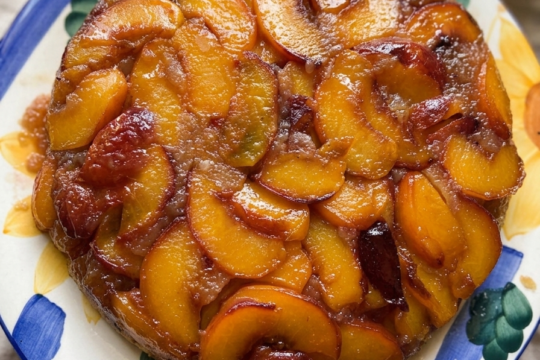
Peach Upside-Down Cake (Tarta Invertida de Melocotón)
Peaches caramelize right in a cast iron skillet in butter and brown sugar, then bake under a simple vanilla cake and flip out warm, caramel-side up. One pan, one flip, no candy thermometer required.
More 🌎 New World
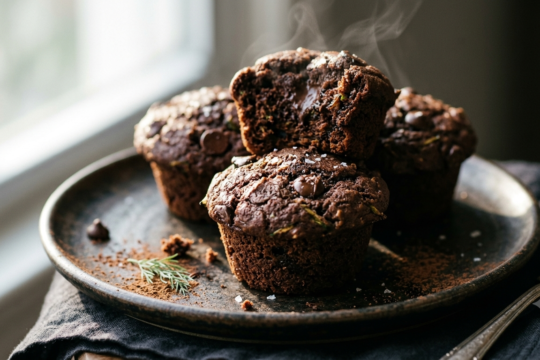
Double Chocolate Zucchini Muffins (Muffins de Chocolate y Calabacín)
Grated zucchini keeps these fudgy chocolate muffins moist without adding any vegetable flavor. The cocoa masks everything. Nobody will know.
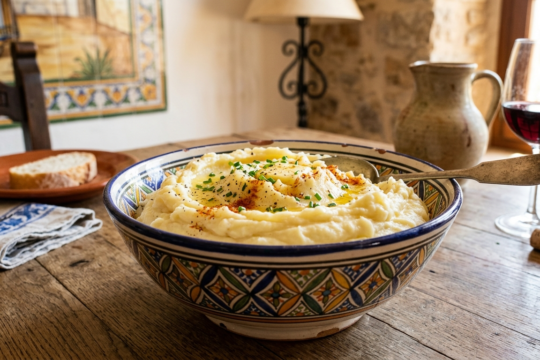
Mashed Potatoes (Puré de Patatas)
The most forgiving dish in the kitchen — and the one most people get wrong by working it too hard. Mashed potatoes want heat, fat, and a light hand.
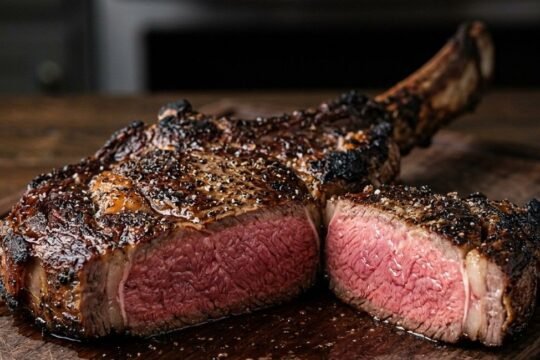
Reverse-Seared Ribeye (Entrecot con Sellado Inverso)
A thick-cut ribeye goes low in the oven first, then gets a hard cast-iron sear at the very end. The reverse-sear method steakhouses use to cook a steak evenly edge to edge, with no gray overcooked band under the crust.