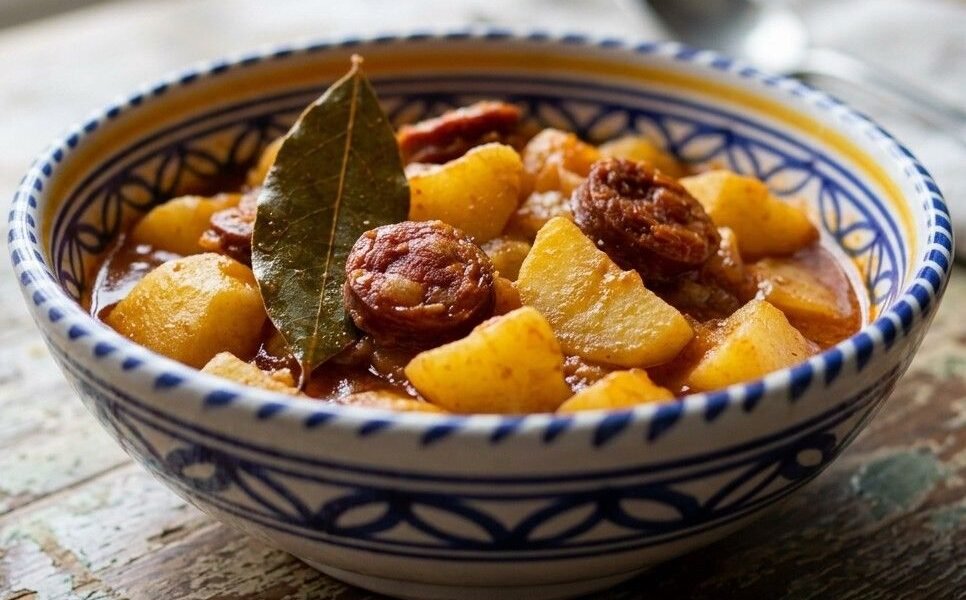
Patatas a la Riojana is La Rioja’s signature dish, and it’s built on a technique most home cooks skip right past: the potatoes get torn, not sliced. Cut partway through each piece with a knife, then twist and snap the rest apart by hand. It looks careless. It isn’t, those ragged edges are the whole point.
Torn potatoes simmered with chorizo in a deep, smoky pimentón broth, that’s the entire dish, and it’s a genuinely rustic one, closer to peasant cooking than restaurant plating. No cream, no flour, no thickener of any kind. The broth thickens itself as it cooks, into something with real body, closer to a chowder than a soup.
What You’re Learning
Torn potatoes thicken the stew, no flour required. A clean knife cut seals a potato’s surface almost immediately. A torn, ragged edge doesn’t, it stays open, and as the potato simmers it sheds starch directly into the broth around it. Over 25 to 30 minutes that shed starch is what turns a pot of water and vegetables into a thick, clingy stew with real body, the same starch a roux or cornstarch slurry would otherwise be doing that job. Skip the tear and use a clean dice instead, and the broth stays thin no matter how long it simmers.
Pimentón burns in seconds directly over heat. Pull the pot fully off the burner before it goes in. Stir the pimentón through the hot oil and rendered chorizo fat off the heat, then return the pot to the stove. Left on direct heat even briefly, pimentón turns bitter and acrid instead of sweet and smoky, and there’s no fixing it once it’s scorched. This same instinct, off heat, then back on, governs pimentón in a lot of Spanish cooking, not just this dish. See our Spanish Charcuterie Guide for how the same pimentón shows up in chorizo itself.
Ingredients
Serves 4.
- 2 lbs (about 5-6 medium) Yukon Gold or russet potatoes, peeled
- 8 oz Spanish chorizo (semi-cured or fresh chorizo para guisar), sliced into 1/2-inch rounds
- 1 medium yellow onion, diced
- 1 green Italian frying pepper or green bell pepper, diced
- 3 cloves garlic, minced
- 2 tablespoons extra-virgin olive oil
- 1 tablespoon sweet smoked pimentón (Spanish paprika)
- 1/2 teaspoon hot pimentón, or a pinch of cayenne (optional, for heat)
- 1 bay leaf
- 4 cups water or light chicken broth
- Salt, to taste
Method
- Tear the potatoes. Cut partway into each potato with a knife, then twist and snap the rest apart by hand rather than slicing all the way through. Break each potato into rough 1 1/2-inch pieces this way.
- Build the sofrito. Heat the olive oil in a Dutch oven over medium heat. Add the onion and green pepper and cook, stirring occasionally, until softened, 6 to 8 minutes.
- Add the garlic and chorizo. Stir in the garlic and sliced chorizo and cook 2 to 3 minutes more, until the chorizo releases some of its fat and the oil turns a deep red.
- Bloom the pimentón off the heat. Pull the pot off the burner entirely and stir in the sweet pimentón, and the hot pimentón if using, immediately. It should sizzle gently in the residual heat, not scorch.
- Add the potatoes and liquid. Return the pot to the heat. Add the torn potatoes and bay leaf, then pour in the water or broth until the potatoes are just covered.
- Simmer. Bring to a boil, then reduce to a gentle simmer. Cook uncovered, stirring occasionally, until the potatoes are tender and the broth has thickened into a rustic, stew-like consistency, 25 to 30 minutes.
- Season and rest. Remove the bay leaf and season with salt to taste. Let the stew sit off the heat for 5 minutes before serving, it thickens further as it stands.
- Serve. Ladle into bowls and serve hot, with crusty bread.
Notes
- The torn-potato technique is what thickens this stew, no flour, roux, or cornstarch anywhere in the pot. A clean dice will leave the broth noticeably thinner.
- Use a semi-cured or fresh Spanish chorizo, not the fully dry-cured sliceable deli kind, it needs to render fat and color into the broth as it cooks. See our Spanish Charcuterie Guide for the difference between Spain’s cured and fresh chorizo.
- Always add pimentón off the heat. It burns and turns bitter in seconds directly over a flame or burner.
- This is meant to be a thick, rustic stew, not a soup. If it looks too thin once the potatoes are tender, keep it at a bare simmer, uncovered, a few extra minutes so the starch has more time to concentrate.
- A green Italian frying pepper is closer to what’s traditional than a standard bell pepper, milder and thinner-walled, but bell pepper works fine if that’s what’s available.
- Leftovers thicken further overnight in the fridge. Thin with a splash of water or broth when reheating.