
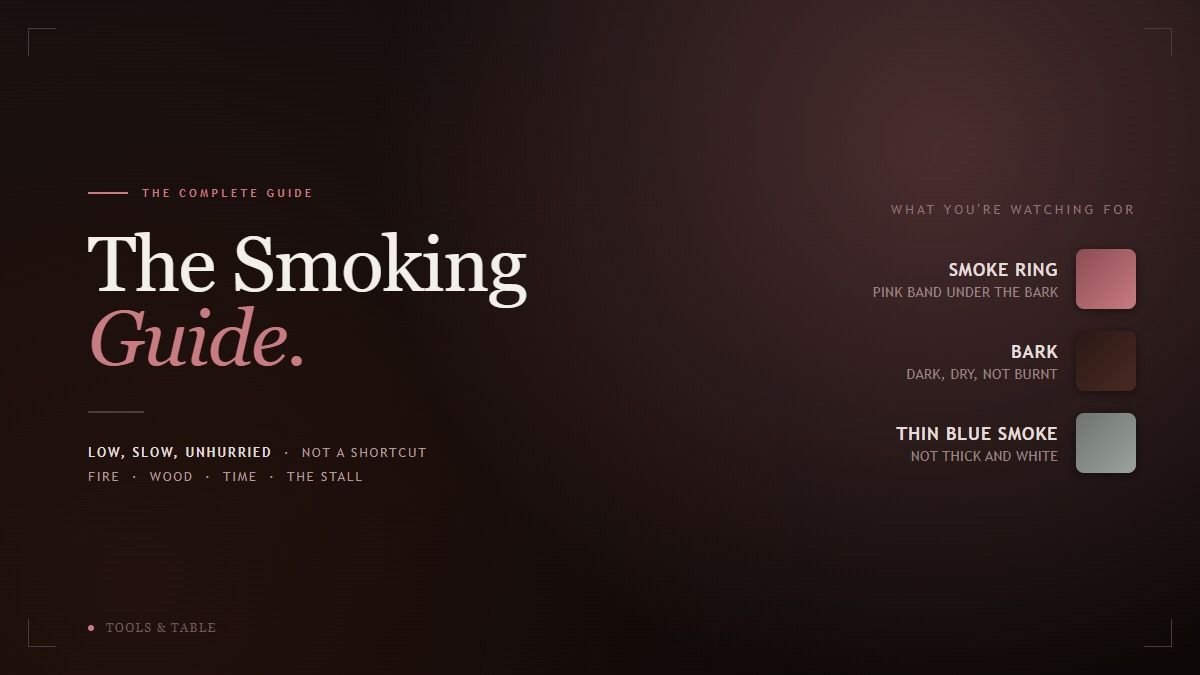
Smoking isn’t grilling done longer. It’s a different technique entirely: indirect heat, low temperature (225–275°F instead of 450°F+), and wood smoke doing real work over hours instead of minutes. The reward is meat that a hot grill can’t produce, deep bark, a pink smoke ring, tough cuts turned tender through slow collagen breakdown, but only if the actual mechanics are right. This is the real breakdown: equipment, wood, timing by protein, and the specific points where a smoke actually goes wrong.
The Core Idea: Indirect Heat, Not Direct
Every smoker setup, regardless of type, does one thing: keeps the fire or heat source away from being directly under the food. Heat and smoke circulate around the meat instead of blasting it from below, which is what makes low, even, hours-long cooking possible without burning the outside before the inside is anywhere close to done. On a kettle grill this means banking coals to one side with the food on the other, a foil pan of water in between to buffer temperature swings. On a purpose-built offset smoker, it means a firebox physically separate from the cooking chamber. Same principle, different plumbing.
Smoker Types at a Glance
| Type | Fuel | Temp Control | Best For |
|---|---|---|---|
| Offset smoker | Wood or charcoal | Fully manual | Most flavor control, steepest learning curve |
| Kettle grill, set up indirect | Charcoal | Manual | Beginners already own one, good entry point |
| Pellet smoker | Wood pellets, electric auger | Automated (set-and-forget) | Consistency, least hands-on |
| Electric smoker | Electric element + wood chips | Automated | Simplicity, mildest smoke flavor |
| Kamado (ceramic) | Charcoal | Manual, holds steady well | Fuel efficiency, versatility |
None of these is the “right” one, they’re a real tradeoff between hands-on control and convenience. A pellet smoker gets a beginner a genuinely good result with far less babysitting; an offset smoker rewards the time investment with more smoke flavor and more control, if the fire management learning curve doesn’t scare you off first.
Wood: What to Burn and Why
Hardwood only, never softwood like pine or fir, the resin content produces harsh, bitter, potentially harmful smoke. Beyond that, different hardwoods genuinely taste different, and matching wood to protein matters more than most beginners expect.
| Wood | Strength | Pairs Well With |
|---|---|---|
| Hickory | Strong | Pork, ribs, classic barbecue flavor |
| Oak | Medium | Everything, the safest all-purpose choice |
| Mesquite | Strong, fast-building | Beef, used sparingly, easy to oversmoke |
| Applewood & cherry | Mild, sweet | Poultry, pork, fish |
| Pecan | Mild-medium, nutty | Everything, a gentler alternative to hickory |
Chunks suit longer offset or kettle cooks, they burn slowly and evenly over hours. Chips burn faster and suit shorter cooks or electric smokers, which often have a small dedicated chip tray. Pellets are their own closed system, matched to pellet smokers specifically, and come pre-blended by wood type. None of these are interchangeable across smoker types without adjusting technique.
Temperature & Time by Protein
| Protein | Smoker Temp | Time | Pull Temp |
|---|---|---|---|
| Pork shoulder / butt | 225°F | 1.5–2 hr per lb | 195–205°F |
| Baby back ribs | 225–250°F | 5–6 hours | Bend test, not a number |
| St. Louis ribs | 225–250°F | 6–7 hours | Bend test, not a number |
| Whole brisket | 225–250°F | 1–1.5 hr per lb | ~203°F |
| Whole chicken | 250–275°F | ~4 hours | 165°F breast, 175°F thigh |
| Turkey breast | 225–250°F | ~30 min per lb | 165°F |
| Salmon (hot smoke) | 175–225°F | 1–2 hours | 140–145°F |
| Sausage | 225–250°F | 2–3 hours | 160°F |
Our own Smoked Beef Brisket runs this exact brisket window, low and slow through a 10–14 hour cook. Salmon is the outlier worth noting separately: much lower temperature and a much shorter cook than every red meat and poultry entry here, treat it as its own category, not a faster version of the others.
The Stall (and How to Push Through It)
Every long smoke hits the stall, the internal temperature climbs steadily, then plateaus for an hour or more, usually in the 150–165°F range. It’s evaporative cooling, moisture leaving the surface at nearly the same rate the smoke is adding heat, not a sign anything’s wrong with the fire. Cranking the heat up doesn’t push through it any faster, it just dries out the bark that’s been building for hours.
The real fix is patience, or the “Texas crutch”: wrapping the meat partway through, once bark has actually set, to trap moisture and power through the stall faster. Foil wraps fastest and steams the surface soft. Butcher paper wraps slower but breathes enough to preserve the bark that already formed, which is why our own Brisket recipe uses paper specifically, not foil, once the bark is where it needs to be.
Reading Doneness: Temperature Isn’t the Whole Story
For collagen-heavy cuts like brisket and pork shoulder, a pull temperature is a starting point, not a finish line. The meat needs to feel probe-tender, a thermometer probe should slide in with almost no resistance, like into softened butter, before it actually comes off. Two briskets can both hit 203°F and be in completely different states depending on how far the collagen has actually broken down. This is the same logic behind why our Oven-Roasted Pork Belly and Smoked Beef Brisket both push well past red meat’s normal safe temperature, the extra heat and time is what converts tough collagen into gelatin, not overcooking.
Resting: Don’t Skip It
Large cuts need a real rest, wrapped and set in a cooler (no ice, just the insulation) for 30 minutes to 2 hours depending on size. This isn’t optional downtime, it’s when juices redistribute through the meat instead of running out onto the cutting board the moment a knife goes in. A brisket sliced straight off the smoker loses noticeably more moisture than one that rested properly first.
A Few Mistakes That Actually Matter
- Watch for thin, wispy blue smoke, not thick billowing white smoke. Thick white smoke means incomplete combustion and a bitter, acrid flavor, not “more smoke flavor.”
- Don’t open the lid constantly. Every peek lets out heat the smoker then has to rebuild, and it adds up to real, unpredictable extra cook time across a long smoke.
- Don’t wrap before the bark has actually set. Wrapping too early traps a bark that hasn’t finished forming, and it never really recovers once it’s been steamed soft.
- Build the timeline around the stall, not around it not happening. A brisket “done” estimate that doesn’t budget an hour or more for the stall is going to be wrong.
- If sauce is part of the plan, timing still matters even off the grill, our Kitchen Mistakes guide covers why sugary barbecue sauce needs to go on late, not early, or it burns before the meat’s actually done.
For the dry-brine step that typically comes before any of this, see our Brining & Marinating guide. For two smokes that put all of this into practice, see Smoked Beef Brisket and Oven-Roasted Pork Belly.