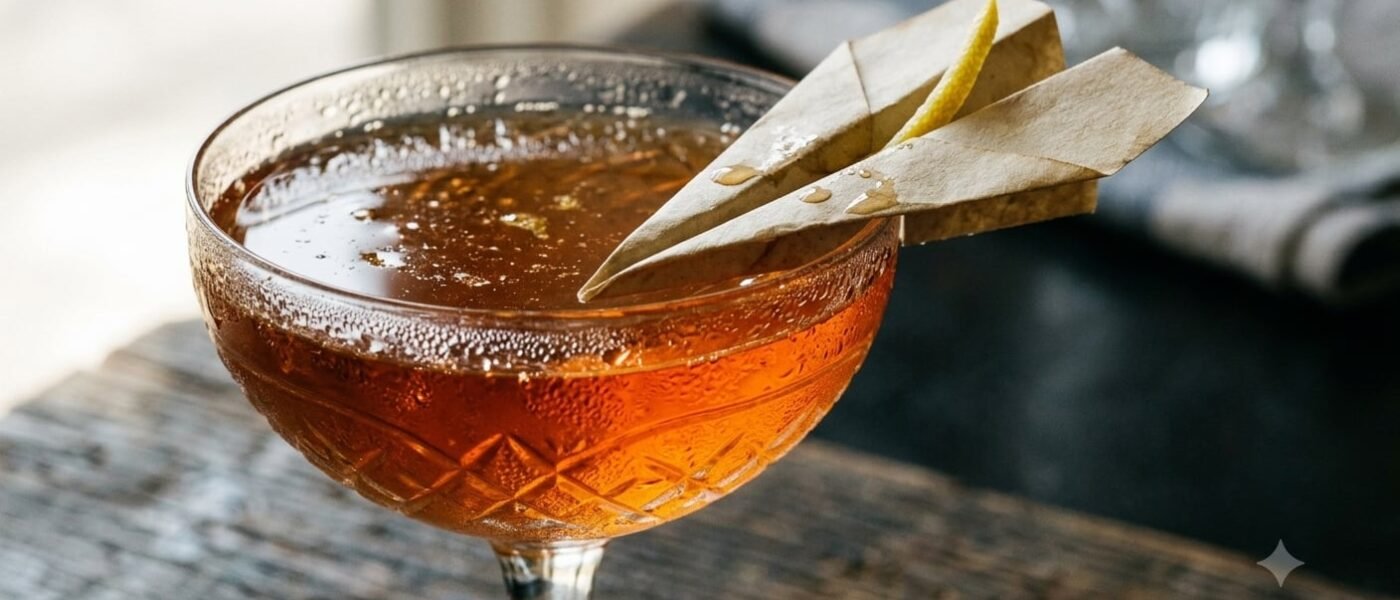
The Paper Plane is a modern classic built on a formula that sounds too simple: equal parts bourbon, Aperol, Amaro Nonino, and fresh lemon juice. All in. Shake. Strain. It shouldn’t work this well, but it does — and once you understand why, you’ll start seeing the equal-parts logic everywhere.
What You’re Learning
Most cocktails have a dominant spirit and supporting players. The Paper Plane treats all four ingredients as equals because each one pulls in a different direction without any one overpowering the others. Bourbon provides warmth and vanilla backbone. Aperol adds bittersweet orange. Amaro Nonino contributes herbal complexity and a gentler bitterness than Campari. Lemon juice cuts through all of it with acid and brightness. The balance is precise — change one ratio and the whole thing shifts noticeably.
This drink gets shaken because it contains lemon juice. Unlike the Negroni, which is stirred to preserve clarity, the Paper Plane benefits from the aeration that shaking produces — it integrates the citrus fully and gives the drink a slightly lighter, more vigorous texture. Shake hard for 10–12 seconds. You want a well-chilled, properly diluted cocktail with the citrus fully emulsified into the spirits. Double-straining removes ice chips and gives it a cleaner finish in the glass.
Ingredients
- 1 oz bourbon
- 1 oz Aperol
- 1 oz Amaro Nonino
- 1 oz fresh lemon juice (about 1 small lemon)
Method
- Combine all four ingredients in a shaker with ice.
- Shake hard for 10–12 seconds.
- Double-strain through a fine-mesh strainer into a chilled coupe glass. No garnish needed.
Notes
- Amaro Nonino is not optional. It’s a delicate, grappa-based amaro — far gentler than Campari or Fernet. Amaro Montenegro is the closest substitute. Don’t swap in a heavy amaro; it’ll overpower the Aperol and lemon.
- Aperol’s sweetness is load-bearing. It balances the lemon. Don’t substitute Campari without reducing the Aperol portion and adjusting — Campari is significantly more bitter and less sweet.
- A rocks glass over a large ice cube works if you don’t have a coupe. It keeps the drink colder longer, though the presentation is different.
- Double-straining (shaker strainer + fine-mesh strainer over the glass) catches ice chips and gives a cleaner texture. Single-strain is fine if you don’t mind.
- The name: created in 2008 by bartender Sam Ross at Milk & Honey in NYC, named after the M.I.A. song. The equal-parts formula is deliberately clever — it looks like a trick, but the balance holds exactly because of it, not despite it.