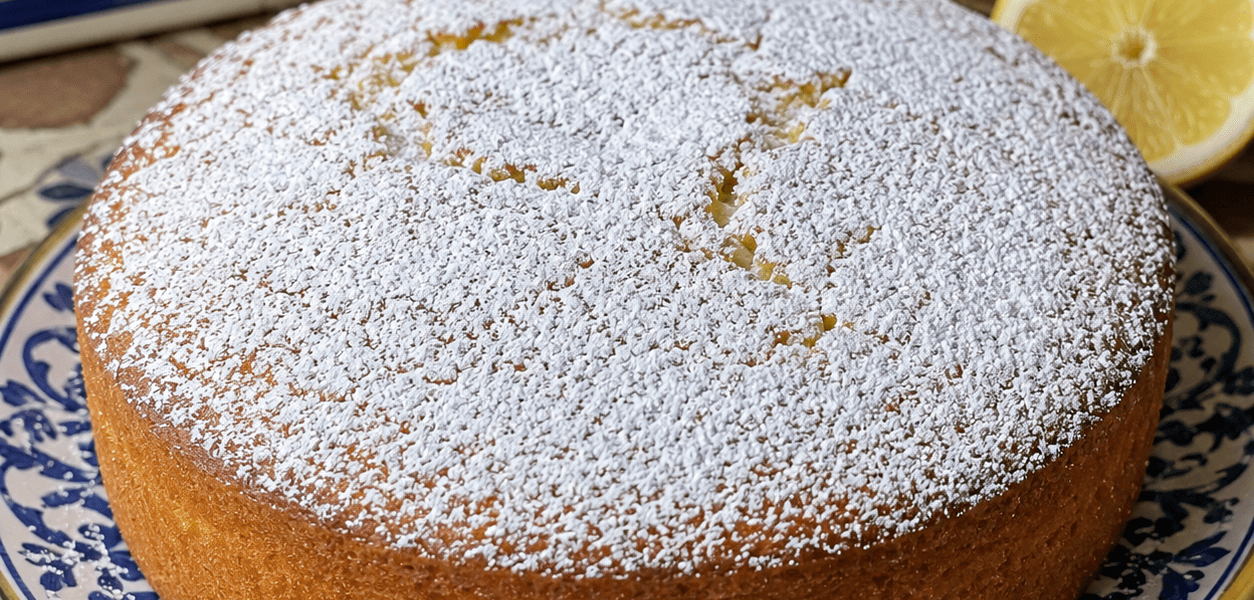
A moist, tender Spanish sponge cake built on yogurt and olive oil instead of butter. No stand mixer, no creaming, no fuss — just a bowl, a whisk, and something worth making every week.
Bizcocho (bee-SKOH-choh) is one of the most practical cakes in the Spanish home kitchen. It appears in countless regional variations but always follows the same logic: simple ingredients, minimal technique, a result worth repeating. This version is built on yogurt and olive oil, which makes it exceptionally moist — the kind of cake that stays tender days after baking in a way butter cakes don’t.
The lemon is not optional. The zest and juice lift the whole cake and cut through the richness of the oil. Leave it out and you have something flat. Include it and you have something people will ask you about.
Ingredients
Makes one 8-inch round cake. Serves 8–10.
- 3 eggs, room temperature
- 1 cup (200g) granulated sugar
- 1/2 cup (120ml) plain Greek yogurt — one single-serve container works perfectly (see tip)
- 1/2 cup (120ml) olive oil
- 1 lemon — full zest + a good squeeze of juice
- 1 1/5 cups (150g) all-purpose flour
- 4 tsp baking powder
- Powdered sugar, for finishing
Method
- Preheat and prep the pan. Preheat your oven to 375°F (190°C). Grease an 8-inch round cake pan or line the bottom with parchment paper. If your eggs are cold, pull them out now — room temperature eggs incorporate more evenly and give the batter better lift.
- Zest and juice the lemon. Wash the lemon thoroughly — you are eating the skin, so this matters. Using a microplane or the fine side of a box grater, zest the entire lemon directly into your mixing bowl. Move the lemon constantly as you work around it, and stop the moment you see white. The bright yellow outer layer is pure flavor. The white pith beneath it is pure bitterness — don’t go past it. Cut the lemon and squeeze about 2 tablespoons of juice into the bowl with the zest. The acidity brightens the flavor and helps activate the baking powder.
- Mix the wet ingredients. Add the sugar, eggs, yogurt, and olive oil to the bowl with the lemon. Whisk everything together until thoroughly combined and the batter looks smooth and uniform — about 2 minutes. There is no special order beyond getting it all in the bowl. No creaming, no staging. Just whisk until it comes together.
- Add the dry ingredients. Add the flour and baking powder directly to the bowl. Fold and whisk until just incorporated — no dry streaks, no lumps. Stop as soon as the batter is smooth. Overmixing develops gluten and makes the cake dense and chewy rather than tender. The batter should be thick but pourable.
- Bake. Pour the batter into the prepared pan and bake for 45 minutes. The cake is done when a toothpick inserted in the center comes out clean, the top is deep golden brown, and the edges have pulled slightly away from the sides of the pan. Start checking at 40 minutes — ovens vary.
- Cool and finish. Let the cake cool in the pan for at least 20 minutes before unmolding. A warm cake will crumble. Once it is fully cool and out of the pan, dust the top by shaking powdered sugar through a small fine-mesh strainer held over the surface. Serve at room temperature. This cake is genuinely better the next day — the lemon flavor deepens and the crumb firms up slightly. Wrap it and leave it overnight if you can.
What You’re Learning
This recipe teaches the one-bowl quick-mix method — wet ingredients combined first, dry folded in second. This is the foundation for a wide range of cakes, muffins, and quick breads. Unlike creamed butter cakes that require mechanical aeration, oil-based cakes rely entirely on baking powder for lift. That makes them faster, more forgiving, and harder to ruin.
You are also learning zesting technique — one of the most used skills in citrus-forward cuisines. The essential oils in citrus zest hold concentrated flavor. The pith just beneath holds concentrated bitterness. The skill is knowing where one ends and the other begins, and stopping in time. This technique carries directly into Spanish, Italian, and Moroccan cooking.
Notes
- Room temperature eggs matter. Cold eggs don’t emulsify as cleanly with oil and yogurt. Pull them out 30 minutes before you start, or sit them in warm (not hot) water for 5 minutes.
- The yogurt container trick. Use a single-serve yogurt container as your unit: yogurt = 1x, oil = 1x, sugar = 2x, flour = 3x. No measuring cups needed. Spanish home bakers have worked this way for generations — proportions hold regardless of container size.
- Olive oil choice. Use a mild, everyday olive oil rather than an intensely grassy extra virgin. The flavor should be background, not forward. Pure olive oil or a light olive oil is ideal.
- Don’t skip the zest. The zest carries far more flavor than the juice alone. If you have juice but no zest, the cake will be noticeably flat. Both together is what makes it.
- Doneness. The toothpick test is your guide. 45 minutes is typical, but check at 40. The top should be deep gold and spring back lightly when pressed in the center.
- Better the next day. Wrap the cooled cake at room temperature and serve it the following morning. The lemon intensity increases and the crumb settles into exactly what it should be.
Frequently Asked Questions
Can I use a different size yogurt, or is the ratio flexible?
The recipe is written by yogurt-container ratio for a reason. Use a single-serve container as your unit: yogurt is 1x, olive oil is also 1x, sugar is 2x, and flour is 3x that same container. Scale the cake up or down by changing the container size and the ratios hold. Standard measurements are also listed above if you would rather measure directly.
Can I substitute the olive oil with a neutral oil?
Yes, a neutral oil like vegetable or canola works and produces a slightly less distinctive flavor. Mild olive oil is worth using if you have it, since its subtle fruitiness is part of what makes bizcocho taste different from a standard vanilla cake, but it should stay in the background either way. An intensely grassy extra virgin oil will overpower the lemon.
Why did my cake turn out dense instead of light?
Overmixing after the flour goes in is the most common cause. This cake relies entirely on baking powder for lift, not mechanical aeration, so once the batter looks smooth with no dry streaks, stop folding immediately. Cold eggs can also cause this. Let them come to room temperature first so they emulsify cleanly with the oil and yogurt.