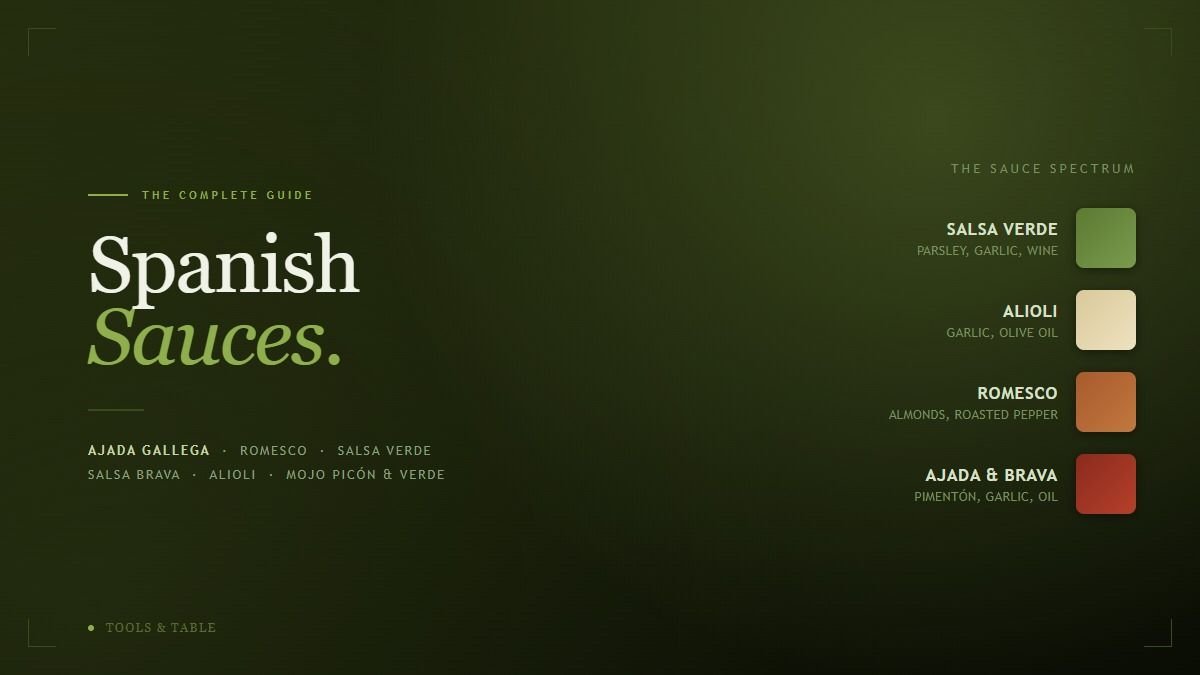
Spanish cooking runs on a short list of sauces that show up again and again, ajada, romesco, salsa verde, salsa brava, alioli, mojo, and once you know how each one is actually built, the same sauce keeps reappearing instead of getting reinvented from scratch every time a dish calls for it. None of them lean on tomato the way most people assume a “Spanish sauce” would. The real building blocks are olive oil, garlic, and one specific regional ingredient, pimentón, roasted peppers and almonds, or fresh herbs, doing almost all the work.
This guide covers the four sauces most likely to actually show up on a Spanish table, ajada gallega, romesco, salsa verde, and salsa brava, plus the two shortest and most essential of all, alioli and mojo, and what separates each one from the sauces they get mistaken for.
Ajada Gallega: Galicia’s Garlic and Pimentón Oil
Ajada is Galicia’s answer to a finishing sauce: garlic slowly colored in olive oil, pulled off the heat, then bloomed with pimentón and loosened with a splash of vinegar or starchy potato water. It’s poured over, not cooked into, whatever it’s served with, most classically pulpo a la gallega (Galician-style octopus over paprika-dusted potatoes), but also plain boiled potatoes or poached white fish, where a spoonful of ajada does the entire job of seasoning.
The technique lives or dies on one moment: the pimentón has to go in off the heat, stirred into oil that’s hot but no longer actively cooking. Pimentón is ground dried pepper, not a spice built to survive direct high heat, and even a few extra seconds in oil that’s still over the flame is enough to scorch it bitter instead of blooming it fragrant. The garlic gets the opposite treatment: it’s cooked low and slow until golden, never browned hard, since burnt garlic turns bitter just as fast as burnt pimentón does. Get both of those right, garlic patient, pimentón off the heat, and ajada takes about five minutes.
Salsa Romesco: Catalonia’s Almond and Roasted Pepper Sauce
Romesco comes from the fishing towns along the Tarragona coast, originally a fisherman’s sauce built to stretch whatever was on hand into something that could carry a plain piece of fish. Today it’s most famous paired with calçots, the charred spring onions at the center of Catalonia’s winter calçotada festivals, and it works just as well over any grilled vegetable, fish, or bread.
The base is ñora peppers, dried, mild, sweet Spanish peppers rehydrated and scraped from their skins, though dried ancho chiles plus a spoonful of sweet pimentón make a close substitute where ñoras aren’t sold. From there it’s roasted tomato, toasted almonds and hazelnuts, garlic, and a slice of bread fried in olive oil until crisp, blended together with sherry vinegar and more olive oil. The fried bread is doing real work, not padding, it’s what gives romesco actual body instead of leaving it a thin, oily purée, the same role a slurry or a roux plays in other sauces. Traditional romesco keeps a little texture from the nuts rather than blending perfectly smooth.
Salsa Verde: Spain’s Green Sauce, Cooked In, Not Spooned On
Spanish salsa verde has almost nothing in common with the raw tomatillo salsa verde from Mexico or the caper-and-anchovy salsa verde from Italy beyond the name and the color. This one is a cooking sauce, not a condiment, built directly into the pan and used to poach fish or shellfish rather than spooned over something already finished. The two classic dishes are merluza en salsa verde (hake) and almejas en salsa verde (clams), both from the Basque Country and Galicia’s Atlantic coast.
The method: garlic cooked briefly in olive oil, a light dusting of flour stirred in for body, then white wine and fish stock added to build the base. The fish or shellfish poaches directly in that liquid, and parsley goes in near the end. The real technique is what happens next, meneando la cazuela, swirling the pan in slow circles rather than stirring with a spoon. That motion works the fish’s own released gelatin into the liquid, thickening and emulsifying the sauce the same way swirling a pan finishes a beurre blanc, without breaking apart the delicate fish or shellfish a spoon would tear up.
Salsa Brava: The Sauce Behind Every Tapas Bar’s Patatas Bravas
Brava means fierce, but by the standards of most cuisines with real chile heat, salsa brava is mild, warm rather than aggressive. It’s a short sofrito, onion and garlic cooked down in olive oil, bloomed with smoked pimentón and a pinch of cayenne, sometimes with a spoonful of tomato added and sometimes not depending on the region, Madrid’s version tends to skip tomato almost entirely, leaning on pimentón alone for both color and flavor. Our own Patatas Bravas recipe walks through this exact sauce from a bare pan to the finished dish.
The Two Sauces Every Spanish Kitchen Keeps On Hand
Alioli and mojo don’t need a dedicated cooking step the way the four sauces above do, but they show up constantly, and both get misunderstood in ways worth clearing up.
| Sauce | What It Is | Served With |
|---|---|---|
| Alioli | Traditionally just garlic pounded to a paste in a mortar, then emulsified with olive oil worked in slowly by hand, no egg. What’s sold as “alioli” today is almost always a garlic mayonnaise, egg-based and far more stable, a modern shortcut rather than the original technique | Grilled meats, seafood, bread, patatas bravas as an alternative to the red sauce |
| Mojo Picón | From the Canary Islands: dried red peppers or pimentón, garlic, cumin, vinegar, and olive oil, blended into a thick, rust-red sauce | Papas arrugadas, the Canary Islands’ salt-crusted wrinkled potatoes |
| Mojo Verde | The Canary Islands’ green counterpart: cilantro or parsley, garlic, cumin, vinegar, and olive oil | Also papas arrugadas, and grilled fish |
The Canary Islands sit off the coast of Africa, technically Spain but geographically and culturally distinct, and mojo is the clearest proof of that: nothing else in mainland Spanish cooking uses cumin as a headline spice the way both mojo sauces do.
Common Mix-Ups
- Confusing Spanish salsa verde with Mexican salsa verde. The Mexican version is a raw or lightly cooked tomatillo condiment. The Spanish version is a cooked fish sauce built in the pan, with parsley, not tomatillo, providing the green.
- Assuming real alioli has egg in it. Traditional alioli is garlic and olive oil only, emulsified by hand. Egg-based versions are a modern, far more forgiving substitute, not the original recipe, though most jars and restaurant versions are the egg-based kind today.
- Adding pimentón straight into oil that’s still over the flame. This is the single most common way ajada, or any pimentón-based sauce, turns bitter. Pull the pan off the heat first; the residual heat is enough to bloom it.
- Calling romesco a tomato sauce. Tomato is one ingredient among several. The almonds, hazelnuts, and fried bread are what actually define its body and flavor.
- Treating “brava” as just a color. A red, pimentón-forward sauce isn’t automatically salsa brava, the onion-and-garlic sofrito base is what makes it brava rather than a plain pimentón oil like ajada.
For the pantry staples behind all of this, pimentón, sherry vinegar, good olive oil, see the Spanish & Latin Pantry section of our Ingredient Substitutions guide, or browse the full Spanish Cuisine collection for recipes built around them.