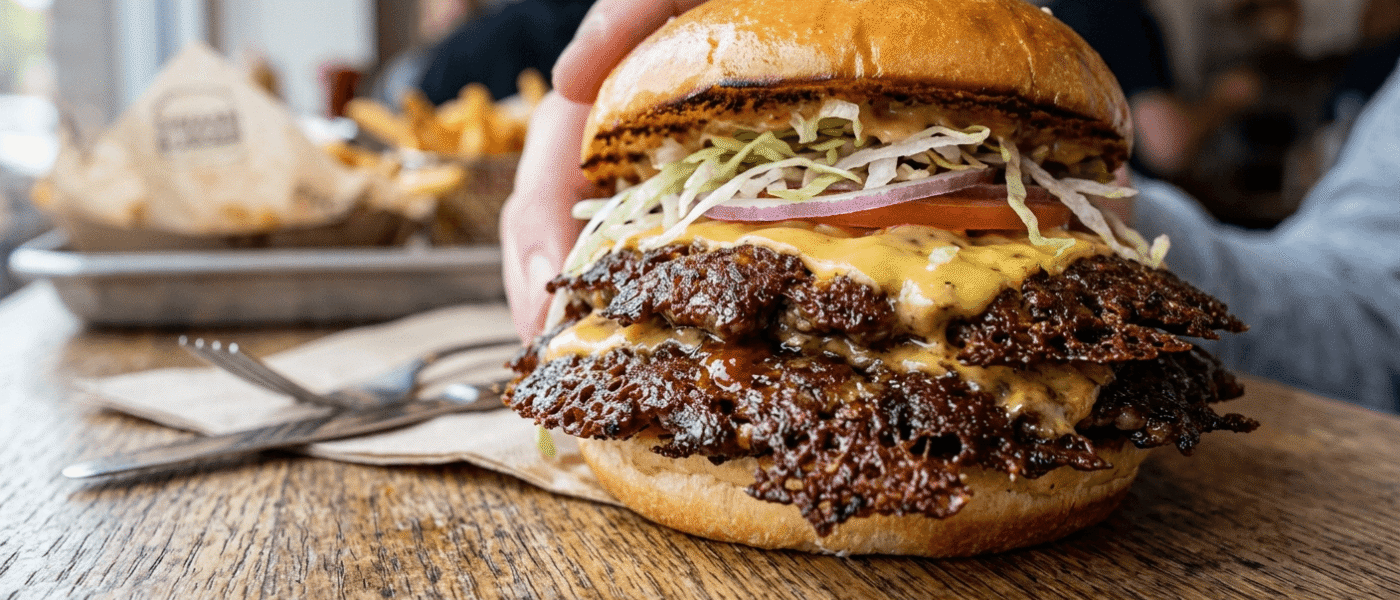
Two thin patties, great cheese, 15 minutes. Better than anything you’ve been ordering. This is the New World starting point.
The smash burger isn’t a trend. It’s a technique — and it’s the correct way to cook a burger on a flat surface. Smashing a ball of beef against a screaming-hot pan creates maximum contact between meat and metal, which means maximum crust, maximum browning, maximum flavour. The result is a thin patty with crispy, lacy edges and a deeply savoury sear that a thick patty can never match. Two of them, stacked, with melted American cheese: this is the burger.
Ingredients
Makes 2 double smash burgers. Scale as needed.
- 450g (1 lb) ground beef, 80/20 fat ratio — do not use lean beef
- 4 slices American cheese — yes, American; it melts correctly
- 2 burger buns — potato buns preferred, Martin’s if you can find them
- Neutral oil with a high smoke point — vegetable or canola
- Salt and black pepper
- For the sauce: 3 tbsp mayonnaise, 1 tbsp yellow mustard, 1 tbsp ketchup, 1 tsp pickle brine, pinch of garlic powder
- To finish: thinly sliced white onion, dill pickle slices, shredded iceberg lettuce
Method
- Make the sauce and prep the toppings. Mix together the mayo, mustard, ketchup, pickle brine, and garlic powder. Taste it and adjust — more mustard for sharpness, more mayo for richness. Set aside. Slice your onion paper-thin, get your pickles and lettuce ready. Everything should be done before you touch the beef, because once the pan is hot you won’t have time.
- Portion the beef. Divide the beef into 4 equal balls — about 115g (4 oz) each. Handle them as little as possible. You’re not shaping patties — just loose balls. Overworking the beef makes it dense. Keep them cold until you’re ready to cook.
- Toast the buns. Set a second pan or the edge of your skillet over medium heat. Butter the cut sides of the buns lightly and toast them face-down until golden, about 90 seconds. Set aside. A toasted bun holds up to the sauce and juice; an untoasted one turns to mush.
- Get the pan screaming hot. This is the most important step. Set your cast iron skillet over high heat and let it get genuinely hot — 3 to 4 minutes, minimum. Add a thin film of oil and let it shimmer and just begin to smoke. You need this heat. A medium-hot pan makes a steamed patty. A screaming-hot pan makes a smash burger.
- Smash and season. Place a beef ball in the pan. Immediately press it flat with a sturdy spatula — press hard, straight down, and hold for 10 seconds. You want a patty roughly the diameter of your bun and no thicker than 1cm. Season the top immediately with salt and black pepper. Don’t touch it again for 90 seconds. You’ll see the edges turn brown and the fat begin to render and crisp. When the edges look lacy and dark and the top is no longer pink, flip once. It should release cleanly — if it sticks, it’s not ready yet. Cook the second side for 30–45 seconds, then immediately lay a slice of cheese on top and let it melt for 15 seconds. Remove to a plate. Repeat with the remaining balls, cooking in batches of two. Don’t crowd the pan.
- Build the burger. Spread sauce on both bun halves. Bottom bun: onion, then two stacked patties. Top bun: lettuce, then pickles. Press together and eat immediately. Do not wrap it, do not wait. This is a hot food and it should be eaten hot.
What You’re Learning
This recipe is your introduction to the Maillard reaction — the browning that happens when proteins and sugars hit high heat. That crust isn’t just colour; it’s flavour. Every sear, every roast, every good piece of chicken or steak relies on the same principle: dry surface, high heat, don’t move it too soon. The smash burger is a fast, clear demonstration of what proper searing looks and smells like. Once you’ve done it once, you’ll recognize the moment in every other recipe.
You’re also learning to build a dish in layers — sauce on the bun first, then the hot element, then the cold finishers. Each component has a job. The sauce is richness and acid. The onions are bite. The pickles cut through the fat. The lettuce is cool and crisp. None of it is random.
Notes
- 80/20 beef is non-negotiable. The fat is what crisps the edges and keeps the patty juicy. Lean beef produces a dry, pale, sad patty. Don’t do it.
- American cheese is correct here. It melts in a way that no other cheese does — evenly, completely, without breaking or becoming greasy. For a smash burger, it’s the right tool. Other cheeses are for other burgers.
- Don’t shape the patties in advance. Loose balls = better crust when smashed. Pre-shaped patties are already compressed and won’t spread properly.
- The spatula matters. A thin, stiff metal spatula gives you the leverage to smash properly and the edge to scrape under the crust cleanly. A silicone spatula won’t work.
- Work fast after the flip. The second side cooks in under a minute. Have your cheese ready before you flip.
- Ventilation. This produces smoke. Turn on your range hood or open a window. It’s worth it.