
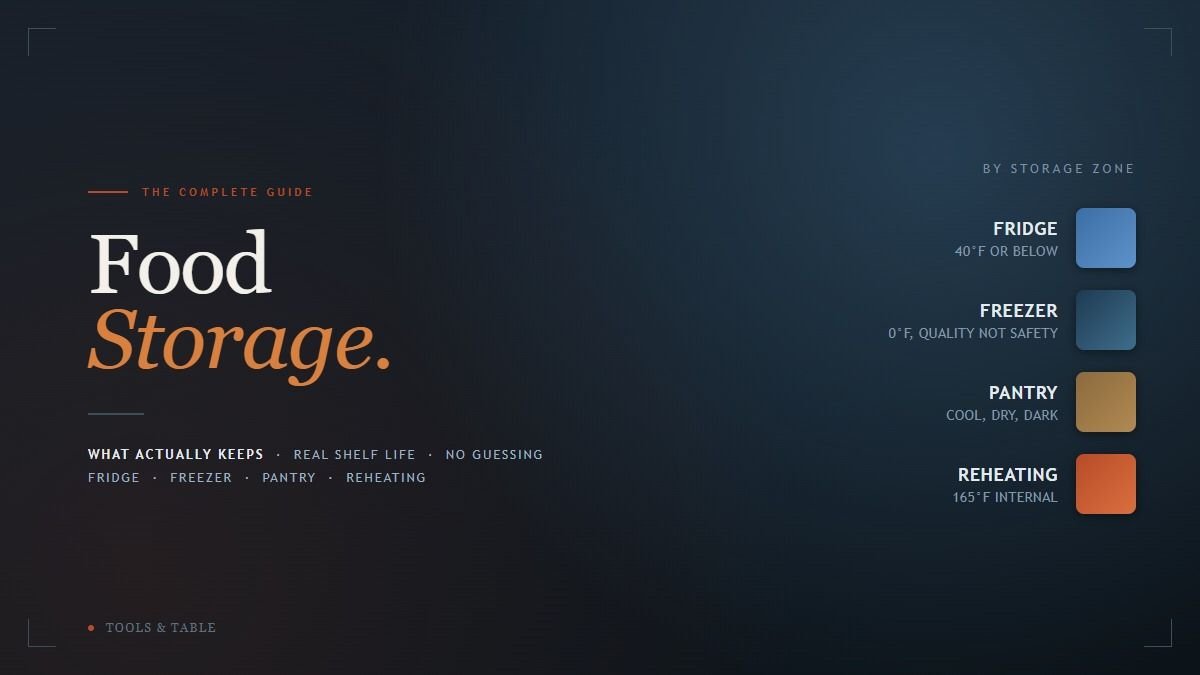
Most food in a kitchen doesn’t go bad on a schedule anyone actually remembers. It sits in the fridge until it looks questionable, or gets thrown out early out of caution, or gets forgotten in the back of the freezer for a year past being any good. This guide is the actual reference: how long things really keep in the fridge, the freezer, and the pantry, organized by category instead of by guesswork.
This covers proteins, dairy, leftovers, and pantry staples. For fresh fruits and vegetables specifically, ethylene gas, counter versus fridge, all of that, see our separate Produce Storage guide. That one’s a different problem with different rules.
What the Dates on Packages Actually Mean
“Sell by,” “best by,” and “use by” are three different things, and only one of them is really about safety. Sell by is a stock-rotation instruction for the store, not you, food is generally still fine for some time after it. Best by is a quality claim, the food is safe past this date, it just may not taste as good. Use by is the closest thing to an actual safety date, and it’s the one worth taking literally, especially on anything perishable like deli meat or soft cheese.
None of these dates account for how the food was actually handled, whether the fridge stayed cold, whether it sat out during the drive home. The tables below are a much more reliable guide than any printed date, because they’re based on what actually happens to food in normal storage conditions.
The Fridge
All of this assumes a fridge actually holding 40°F or below. If you’re not sure yours does, an inexpensive fridge thermometer settles it in a day.
| Category | Fridge Life |
|---|---|
| Raw poultry | 1–2 days |
| Raw ground meat & ground poultry | 1–2 days |
| Raw beef, pork & lamb (steaks, chops, roasts) | 3–5 days |
| Raw fish & shellfish | 1–2 days |
| Cooked meat, poultry & seafood leftovers | 3–4 days |
| Soups, stews & sauces | 3–4 days |
| Cooked grains & plain pasta | 3–5 days |
| Eggs, in shell | 3–5 weeks |
| Hard-boiled eggs, in shell | 1 week |
| Milk, opened | 5–7 days, or through the printed date |
| Hard cheese, opened | 3–4 weeks |
| Soft cheese, opened | About 1 week |
| Opened condiments (mayo, ketchup, mustard) | 2–12 months depending on the condiment, check the label |
Notice raw poultry, ground meat, and fish all sit at the short end, 1–2 days. That’s the category to actually plan around: buy it close to when you’ll cook it, or move it to the freezer the same day if your plans change.
The Freezer
A freezer at 0°F keeps food safe indefinitely. These numbers aren’t a safety cutoff, they’re a quality one, past this point the food is still fine to eat, it just starts losing texture and flavor to freezer burn.
| Category | Freezer Life |
|---|---|
| Ground meat & ground poultry | 3–4 months |
| Steaks, chops & roasts | 4–12 months |
| Whole poultry | About 1 year |
| Poultry pieces | 9 months |
| Fatty fish (salmon, mackerel) | 2–3 months |
| Lean fish (cod, tilapia) | 6–8 months |
| Cooked leftovers | 2–3 months |
| Bread | About 3 months |
| Butter | 6–9 months |
Freezer burn is dehydration, not spoilage, it happens where air reaches the food’s surface and pulls moisture out. Air-tight wrapping matters more than any other single factor: press plastic wrap directly against the food before bagging it, push the air out of the bag before sealing, and label everything with the date. “I’ll remember what this is” is exactly how food ends up in the freezer for two years unidentified.
The Pantry
| Category | Pantry Life |
|---|---|
| White flour | About 1 year |
| Whole wheat flour | About 3 months (more oil, goes rancid faster) |
| White rice | 4–5+ years, essentially indefinite if kept dry |
| Dried pasta | About 2 years |
| Canned goods, high-acid (tomatoes, citrus) | 12–18 months |
| Canned goods, low-acid (beans, corn, soup) | 2–5 years |
| Whole spices | 3–4 years |
| Ground spices | 2–3 years (safe after, just weaker) |
| Cooking oils, unopened | 1–2 years |
Flour is worth a specific callout: white flour keeps around a year because it’s been stripped of the germ, which is where the oil lives. Whole wheat flour still has it, so it goes rancid in a fraction of the time. If you bake with whole wheat regularly, the fridge or freezer genuinely extends its life. For how to actually measure either one correctly once it’s out of the bag, see our measuring guide.
Cooking oils are the other one worth watching closely, both heat and light speed up oxidation, so where an oil sits matters as much as how old it is. Storing it right next to the stove is a specific, common mistake, covered in our Kitchen Mistakes guide if you want the full reasoning.
Reheating Leftovers Safely
Reheat leftovers to an internal temperature of 165°F, checked with an instant-read thermometer, not by how hot the outside feels or how long it’s been in the microwave. This is the same standard used for cooking poultry from raw, and it’s what actually kills off any bacteria that grew during storage, not just warms the food back up.
Get leftovers into the fridge within two hours of cooking, or within one hour if the room is above 90°F. That’s the same danger zone rule covered in more depth in our Picnic Food Guide, and it applies just as much to a pot of soup cooling on the stove as it does to food sitting out at a park. Splitting a large batch into smaller, shallower containers before refrigerating helps it cool through that window faster instead of staying warm at the center for hours.
When in Doubt
These numbers are general guidance, not a guarantee, actual shelf life depends on how fresh the food was to start, how consistently your fridge holds temperature, and how it was handled before it got to you. Smell and appearance are still worth trusting on top of the numbers above, not instead of them. If something’s within its window on this page but looks or smells off, that’s real information too, and it wins.
For fresh produce specifically, see the Produce Storage guide. For the fridge-and-freezer-adjacent mistakes that aren’t about timing, potatoes stored next to onions, warm food going straight into the fridge, thawing meat on the counter, see the Kitchen Mistakes guide.